Ammar Mutawa – Riyadh:
- This topic is an Arabic translation of a huge special issue issued by the New York Times (Link) in English about the Arab Spring revolutions
Where can we begin to chronicle this miserable phase that the Arab and Islamic region is experiencing, in which its people are imbibing the scourge of war, destruction, terrorism, and extremism, while the rest of the world is witnessing a wave of greater human progress and civilizational development? The New York Times believes that the moment of real change in the course of the region began with the catastrophe that befell the Arab world at the moment when the American and British aggression against Iraq and its occupation began in 2003. That aggression did not destroy the Baath regime. Not only the Iraqi state, but it destroyed the Iraqi state, created the appropriate conditions for the birth of ISIS and similar terrorist organizations, and eliminated the Arab world and turned it into a combustible region and a source of a global refugee crisis. It also gave the starting signal to the era of terrorism that is striking the world today and disturbing humanity. For this reason, the newspaper issued a special issue entitled “Torn Lands: How Did the Arab World Become Displaced?” by writer Scott Anderson, and it was published on August 11, 2016. It was entirely devoted to one topic that took up all the pages of the issue, which happened for the first time in the history of this ancient newspaper, listing a tally of documented figures for the human and financial losses caused by the American aggression against Iraq under a false pretext. One million Iraqis were killed. And 455,590 people, including 4,801 soldiers and officers from the American military, and 3,487 soldiers from other allies of the aggression. The site adds that the financial cost of the war on the victorious and the defeated amounted to one trillion and 705 billion and 856 million dollars. Regarding the motivations for issuing this unique special work, the newspaper confirms that it is “a story unlike anything previously published. It is much longer than the typical magazine story. In print, it would occupy an entire issue. This report, which lasted approximately 18 months of reporting, produces the story of the catastrophe that has torn the Arab world apart since the invasion of Iraq in 2003, leading to the emergence of ISIS and the global refugee crisis.” The newspaper says that writer Scott Anderson provided the reader with a deep sense of the Arab crisis, through the eyes of six characters in Egypt, Libya, Syria, Iraq, and Iraqi Kurdistan. Andersen’s text is accompanied by 10 portfolios by photographer Paolo Pellegrin, taken from his extensive travels throughout the region over the past 14 years, as well as a virtual reality experience that integrates the viewer with combat forces in Iraq and Syria. As for the eyewitnesses on whom the report was based, they are “six people: the first is Azar Mirkhan from Iraqi Kurdistan, the second is Laila Suef from Egypt, the third is Majdi Al-Mughosh from Libya, and the fourth is Kholoud Al-Zaidi from The fifth is Majd Ibrahim from Syria, and the sixth is Waqas Hassan, also from Iraq. Regarding the motivations for choosing these particular people, the newspaper says, “The six are from different regions, different cities, different tribes, different families, but they share, along with millions of other people in the Middle East, an experience of profound dislocation… Their lives have been changed forever by the turmoil that began in 2003 with the American invasion of Iraq, and then accelerated with the series of revolutions and insurrections that have become known collectively. In the West, in the name of the Arab Spring.” It is noteworthy that the newspaper considered that the events of the Arab Spring were only one of the secondary results and aftershocks of the disaster of the occupation of Iraq, and it quoted international sources as estimating that the losses of the Arab world amounted to 830 billion dollars, in addition to the devastation occurring in Tunisia, Libya, Egypt, Yemen, Iraq, and Syria. The newspaper considers that there are no indications that there is a better Arab future, as most Arab wounds are bleeding, inflamed, and difficult to heal. She wondered: “What is the future of societies that no longer consider themselves national societies, but rather social components, divided on the basis of religion, sect, sect, or ethnicity?” The newspaper presented its special issue in five parts bearing the titles: “Introduction, the Iraq War, the Arab Spring, the Rise of ISIS, and the End,” respectively. This is an extremely lengthy issue that required it to be published in a separate supplement, while the newspaper’s website reacted to the excessive length of the topic by inviting its visitors to activate the “Save Progress” service, to resume reading where the reader left off. The first part focuses on three decisive historical factors To understand the current crisis: the inherent instability of the artificial states in the Middle East, the precarious position in which Arab governments allied with the United States find themselves when they are forced to pursue policies that their people bitterly oppose, and the American intervention in the de facto division of Iraq in 2003. The second part is mainly devoted to the American invasion of Iraq, and how it laid the foundation for the Arab Spring revolutions. In the third part, the story accelerates, and the newspaper examines the tragic outcome with which these revolutions ended, as happened in Egypt and Libya. And Syria… In the fourth part, the newspaper examines the reasons for the rise of ISIS, while the fifth part traces the displacement resulting from the region and the global refugee crisis emanating from the Arab countries. As for the newspaper’s methodology in presenting the ideas of its documentary work, it came in a cinematic way by presenting the life stories of the six heroes chosen by the newspaper, and through them it attempts to identify the transformations. The major events that the region has gone through… The Waei Foundation for Research and Development reviews the highlights of this unique issue, going beyond the life stories of eyewitnesses, to the general intellectual and documentary elements.
Divide and conquer!
The newspaper reviews, in a historical sequence that is deeper than the apparent reasons, the reasons that led to the outbreak of the Arab Spring revolutions, starting with the events of the attack on the citizen Mohamed Bouazizi in Tunisia in 2011 AD, and ending with the wars that occurred in the Arab region, most notably in Syria, Libya, Yemen, and Egypt. The newspaper returns to the story from its beginning, since the clinical fall of the Ottoman Empire, the last stronghold of the connected Arab and Islamic region, where the process of dividing the region began at the end of World War I, when two victorious allies, Britain and France, divided the lands of the defeated Ottoman Empire among themselves as spoils of war. In Mesopotamia, the British joined three largely independent Ottoman provinces and named them Iraq. The southernmost part of these provinces was dominated by Shiite Arabs, the middle by Sunni Arabs, and the northernmost by non-Arab Kurds. To the west of Iraq, European powers took the opposite approach, carving out the vast territories of “Greater Syria” into smaller, more manageable parcels. French rule was favored by the smaller Syrian state – essentially the nation that exists today – and the coastal enclave of Lebanon, while the British took Palestine and Transjordan, an area in southern Syria that would eventually become the Zionist entity and Jordan. Shortly afterwards in 1934, Italy joined three old North African regions that had been taken from the Ottomans in 1912 to form the colony of Libya. To maintain sovereignty over these fractured lands, European powers adopted the same “divide and rule” approach that had served them well in the colonization of sub-Saharan Africa. This was done by empowering the local ethnic or religious minority to act as their local managers, confident that this minority would never rebel against their foreign observers so as not to be overwhelmed by the deprived majority. This was only the most overt level of the European “divide and rule” strategy, but beneath the sectarian and regional divisions of these “nations” lay very complex tissues of tribes, clans, and social customs that remained the population’s main source of identification and loyalty. Just as the United States Army and white settlers had done with Indian tribes in their conquest of the American West, the British, French, and Italians proved adept at pitting these groups against each other, by giving weapons and food to one faction in exchange for fighting others. The big difference is that in the American West, the tribal system was essentially destroyed. In the Arab world, the Europeans eventually left, however The sectarian and tribal divisions that fueled it remain. The newspaper points out that there is something striking about the Arab Spring revolutions, which is that the six most affected – Egypt, Iraq, Libya, Syria, Tunisia and Yemen – are all republics, rather than kingdoms. Of these six, the three that have completely disintegrated – Iraq, Syria, and Libya – are all members of that small list of Arab states created by Western imperial powers early in the twentieth century. In each of these three states, there has been little thought about national cohesion, and a greater presence of tribal and sectarian divisions.
In the beginning was Baghdad!
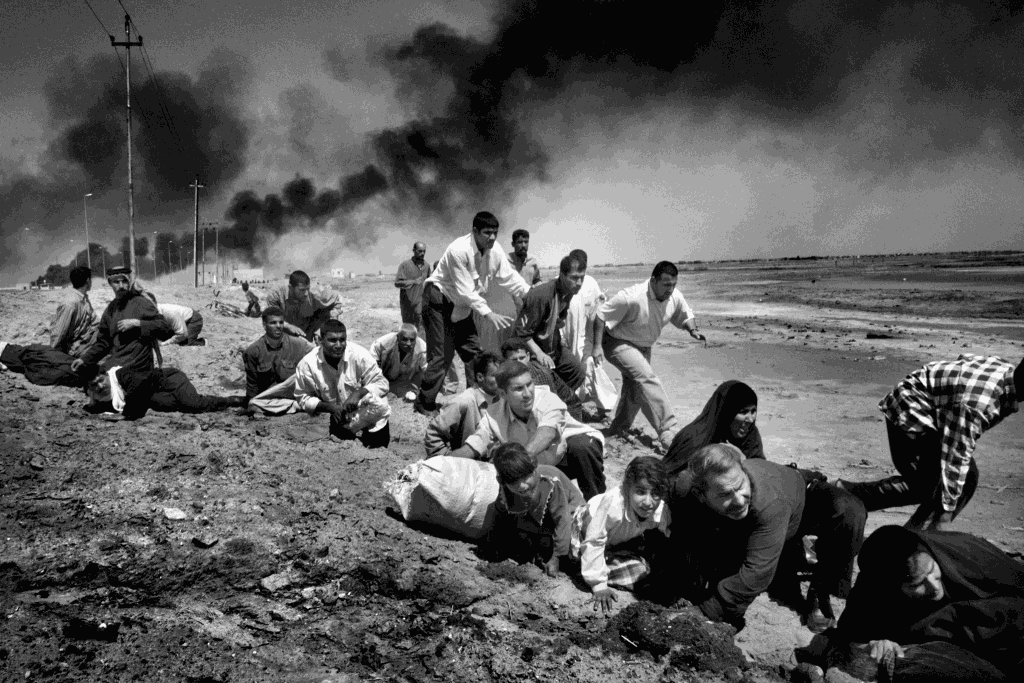
Iraqi citizens hide from the bullets of American forces during the Iraqi occupation of Basra – The New York Times
In light of the above, the newspaper concludes that Mohamed Bouazizi’s suicide in 2011 seems less a catalyst for the Arab Spring than the straw that broke the back of the tensions and contradictions that had been simmering beneath the surface of Arab society for a long time. The newspaper attributed the beginning of the transformation in the region to a different event, which occurred eight years before Bouazizi’s death, when the process of disintegration began: the American invasion of Iraq. On the afternoon of April 9, 2003, in Al-Firdaws Square in downtown Baghdad, when a towering statue of the Iraqi dictator Saddam Hussein was pulled, with the help of a winch and an American M88 armored vehicle, to the ground… From this moment, the newspaper proceeds to the actual documentary part of the edition.
ISIS..the end of everything!
https://int.nyt.com/data/videotape/finished/2016/08/arabspring/vr-640.mp4 “Iraq did not return after the occupation. Everything was collapsed, politically, socially, culturally and security-wise,” says the journalist as she prepares for the watershed moment that affected the history of the region and its repercussions, the emergence of ISIS, the State of Iraq and the Levant. The newspaper says that the State of Iraq began as popular committees of an Islamic nature to resist the American occupier, but its identity quickly took shape with the arrival of members of Al-Qaeda in Iraq, turning the organization into a branch of Al-Qaeda in the face of Iran’s Shiite militias, which seemed to have gained American approval and assumed the throne of the state under the auspices of the occupier. Events accelerated with the entry of elements from Al-Qaeda in Iraq into Syria, and the result was that the most extreme version of Al-Qaeda, ISIS, emerged to the world, and whose expansion began rapidly until the decisive moment when they took control. On Fallujah, in June 2014. The newspaper reports, through the words of the young Iraqi Wakaz Hassan, that the moment when ISIS elements seized control of the city of Fallujah in Anbar Governorate, was the beginning of their spread to seize neighboring cities and towns. By June, a squad of ISIS fighters had entered the western suburb of Mosul, the largest city in northern Iraq, just 140 miles by highway from Tikrit. By June 9, the highway bypass around Tikrit was the scene of a frantic stampede of thousands of Iraqi soldiers, many of whom had withdrawn, in uniform, to Baghdad, 100 miles to the south. ISIS advanced past Mosul to Baiji, the oil refinery city, 40 miles north of Tikrit, and then, on June 11, they entered Tikrit itself. In Tikrit, just as in Mosul and Baiji, the Iraqi army offered almost nothing, with different units seemingly competing only over how quickly they could escape and how much of their weapons they could leave behind the enemy. The June 2014 ISIS campaign was one of the most astonishing military feats in modern history. In less than one week, a lightly armed guerrilla force, with fewer than five thousand fighters, dispersed a modern, well-equipped army at least 20 times its size. ISIS seized thousands of weapons and advanced military equipment, and the population centers it now controls, with a total population of five million people. The newspaper says that under the rule of Prime Minister Nouri Kamel al-Maliki, which lasted for eight years, the Shiite community in Iraq came to dominate every aspect of the government. National, including its army, with poor sectarian treatment of Sunnis. For many of the region’s Sunni residents – including Baiji and Tikrit – this harsh treatment led to a deep disdain for both the central government and its army, which they viewed as occupiers. Of course, this Shiite-dominated army was fully aware of the contempt of the local population, and was deeply distrustful of them, to the point that at the first sign of trouble the army would withdraw in the face of a few Sunni jihadists who vowed revenge. And here the societal rift deepened irreversibly again!
The Kurds…the single story
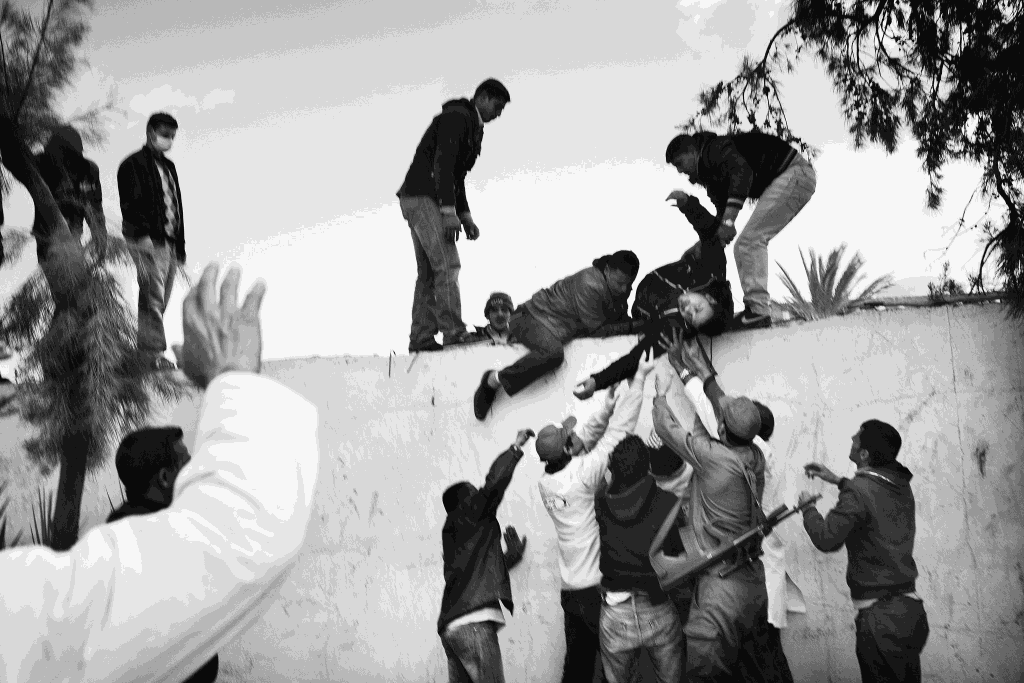
Iraqi Kurdish citizens flee their homes as ISIS forces approach – The New York Times
After the pivotal June 2014 attack in the history of ISIS, the Kurds knew that they were the next target, especially the Yazidis, a Kurdish religious minority that ISIS describes as “devil worshipers” and vowed to exterminate them. This is what actually happened, in the far northwest of Iraq and outside the official territory of the Kurdistan Regional Government, on August 1, 2014, when ISIS fighters attacked an advanced position of the Peshmerga forces in the town of Zumar, located only 10 miles away. From the last road to Sinjar, the cultural capital of the Yazidis, as usual, the government was absent. According to the journalist, on August 3, 2014, ISIS members arrived in Sinjar and began carrying out mass executions, a massacre that would claim the lives of at least 5,000 Yazidis. They were also collecting thousands of girls and women to use them as sex slaves. From that moment on, ISIS in the Kurdish land had the upper hand, but this did not last long. The newspaper quotes the Kurdish doctor, Azar Mirkhan, as saying, “The Kurds were keen to be liberated from the American soldiers bordering their areas,” and he stresses that this should not raise any surprise, because the Kurds are, as he described it, “a people strongly committed to creating a homeland.” Therefore, the Kurds of the Kurdistan Regional Government found it unacceptable for ISIS to maintain control over any of its lands, so the Peshmerga were prepared to suffer greater losses to regain Kurdish land more quickly. ISIS elements knew this very well. ISIS quickly decided to surprise the Kurds, and advanced to Erbil, the capital of the Kurdistan region. The performance of the Peshmerga was very shaky, with a complete collapse of the Iraqi army. ISIS took advantage of this and effectively took control of Erbil, and began a new campaign to exterminate the Yazidis.
The martyr Egyptian revolution

Dr. Laila Soueif during her talk to the newspaper – The New York Times
The newspaper was exposed to the Egyptian revolution in the context of its reporting of the testimony of Dr. Laila Soueif, a university professor, specifically from the morning of May 28, 2012, when the Egyptian National Elections Commission announced the names of the two men who would compete in a second round to name the first democratically elected president in Egyptian history. The only candidate certain to advance was Mohamed Morsi, a representative of the Muslim Brotherhood, the only party with enough Islamist voters united behind it to form a meaningful voting bloc. And against him was Ahmed Shafiq, former Prime Minister of the Hosni Mubarak regime. Soueif tells how the leftist and secular blocs found themselves supporting the election of a man who would defend Egypt’s return to Islamic values, which, according to her, caused a lot of astonishment among the members of those movements. But in the June runoff, Morsi succeeded with 51.7 percent of the vote. In his inauguration speech on June 30, Morsi promised that “in the new Egypt, the president will be an employee, a servant of the people, and he called on the people to prepare to work and build.” But the deep state was more prepared. Days before the new president took power, the Supreme Council of the Armed Forces, or military council, which has ruled Egypt since the overthrow of President Mubarak, transferred most presidential powers to the military. This came after a decision was issued by the Supreme Constitutional Court, which dissolved a parliament controlled by the Muslim Brotherhood and other Islamic political parties. On the day he took office, Morsi was powerless. He was hardly the silent face of a democracy already destroyed by the army. The newspaper says that Morsi tried forcefully to regain the power that was taken from his office. He ignored the orders of the Supreme Constitutional Court and ordered the return of the dissolved Islamist-controlled parliament. Most daringly, he excluded the senior military leadership, including the powerful Defense Minister Mohamed Hussein Tantawi. He appointed General Abdel Fattah El-Sisi in his place. Soueif considers that the most important moment in Morsi’s short career was in October 2012, when Morsi attempted to expand the powers of the presidency by decree, a move that alarmed both the deep state and the secular opposition, which, as she described, grew increasingly concerned about increasing Islamization. A new round of protests began in a number of Egyptian squares. Soueif says this was “the opening that the deep state seemed to be waiting for, the opportunity to reopen the traditional schism that had existed between Islamists and secularists.” The newspaper comments: “For decades, Egyptian generals had held off the Muslim Brotherhood, as the greatest threat to the modern secular state, and positioned themselves Naturally as guardians against them, this strategy collapsed during the days of the revolution, with Islamists and progressives alike turning against the generals. “It was very clear what the state was doing,” the newspaper quotes Soueif as saying. “First, to spoil everything Morsi tries to do, so that nothing gets done, and for people to say: ‘He is a failed president.’” Secondly, spreading concerns about it. This was easy to do, because the propaganda against the Muslim Brotherhood was based on calling them “terrorists.” The newspaper says that by the spring of 2013, Egypt had become rapidly polarized between the president’s supporters and his opponents… before banners suddenly went up calling for the army to intervene. Among the supporters of these banners were some cadres of the January Revolution, which the newspaper comments on by saying: “This was not just a case of loss of national memory. Rather, one of the most interesting aspects of Egyptian society was a long reverence for its army, a tradition that was instilled in Egyptian students from elementary school.” The journalist says: “On June 30, 2013, on the first anniversary of Morsi’s inauguration, huge demonstrations took place across Egypt, with demonstrators demanding his resignation. Meanwhile, Morsi’s supporters gathered in other squares. Each group of demonstrators was chanting their demands in full without any interruption, without the sound of a third way being heard.” “At this critical juncture, Defense Minister Abdel Fattah al-Sisi, like a kindly functionary, issued an ultimatum to the man who had appointed him, giving Morsi 48 hours to ‘meet the people’s demands’ or the army would intervene to restore order. The president rejected the threat. In his speech, on July 3, Sisi overthrew the Egyptian government. He also abolished the constitution, arrested Morsi and other Muslim Brotherhood leaders and closed four television stations. Within days, he announced the formation of an interim government. “Transitional,” composed of military officers and organizers during the Mubarak era, but all Egyptians knew that the real power now rested with Sisi. After that moment, “the face of the new regime was fully revealed,” the newspaper says. Until August 14 came, when army and police forces moved to Rabaa Square in Cairo to disperse thousands of Egyptians who had camped there during the previous month. At least 800 and perhaps more than 1,000 demonstrators were killed in the massacre that followed.” The newspaper says that that day was the final scene in the story of the Egyptian revolution.
Syria…the gaping wound
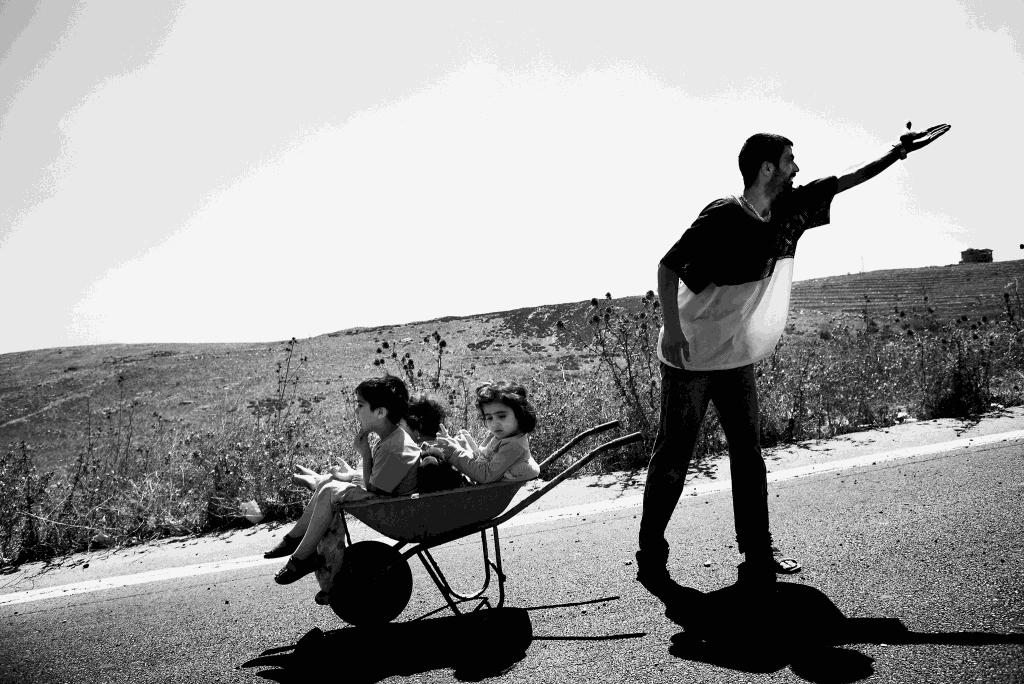
A Syrian refugee family on its way to the Lebanese border – The New York Times
The newspaper stands with the Syrian revolution, which it considered to be the most intertwined and complex in the Arab region, as it began as a revolution and ended as a horrific civil war, which is the description that the newspaper will use from now on in talking about what is happening in Syria. The newspaper says that since the first days of the Syrian revolution entering into armament and open fighting, one of the most optimistic features of the speed of the ceasefire between the two parties was the temporary alliances that are often formed between the armed rebels and the regime’s militias. The newspaper believes that this pattern of secret deals contributed to delaying the regime’s resort to a scorched earth policy, because some of the pro-Assad militias were always intertwined with the revolutionary forces in the same areas. But, according to the journalist, that dynamic ended in early May 2013. In a massive lightning move, the Free Syrian Army returned to the devastated Baba Amr neighborhood, and its members, who surrendered to the regime’s cordon, were besieged and slaughtered. From that moment of separation, Syrian army artillery shells began to fall completely on residential neighborhoods. But the major turning point in the history of the Syrian revolution, according to the newspaper, was the entry of Russian military forces into the battlefield alongside Assad and his Shiite militias, which led to giving Assad the kiss of life again, in exchange for his complete surrender of his country to turn it into a haven for Russian weapons experiments and sabotage activities, which ultimately resulted in the advance of Assad’s militias to take control of the scorched earth, making Syria the country that exports the most refugees in the world.
Is there hope?
The newspaper summarizes its journey in the Arab region with great hesitation. It is optimistic and pessimistic at the same time. Optimistic, because history says that everything can come back again, just as it happened in Nazi Germany. And pessimistic, because there is nothing on earth that indicates an opportunity to return again, as the Arab region has been completely destroyed, and its people no longer have a glimmer of hope other than the belief that tomorrow can bring them some breezes of freedom. To view the complete file: Here