Prince of resistance to the French colonizers on the African continent
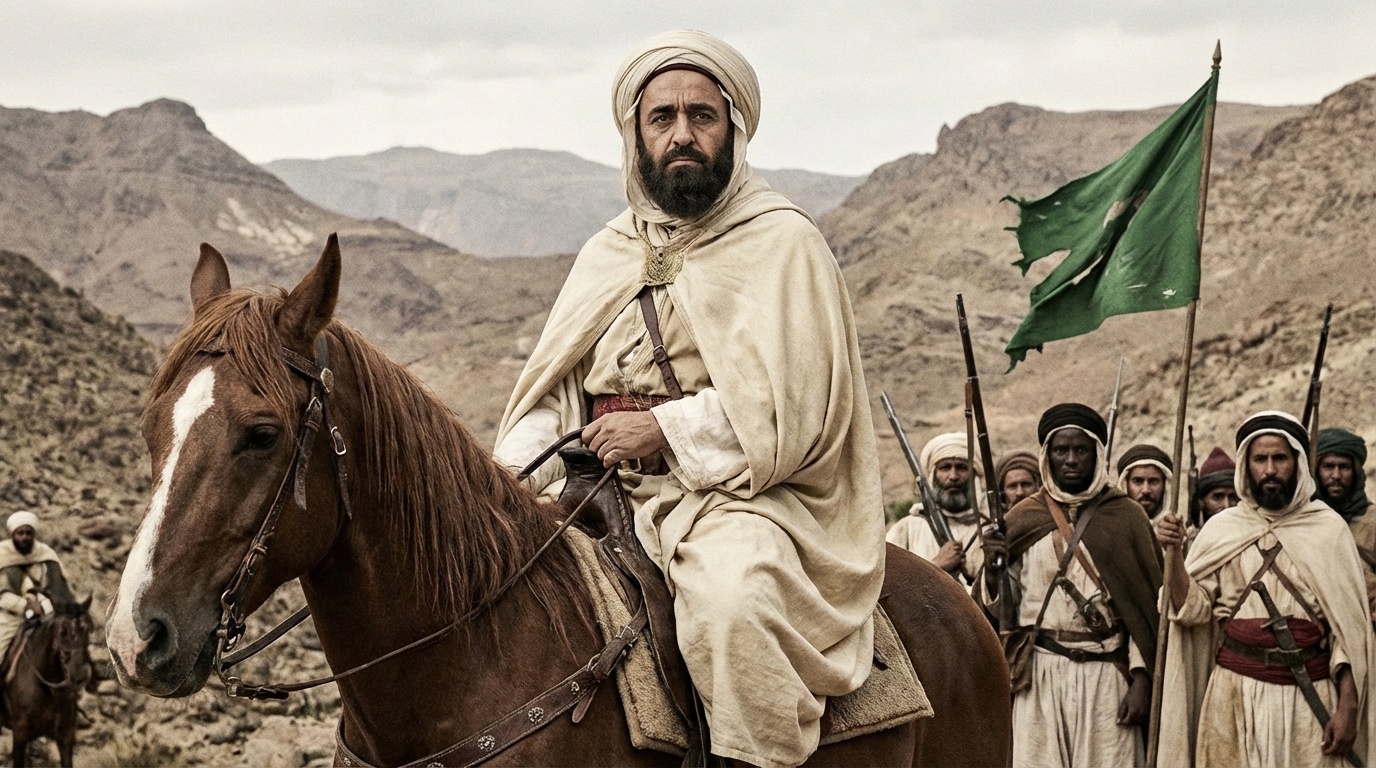
Not only in Algeria, but in all of West Africa, the French did not know a man who caused them so much “trouble” as he did. Abdul Qader Al-JazairiThe prince who lived a sensitive period in the history of the Islamic nation in general, and the history of Algeria in particular, and had a great influence there through his struggle against colonialism, then his imprisonment and migration to Damascus until his death. Algerian Alam Mujahid, resistance fighter and poet. The Algerians pledged allegiance to him in 1832, emir of the resistance. French colonizerHis life passed through three basic stages: The first He spent it seeking knowledge and learning about the conditions of Arab countries on the way to Hajj. And the second He lived it in jihad and resisting the enemy, and he died Third A prisoner in France and then a respected fighter in Damascus.
Birth and upbringing
Prince Abdelkader was born in 1807 in the village of Kaitna in the Algerian state of Oran. He received his initial education in the zawiya, which was supervised by his father Muhyiddin, the sheikh of the Shadhiliyya order. He then moved to the city of Oran, where he learned from a number of its scholars the foundations of science, such as history, philosophy, mathematics, Arabic literature, astronomy, medicine, and so on. His father, Muhyiddin, collided with the Ottoman governor of the city of Oran, so he placed him under house arrest, and in 1825, he allowed him to perform the Hajj, so he and his son Abdul Qadir went out. During that trip, he visited many Arab countries, starting with Tunisia, then Egypt, then the Hijaz, all the way to the Levant, and Iraq, where he visited the shrine of Abdul Qadir al-Jilani, the founder of the Qadiriyya order, which includes the zawiya that his father supervised.
He gathered volunteers, formed a strong army, and achieved successes. This forced the commander of the French army in Oran, “De Michel,” to conclude a truce with him on February 26, 1834.
Control of the ruler of Oran
After that, he passed through the Hijaz, and on his return to Algeria, he visited Egypt and Tripoli, and settled in his village (Al-Qatna). The trip enabled Abdul Qadir and his father to move away from the control of the ruler of Oran, who was afraid of the influence of Abdul Qadir and his father, Muhyiddin. Two years after that, Algeria was subjected to French occupation, in the month of Muharram 1246, corresponding to July 5, 1830, which was the most important stage in his life, due to the serious developments it was filled with, related to his confrontation with the French. After his father apologized for leading the popular resistance, he took over its leadership, then he was pledged to jihad in Rajab 1248, corresponding to November 1832, and the general pledge of allegiance was granted to him in the camp on the 17th. Ramadan 1248, corresponding to February 4, 1833.
Foundations of the modern Algerian state
Prince Abdelkader rushed to form his government, laid the foundations of the modern Algerian state, gathered volunteers, formed a strong army, and achieved successes that forced the commander of the French army in Oran, “De Michel,” to conclude a truce agreement with him on February 26, 1834. The agreement stipulated a truce through which France granted him authority over the western Algerian region and the Chlef region, but the colonialists did not adhere to the terms of the treaty and violated it several times. On May 30, 1837, he again forced the French to negotiate with him and sign the Treaty of Tafna, which recognized his sovereignty over the western and central side of Algeria, which was signed by the French General Peugeot. Then the French repeatedly violated the truce and adopted a scorched earth policy, using brutal methods of killing children, women, and the elderly and completely burning cities and villages that supported him.
The beginning of the fall
General Peugeot summarized this policy in a threat addressed to the prince’s men: “You will not plow the land, and if you plow it you will not plant it, and if you plant it you will not reap it,” which is the policy that led to the fall of his cities and military centers, and forced him to wage guerrilla warfare (1844-1847). As French pressure continued on him, he took refuge in Al-Aqsa Morocco, hoping to support the Moroccan Sultan Moulay Abdel Rahman, but French pressure and their threat to occupy Morocco prevented that, so the prince was forced to announce his surrender in December 1847, and he was transferred to a prison in the city of Pau in southern France, and then in Amboise in the Loire province. The prince remained in this state, until Napoleon III later decided to release him, so he traveled to Turkey on December 2, 1852, and from there he moved to Syria, and settled in the city of Damascus beginning in 1855, where he taught in the Umayyad Mosque, and before that in the Ashrafieh School, and in the Real School, whose homes embraced and protected more than 15 thousand Christians, after the events of strife between Muslims and Christians, which Damascus witnessed in 1860, and this is the position Which was internationally acclaimed.
The big impact
Prince Abdul Qadir wrote a number of books, such as “The Sharp Lender,” “The Autobiography,” “The Memory of the Wise One,” which was translated twice and was known as “A Letter to the French,” and “Attitudes,” in addition to other letters. Prince Abdul Qadir died in Damascus on May 26, 1883, at the age of 76. He was buried in the Salihiya neighborhood next to Sheikh Ibn Arabi in implementation of his will. In 1965, his body was transported to Algeria and buried in the Upper Cemetery.