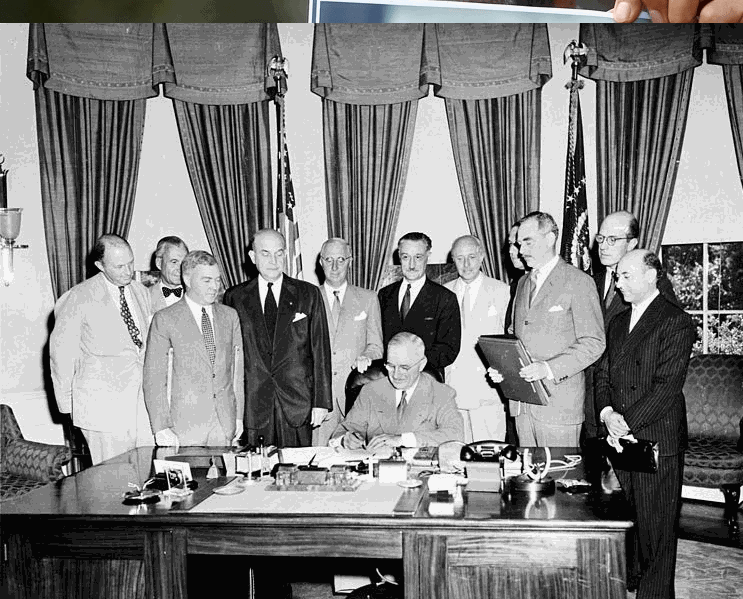
- The moment of signing the agreement establishing the alliance in Washington on April 4, 1949. Image source: Al-Maarifa website
No one knows precisely what the important advantage is that your country’s location in the North Atlantic Ocean is a reason for joining an alliance based on this specific point… But it is clear that those who decided to establish the alliance were looking for an advantage that would prevent the entry of the Soviet Union and the countries of the Middle East and Africa as members of their sublime alliance, so they found nothing but this unique advantage to declare their alliance… NATO. The North Atlantic Treaty Organization, known as NATO for short, is an organization founded in 1949 based on the North Atlantic Treaty that was signed in Washington on April 4, 1949, to form a system of collective defense in which member states agree on mutual defense in response to any attack by external parties. NATO consists of 29 countries with “independent member” status across North America and Europe, and a further 21 countries participate in NATO’s Partnership for Peace programme, with a further 15 countries participating in institutional dialogue programmes. The list of members includes Albania, Belgium, Bulgaria, Canada, Croatia, the Czech Republic, Denmark, Estonia, France, Germany, Greece, Hungary, Iceland, Italy, Latvia, Lithuania, Luxembourg, the Netherlands, Norway, Poland, Portugal, Romania, Slovakia, Slovenia, Spain, Turkey, the United Kingdom, the United States, and Montenegro. Three NATO members (the United States, France, and the United Kingdom) are permanent members of the UN Security Council, wield veto power, and are officially nuclear-weapon states. The last country added to NATO was Montenegro on June 5, 2017. The alliance currently recognizes Bosnia and Herzegovina, Georgia, and Macedonia as aspiring members. NATO’s headquarters is located in the Haren district of the Belgian capital, Brussels, and a headquarters for Allied Command operations has been allocated near the Belgian city of Mons. The alliance includes several internal councils in what is known as the “NATO Parliamentary Council”, and among its most important basic committees are: political affairs, defense planning, nuclear defense affairs, economic planning, defense scrutiny, organizational structure, civil emergency planning, media and propaganda, civil and military budgeting, and air coordination.
Stages of ascension
Since its founding, NATO was nothing more than a political organization that brought together the opponents of the Soviet Union, until the Korean War (a civil war that occurred on the Korean Peninsula between 1950-1953), which mobilized the members of this organization militarily for the first time, so that an integrated military structure was built under the supervision of two American commanders, but it did not carry out any military operations. The course of the Cold War led to NATO competing with the Warsaw Pact (a former military organization of communist Central and Eastern European countries founded in 1955 AD), until the Berlin Wall fell in Germany in 1989, so NATO conducted its first military interventions in Bosnia from 1992 to 1995 and later Yugoslavia in 1999. The organization sought to improve relations with the former Warsaw Pact countries following the fall of the Soviet Union and the collapse of the alliance. Russia, and several Eastern European countries joined NATO in 1999 and 2004.
External missions
The organization was used militarily for the first – and only – time after the events of September 11, 2001, after which forces were deployed in Afghanistan under the command of NATO’s ISAF. The organization has filled a range of additional roles since then, including sending trainers to Iraq and assisting in counter-piracy operations. In 2011, it imposed a no-fly zone over Libya in accordance with United Nations Security Council Resolution No. 1973. In general, the alliance has now turned into what can be described as a joint European-American army, and its operations are concentrated in the Middle East region, where the United States employs it in its conflicts that it gives an international character with the participation of NATO forces, including raids on the rights of peoples and the sovereignty of nations. NATO forces continue to occupy Afghanistan and make interventions. In Iraq and Libya, it exists to this day.