This is an issue that does not concern Ethiopia alone. Ethiopian Prime Minister Abiy Ahmed’s battle to reduce the influence of the Tigray minority in the sphere of government turned into bloody armed confrontations about two weeks ago, the effects of which spread to its immediate regional surroundings. Are we facing a regional civil war? Will this war last?

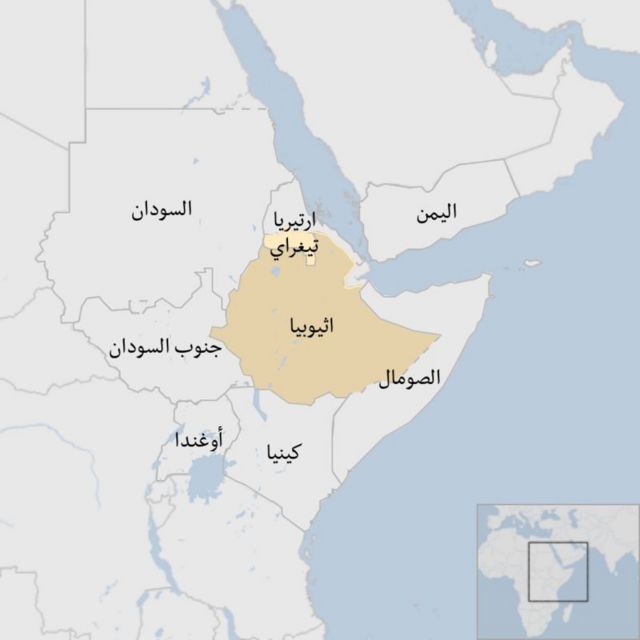
The Tigray region, which is located to the north of Ethiopia, on the border with Eritrea and Sudan, includes the third largest ethnic group in the country with 7.3 percent (out of a total of 108 million people), about 60 percent of whom are Christians, and in Tigray is located the village of Negus, King of Abyssinia, where a number of companions took refuge, fleeing the oppression of the Quraysh. To the south of Tigray is the Amhara region, which represents the second ethnicity in the country with 27 percent, and the majority of its population are also Christians. As for the largest ethnicity in the country, it is the Oromo, in the center of the country, which embraces the capital, Addis Ababa, and to which the Prime Minister belongs. Their percentage is estimated at 34.4 percent, and the overwhelming majority of its population are Muslims, but they are marginalized.
Turning point
The Tigray People’s Liberation Front gained its weight from its major role in overthrowing the military rule led by Mengistu Hailemariam (1974-1991). Since 1991, the Tigray Liberation Front has dominated government, controlling key positions in the state and tightening its grip on the army. But in 2018, unrest occurred in several regions, especially the Oromo, which eventually prompted Prime Minister Hailemariam Desalegn to resign, and the ruling coalition chose Abiy Ahmed as his successor. Abiy Ahmed was the first prime minister from the Oromo majority, but he was a Christian with a Muslim father and an Amhara Christian mother, and his wife was also an Amhara Christian, thus bringing together the two largest ethnicities in the country. At the beginning of his rule, Abiy Ahmed was able to reconcile with Eritrea and implement what was agreed upon in the Algiers Agreement, which ended the war between the two countries (1998-2000), and thus won the Nobel Peace Prize in October 2019.
An inevitable confrontation
The confrontation was inevitable between a strong man and a front that penetrated deep into the state, especially after Abiy Ahmed began removing Tigray men from sensitive political and military positions, and replacing them with figures from other ethnicities. Abiy Ahmed also opened corruption files involving Tigray officials during the three decades in which the Front ruled, which accused him of marginalizing and targeting it through investigations into suspicions of corruption. When the Prime Minister sought to melt the coalition of ruling parties representing several ethnicities into one party, the Tigray Liberation Front refused to join this party, and its leaders joined their region, and that was the beginning of the irrevocable divorce with Abiy Ahmed. But the point that spilled the beans was Abiy Ahmed’s decision to postpone the elections, which were scheduled for last August 29, to 2021, due to the Corona virus, and Parliament voted in favor of this decision. But the Tigray Front refused to postpone the elections, and on September 9, it organized elections in the region, which the federal government did not recognize, nor did the Front recognize the legitimacy of Abiy Ahmed, after “the end of his official term,” thus cutting off Muawiyah’s hair. As punishment, the government reduced federal funds allocated to the region, which provoked the Tigray Front, and considered it an “act of war.” The moment of war, last November 4, matters reached the stage of no return, after the government accused the Tigray Front of launching a “traitorous attack” on a federal army camp in the region, which the Front denied, but it was clear that the region had become outside the government’s control. The federal army’s attack focused on the western region of the rebel region on the border with Sudan, with the aim of preventing any communication between the “rebels” and the western neighbor, despite Khartoum’s declaration of its support for Abiy Ahmed. The intensity of the battles pushed more than 30,000 people to flee the region to Sudan, especially after massacres occurred against civilians. But the Tigray Front, which has heavy weapons and a quarter of a million fighters, and is fortified by impregnable mountains, prevented the federal army from entering its capital, Mekelle, which prompted Abiy Ahmed to dismiss the army commander, after four days of fighting, especially since many of the leaders of his military divisions are from Tigray. Not only did Abiy Ahmed promote the Deputy Army Commander, Burhan Jula, to commander, but he also appointed Deputy Prime Minister Demeke Mekonnen as Minister of Foreign Affairs, and appointed Amhara President Temesgin Teroneh as the new head of intelligence. These sensitive changes in the army, intelligence, and foreign affairs reflect Abiy’s desire to end Tigray’s influence in the country with one blow. Abiy Ahmed also used air force to break the resistance of the Tigray Liberation Front and neutralize its heavy weapons, especially artillery and missiles.
Regional war
Addis Ababa allied with Asmara, the capital of Eritrea, against the Tigray People’s Liberation Front, whose fighters were on the front lines during the war against Eritrea, leaving the region’s fighters trapped in the jaws of pincers. The Tigray Front responded by bombing the airport of the Eritrean capital, Asmara, with three missiles, to get it out of the war, to no avail. While government forces took control of the southern region of the region in addition to the western region, Abiy Ahmed gave a three-day deadline for the rebels to surrender, which ended on November 18. Government aircraft bombed the capital of Tigray, Mekele, while government forces advanced towards it to invade it. Abiy Ahmed, the rebel, vowed that “after the expiration of this deadline (three days), the final decisive work to implement the law will be completed in the coming days.” While the Tigray Front used missiles to try to deter the federal army, bombing two airports in the south of the Tigray region. 34 Ethiopians were killed in an ambush by an unknown armed group in Benishangul Province (west), where the Renaissance Dam is located, on the border with Sudan. In parallel, Egyptian-Sudanese air maneuvers are taking place in the Merowe region in northern Sudan, and the Tigray Front accused Abiy Ahmed of bombing the region with Emirati drones stationed in the Eritrean city of Assab. All of these indicators indicate that things are not heading under control, and the continuation of the battles in Tigray raises the possibility of ignition in the Horn of Africa and the Nile Basin region, and the expansion of the humanitarian tragedy that may affect millions of residents from northern and western Ethiopia.