
After weeks of continuous war between Azerbaijan, supported by Turkey, and Armenia, supported by Russia, and after a conflict that lasted for more than 40 years, Russian President Vladimir Putin announced that Baku and Yerevan had reached an agreement on a “comprehensive ceasefire” in the Nagorno-Karabakh region, which entered into force at 9 pm, Monday, November 9, GMT.
According to the terms of the agreement, which was considered an unconditional Armenian surrender, the two parties to the conflict retain “the positions they control,” which means consolidating the military victories achieved by the Azerbaijani forces that led to the restoration of control over 5 cities, the last of which is Shusha, 4 towns and more than 300 villages, as well as strategic hills.
The agreement also stipulates the handover of three provinces occupied by Armenia within a specific period of time: Kalbajar until November 15, Agdam until the 20th of the same month, and Lachin until next December 1, in addition to maintaining a land corridor linking the lands still under the control of the separatists and Armenia. The agreement also stipulates the deployment of peacekeeping forces in Nagorno-Karabakh, and the exchange of all prisoners within a specific period of time.
Armenian surrender
For his part, Armenian Prime Minister Nikol Pashinyan announced that he had signed a “painful” agreement with both Azerbaijan and Russia to end the war. Pashinyan said in a statement on his Facebook page: “I signed a declaration with the Russian and Azerbaijani presidents to end the war in Karabakh,” describing this step as “indescribably painful, for me personally as well as for our people.”
Pashinyan said in his statement that he made the decision to sign the ceasefire agreement “after an in-depth analysis of the military situation,” referring to the progress achieved by Azerbaijani forces over the past six weeks, stressing that this agreement is “the best solution available in the current situation.”
Immediately after the news spread, thousands of angry Armenian demonstrators flocked to the government headquarters in the Armenian capital, Yerevan, where the majority of them demonstrated outside the headquarters, while a few hundred of them stormed it and wreaked havoc in its offices, especially in one of the cabinet halls, and smashed the windows of a number of its windows. The demonstrators chanted slogans denouncing the Prime Minister, including “Nikol is a traitor.”
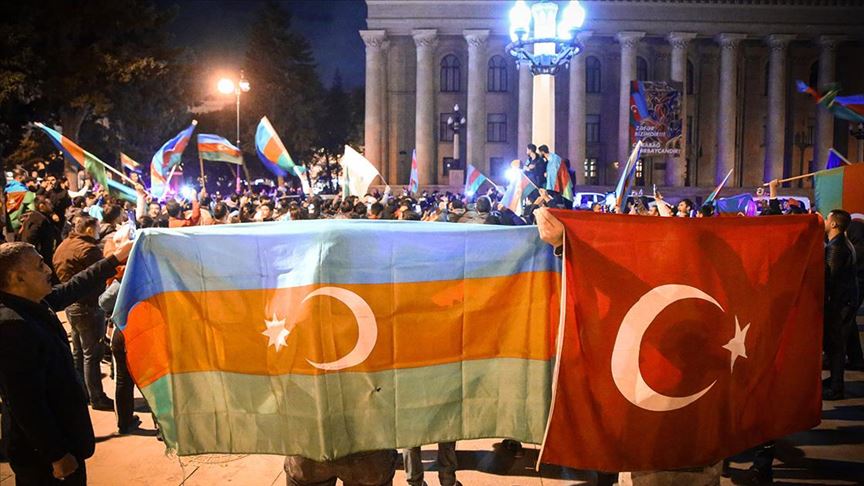
Azeri celebration
As for the President of Azerbaijan, Ilham Aliyev, he spoke of a “surrender document” that Yerevan was forced to sign after six weeks of fighting. Aliyev said in a speech on television: “We forced him (Armenian Prime Minister Nikol Pashinyan) to sign the document. It is essentially a surrender document.” He added: “I said that we would expel them (Armenians) from our lands like dogs, and we did.”
The Azerbaijani President explained that the ceasefire agreement acquires “historical importance,” noting that it stipulates that Armenia withdraws its forces from the region within a short period of time, and that Russia, as well as Turkey, an ally of Azerbaijan, participate in implementing the terms of the agreement. Aliyev called the Armenian Prime Minister a “coward” because he did not sign the agreement in front of the media.
Turkish intensification
With declared and explicit Turkish support for Azerbaijan, the conclusion of the agreement comes after the Azerbaijani forces announced their control of Shusha, the strategic city located 15 kilometers from the capital of Nagorno-Karabakh, Stepanakert, despite the Armenian forces’ denial of that victory, which represented a turning point in the war that began last September 27.
Since the outbreak of the war six weeks ago, there have been more than one ceasefire attempt sponsored by the Minsk Group (France, Russia, and the United States), which was formed since 1994, but all of them failed due to Armenia’s insistence on not withdrawing from the Azerbaijani Nagorno-Karabakh region, which it has occupied since the collapse of the former Soviet Union three decades ago.
With the intensification of battles near the city of Shusha and the victories achieved by Azerbaijani forces, diplomatic efforts intensified over the weekend, and Putin spoke on Saturday with his Turkish counterpart, Recep Tayyip Erdogan, and his French counterpart, Emmanuel Macron. Erdogan, whose country supports Azerbaijan, had congratulated Baku after it announced control of Shusha, considering this victory “an indication of the near liberation of the rest of the occupied territories.” And it was.