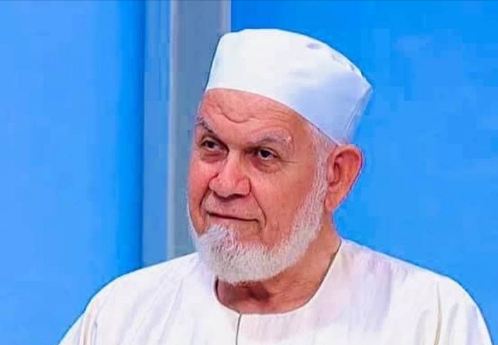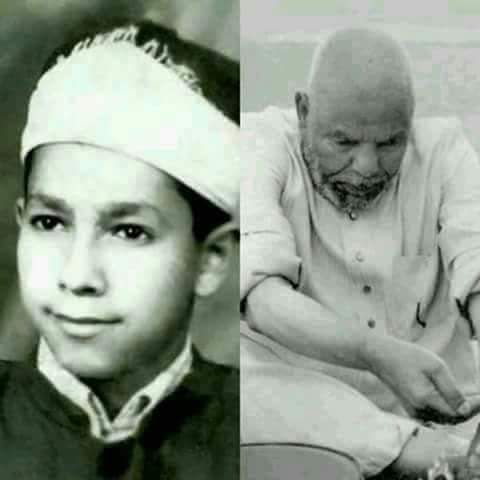

He is one of the greatest imams and preachers to whom Egyptians and Arabs are deeply attached. He is famous for his seminars on interpretation of the Holy Qur’an, which have won and continue to be admired by masses of Muslims around the world, in addition to his immortal positions in which he defended Sharia law and confronted financial and administrative corruption in the Ministry of Endowments when he was its minister, and then confronted the attempts of many writers to attack Islamic issues such as the hijab, the prohibition of usury, and other issues. Sheikh Muhammad Metwally Al-Shaarawi was born on April 15, 1911 AD in the village of Dagados, the Mit Ghamr center in Dakahlia Governorate. He memorized the Holy Qur’an at the age of eleven. In 1922 AD, he joined the Zagazig Al-Azhar Primary Institute, and showed brilliance from a young age in memorizing poetry and famous sayings and wisdom. Then he obtained the Al-Azhar Primary School Certificate in 1923 AD. He entered the Al-Azhari Secondary Institute, and his interest in poetry and literature increased. He gained a special status among his colleagues, so they chose him as president of the Student Union and president of the Writers’ Association in Zagazig. He was with him at that time: Dr. Mohamed Abdel Moneim Khafagy, the poet Taher Abu Fasha, Professor Khaled Mohamed Khaled, Dr. Ahmed Heikal, and Dr. Hassan Gad, and they would show him what they wrote. It was a turning point in Sheikh Al-Shaarawi’s life, when his father wanted to enroll him in Al-Azhar Al-Sharif in Cairo. Sheikh Al-Shaarawi wanted to stay with his brothers to cultivate the land, but his father’s insistence prompted him to take him to Cairo, pay the expenses and prepare the place for housing. All he had to do was stipulate that his father buy him quantities of major books on heritage, language, Qur’anic sciences, interpretations, and books on the Prophet’s hadith, so that his father would be satisfied with his return to the village. But his father saw this trick, and bought him everything he asked for.
Struggle against the occupier
Al-Shaarawi joined the Faculty of Arabic Language in 1937 AD, and became busy with the National Movement and the Al-Azhar movement, where resistance to the British broke out from Al-Azhar Al-Sharif. The movement to resist the British occupiers in 1919 broke out from Al-Azhar Al-Sharif, and from Al-Azhar came publications expressing the discontent of the Egyptians against the British occupiers. The Zagazig Institute was not far from Al-Azhar Castle in Cairo, so he and his colleagues would go to Al-Azhar’s squares and corridors. He was then president of the Student Union in 1934 AD. He graduated in 1940 AD, and obtained an international diploma with a teaching license in 1943 AD. After his graduation, Sheikh Al-Shaarawi was appointed to the Religious Institute in Tanta, then he moved to the Religious Institute in Zagazig, then the Religious Institute in Alexandria, and after a long period of experience, Sheikh Al-Shaarawi moved to work in Saudi Arabia in 1950 to work as a professor of Sharia at Umm Al-Qura University. Al-Shaarawi was forced to teach the subject of beliefs, despite his originally specialization in language, and this in itself constitutes a great difficulty. However, Sheikh Al-Shaarawi was able to prove his superiority in teaching this subject to a great degree that received everyone’s approval and appreciation.
The beginning of the journey
In 1964, he was appointed to Cairo Director To the office of the Sheikh of Al-Azhar Al-Sharif, Sheikh Hassan Mamoun. Then, Sheikh Al-Shaarawi traveled to Algeria as head of the Al-Azhar mission there and stayed in Algeria for about seven years, which he spent teaching. While he was in Algeria, the setback of June 1967 occurred. When he returned to Cairo, he was appointed director of the endowments of the Gharbia Governorate for a period, then agent for preaching and thought, then agent for Al-Azhar, then he returned again to Saudi Arabia, where he taught at King Abdul Aziz University. In November 1976, Prime Minister Mamdouh Salem chose him as Minister of Endowments and Al-Azhar Affairs, where he remained until October 1978.
Resisting corruption
Sheikh Al-Shaarawi had a prominent role in resisting the Westernization campaigns of his time, as the imam of the preachers attributed the opinions of the orientalists, which accused the Holy Qur’an of falsehood due to conflicting verses, to the weakness of their linguistic ability, and he refuted their accusations and corrected them as he passed. Explained On the surahs of the Holy Qur’an. Al-Shaarawi was considered the first to issue it A decision Ministerial By establishing the first Islamic bank in Egypt, which is Faisal Bank, as this is one of the powers of the Minister of Economy or Finance, who authorized him, and the People’s Assembly approved this, and in the year 1987 AD he was chosen as a member of the Arabic Language Academy (the Immortal Council).
International fatwas
In 1954, there was an idea proposed to move the Maqam Ibrahim from its place, and move it backwards until they cleared the path that had become narrow for the two pilgrims and was hindering the movement of circumambulation, and one day had been set for King Saud to move the shrine. At that time, Sheikh Al-Shaarawi was working Professor At the College of Sharia in Mecca, he heard about this and considered this matter Contrary For Sharia law, he began to move and contacted some of the Saudi and Egyptian scholars in the mission, but they informed him that the matter was over and that the new building had been erected, so he sent a five-page telegram to King Saud, in which he presented the issue from a jurisprudential and historical perspective. The Sheikh reasoned in his argument that those who invoked the action of the Messenger were on the right side, because he is a messenger and a lawgiver and has what no one else has and he has the right to do something new and unprecedented, and he reasoned. Also In the position of Omar bin Al-Khattab, who did not change the location of the shrine after it was moved due to a flood that occurred during his reign and returned it to its place during the reign of the Messenger. After the telegram reached King Saud, he gathered scholars and asked them to study Al-Shaarawi’s telegram. They agreed with everything that was stated in the telegram, so the king issued a A decision Not to move the shrine, and the king ordered Al-Shaarawi’s proposals to expand the mataf to be studied, as the sheikh suggested that the stone be placed in a small dome of unbreakable glass. Allowance From the old shrine, which was a large building that was narrow for both sects.
Notable tasks
During his life, he was appointed to several jobs, including that of working A teacher He worked at the Tanta Al-Azhari Institute, then he was transferred to the Alexandria Institute, then the Zagazig Institute, then he was loaned to work in Saudi Arabia in 1950 AD. And he worked A teacher Faculty of Sharia, King Abdulaziz University in Jeddah. As appointed Agent To the Tanta Al-Azhari Institute in 1960 AD, And a manager For Islamic Da’wah at the Ministry of Endowments in 1961 AD. An inspector For Arabic Sciences, Al-Azhar Al-Sharif, 1962 AD. Director To the office of the Grand Imam, Sheikh of Al-Azhar, Hassan Mamoun, 1964 AD, As president For the Al-Azhar mission in Algeria in 1966 AD. As appointed Visiting professor at King Abdulaziz University, Faculty of Sharia in Mecca, 1970 AD, and Head of the Department of Postgraduate Studies at King Abdulaziz University, 1972 AD. And a minister Endowments and Al-Azhar Affairs 1976 AD. Eye as well Member At the Islamic Research Academy in 1980 AD and was chosen Member In the Shura Council of the Arab Republic of Egypt in 1980 AD, he was also offered the Sheikhdom of Al-Azhar and several positions in a number of Islamic countries, but he refused and decided to devote himself to Islamic preaching.
Wide honor
The late sheikh wrote a number of books, the most prominent and greatest of which are Al-Shaarawi’s interpretation of the Holy Qur’an, The Muslims’ Welcome to the Birth of the Best of Messengers, Easy Islamic Jurisprudence and Its Legal Evidence, I Am of the Lineage of the Prophet’s Family, Islam and Contemporary Thought, The Perfect Human Being Muhammad, may God bless him and grant him peace, and so on. The Imam was awarded several medals and awards, most notably the Order of Merit, First Class, on the occasion of his reaching retirement age on April 15, 1976, before his appointment as Minister of Endowments and Al-Azhar Affairs, the Order of the Republic, First Class, in 1983 and 1988, and a medal on Preachers’ Day. He also received an honorary doctorate in literature from the Universities of Mansoura and Menoufia. The great scholar passed away on June 17, 1998, corresponding to Safar 22, 1419 AH.