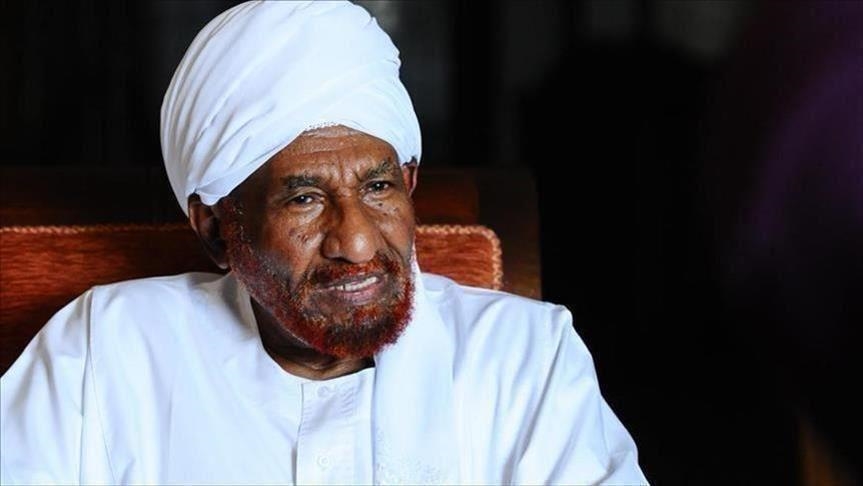

In the early hours of Thursday, November 26, 2020, veteran Sudanese politician “Sadiq Al Mahdi” died in isolation in the Emirates, days after his health condition deteriorated due to his infection with the new Corona virus Covid-19. The obituary statement was officially issued by the Umma Party, headed by Al-Mahdi, announcing the sad news to the Sudanese people about the departure of the last Sudanese prime minister before Al-Bashir’s coup in 1989, and the leader of the “civil jihad” against Al-Bashir’s rule, who remained in the opposition seat for 30 years, confident of the fall of Al-Bashir’s rule.
Busy life
Imam Al-Sadiq Al-Mahdi was born on December 25, 1935. His father was the leader of the Ansar Al-Mahdi sect, “Imam Al-Sadiq bin Abdul Rahman bin Muhammad Ahmad Al-Mahdi.” He studied economics and political science at Saint John’s College, Oxford University, where he obtained a bachelor’s and master’s degree. During his studies in Britain, he met his rival and brother-in-law, Dr. Hassan Al-Turabi, a student at the Faculty of Law at the University of London, and a friendship developed between them, which affected Sudan’s political future after that. He returned to Sudan to work in managing his family’s agricultural property in 1957, and in addition to that, he began practicing political work like his generation. He joined the Umma Party, which represented the sect of supporters of his grandfather (Muhammad Ahmed Al Mahdi), who supported Sudan’s independence from subordination to the British occupation.
New era
However, Al-Sadiq Al-Mahdi’s influence at that time did not go beyond writing some publications on issues related to the affairs of the Ansar sect, but the death of his father, Imam Al-Sadiq Abdul Rahman Al-Mahdi, and the political movement that overthrew President Abboud in October 1964 opened the door for him to enter into political work from a wide range, taking advantage of his sacred lineage among his grandfather’s followers, whose fans were large at that time. In addition to the fact that his uncle, Imam al-Hadi al-Mahdi, who succeeded his father, al-Siddiq al-Mahdi, did not have the political capabilities of his father, which threatened the unity of the Umma Party, which split into two parties: the first said that the imam of the Ansar sect has all the powers within the Umma Party, and this is the opinion of Imam al-Hadi al-Mahdi, and he is supported in that by the brilliant lawyer Muhammad Ahmad al-Mahjoub. The other party believed that the Imam of the Ansar should have restricted powers over the party, and this wing was led by al-Sadiq al-Mahdi and the younger generation in The Umma Party who participated in the October Revolution of 1964. In the 1964 Parliament, the majority of the council was in favor of the Umma Party, but it was not enough for it to rule alone, so coalition governments were formed between the parties. In the beginning, the Umma Party was ruled by Muhammad Ahmad al-Mahjoub, a follower of Imam al-Hadi (uncle of al-Sadiq al-Mahdi), in cooperation with the National Unionist Party and the People’s Democratic Party. But soon disagreements arose between Muhammad Ahmad al-Mahjoub and Ismail al-Azhari regarding the powers between the head of the Sovereignty Council and the Prime Minister, so that Ismail al-Azhari allied with Sadiq al-Mahdi against his uncle’s party, and Sadiq al-Mahdi was elected prime minister, with the full powers of the Sovereignty Council vesting in Ismail al-Azhari, making Sadiq al-Mahdi the youngest prime minister in history at only 29 years old, in 1966. But Muhammad Ahmad al-Mahjoub and his successor, the Imam Al-Hadi did not surrender, so they worked to overthrow the government of Al-Sadiq Al-Mahdi from within Parliament. It was in 1967, when Muhammad Ahmed Al-Mahjoub was re-elected as Prime Minister, and Al-Sadiq Al-Mahdi and his group returned to the violent opposition inside Parliament, which forced Al-Sadiq Al-Mahdi to search for alliances inside and outside Parliament, so he allied with the People’s Democratic Party group to obstruct Al-Mahjoub’s government as much as possible. He also allied with the Communist Party, the rising force in Sudanese politics at that time, and the events of the Teachers’ House took place in 1967, when a communist assaulted the position of the Prophet. Parliament met and issued a decision to dissolve the Communist Party and expel its members from Parliament, amid condemnation from Al-Sadiq Al-Mahdi, whose condemnation no one cared about. Then the 1968 elections were held.
Numeiri’s coup
After that, Sadiq al-Mahdi reconciled with his uncle, Imam al-Hadi, and the two wings of the Umma Party merged and participated together in the 1968 elections, which produced a parliament with a large majority for the Umma Party. The party ruled under the leadership of Muhammad Ahmad al-Mahjoub until April 1969. Then the man fell ill and left for Britain. Before his departure, he placed his resignation on the parliament’s table, so the parties were lazy to appoint a new government headed by al-Sadiq al-Mahdi, and a political and constitutional vacuum occurred that was later exploited by the military coup led by Colonel Jaafar Al-Nimeiry 1970. Jaafar Al-Nimeiry’s coup was disastrous, as he attempted to repeat the scenario of confiscating lands and property carried out by Abdel Nasser in Egypt and Abdel Karim Qassem in Iraq. The parties that were ruling the country were also brutally abused, led by the Umma Party and the Democratic Unionist Party, and the Muslim Brotherhood received brutal treatment, especially for their role in dissolving the Communist Party, as the Communists were the party behind Al-Nimeiry’s coup. Al-Sadiq Al-Mahdi and his uncle, Imam Al-Hadi, differed in how to confront Al-Numairi’s coup. Al-Hadi chose revolutionary armed action to overthrow what he saw as the satanic communist rule, while Al-Sadiq Al-Mahdi saw that calm and dialogue with the coup plotters was better, especially since they enjoyed absolute support from the army and neighboring countries (Egypt and Libya). As a result, the division in the Umma Party returned unannounced, and Imam Al-Hadi announced the armed revolution against Al-Numeiri in cooperation with the Muslim Brotherhood in the Al-Jazeera Aba region, and a hideous massacre occurred after the city was bombed by Sudanese and Egyptian warplanes, with the bloody toll estimated at 5,000 dead in the most accurate sources, while the Umma Party claims that the dead were in the tens of thousands. After the death of Abdel Nasser and Sadat’s apostasy from Nasserism on May 15, 1971, sharp disputes erupted between Sadat and Muammar Gaddafi. Jaafar al-Numeiri supported Sadat in all his steps, even in the Camp David Accords with Israel. Gaddafi attracted Numeiri’s opponents and gave them financial support to overthrow his rule by armed force. Sadiq al-Mahdi was one of those attracted by Gaddafi, in addition to the rest of the National Front, which included the Federalists and the Muslim Brotherhood. Muslims, and it was agreed to invade Khartoum from armed supporters of the Mahdi, and this coincided with the army’s coup against Jaafar al-Numeiri, to prevent any Egyptian intervention to save him. Al-Nimeiri’s supporters were also neutralized so that the scenario of the failed communist coup in 1971 would not be repeated. The plan succeeded, and the fighters arrived in Khartoum, and at zero hour they set off to seize all the agreed-upon points, but al-Sadiq al-Mahdi hesitated at the last minute, as he feared the growth of influence. Brotherhood Muslims were involved in the coup process, thus threatening the chances of his ruling Sudan. Therefore, he did not agree to operate the radio to recite Statement No. 1, which was controlled militarily by the youth of the Muslim Brotherhood, and they did not know how to operate it, which gave Jaafar al-Numeiri an opportunity to catch his breath and abort the coup, which was known in Sudanese political literature as the Libyan invasion.
Al-Mahdi is a prisoner
After the failure of the coup, Al-Sadiq Al-Mahdi was taken prisoner to the city of Port Sudan, and Al-Nimeiry became aware that he would not be able to rule the country by excluding the opposition, so he set his mind to national reconciliation, and presented the idea to Al-Sadiq Al-Mahdi, who agreed alone, then presented it to the leader of the unionists, “Sharif Hussein Al-Hindi,” who refused, and Hassan Al-Turabi, the leader of the Islamists, agreed to reconciliation, so Al-Numeiri announced an amnesty for the prisoners, and appointed Al-Sadiq Al-Mahdi and Hassan Al-Turabi in the Socialist Union. (The only legitimate party in the country) Assistants to the Secretary-General of the party. But Al-Sadiq Al-Mahdi’s agreement to the reconciliation was tactical, as he quickly reneged on it and returned to the sharp opposition to the Numeiri regime, while Dr. Al-Turabi chose to complete the reconciliation until the end, and not to abandon it until Al-Numairi removed it. Al-Sadiq Al-Mahdi benefited from reconciliation in reorganizing the Umma Party and building it in a modern way. When Numeiri fell with the April 1985 uprising, to which the army responded, the Umma Party had the lion’s share of the spoils of the uprising, by returning the expelled and returning confiscated property. In the 1986 elections, the Umma Party won 100 seats in Parliament, 40 seats ahead of its closest competitor (the Democratic Union), and 48 seats ahead of the National Islamic Front. Successive coalition governments were formed headed by Sadiq al-Mahdi, who ruled Sudan for three years. In February 1989, the army threatened Al-Sadiq Al-Mahdi to intervene to correct the situation if a government capable of resolving the crisis in the south was not formed. Al-Sadiq Al-Mahdi excluded the Islamic Front, which the Islamic Front considered a coup against it and the constitution, so it planned a coup against the government. Within four months, the Islamic Front turned against Al-Sadiq Al-Mahdi in June 1989, and claimed that it had done so under duress because if it had not done so, the army, the communists, or the Baathists would have turned against Al-Sadiq. The weak Mahdi.
The struggle against Al-Bashir
Brigadier General Omar al-Bashir came to power in 1989 with the spears of the Islamic Front, in a white coup, where Sadiq al-Mahdi was arrested and tortured, and al-Mirghani and al-Turabi were arrested. These arrests were a camouflage so that no country would interfere in Sudan, until the ground was established for the coup. After that, everyone was released and they were offered to participate in what were called the National Dialogue Conferences. In his opposition to the Salvation regime, Sadiq al-Mahdi had the same opinion of the Numeiri regime, as he participated in dialogue with the regime at first, then he turned to the armed opposition, which gave him a greater seat for dialogue, and finally he turned to the civil opposition to overthrow the regime. Al-Sadiq Al-Mahdi agreed to negotiate with the regime in the beginning, and his cousin, Mubarak Al-Fadil, had defected from him outside the country, and he saw no solution to confront the government other than weapons only. But the regime threatened Al-Sadiq Al-Mahdi in 1995, through Major Salah Gosh, that if the opposition demonstrations did not stop, the regime might resort to liquidating him. Then Al-Sadiq Al-Mahdi decided to leave the country as part of a complex smuggling operation called “Operation Tahdoun.” In Asmara, the capital of Eritrea, Al-Sadiq Al-Mahdi announced armed action against the regime, and established forces known as the “Army of the Nation” along with the rest of the Sudanese political parties. They launched military operations on the Sudanese-Eritrean border throughout the years 1997, 1998, and 1999. However, the regime’s call for national dialogue flirted with Al-Sadiq Al-Mahdi, especially what followed of Al-Bashir’s coup against Al-Turabi, his arrest, and the abuse of him. Al-Sadiq Al-Mahdi responded. For dialogue with Al-Bashir within a process called “Call of the Nation,” where Sadiq al-Mahdi was allowed to return to the country and all cadres of the Umma Party were allowed to engage in political work. Sadiq al-Mahdi called this strategy “civil jihad.” But the Bashir regime was smarter than the Numeiri regime, as it took advantage of the return of the Umma Party to the country to tear it apart, buy its leadership, and lure them with positions and leadership. Within 3 years, the Umma Party split into 5 parties, all bearing the name of the Umma. When Sadiq al-Mahdi realized the deception, he decided to return abroad, but he found that everything had been decided, as “John Garang” signed peace with the Khartoum government under American sponsorship in the Naivasha resort, and the other opposition parties signed Peace be upon him with the Khartoum regime under the auspices of Egyptian intelligence in Cairo, and Al-Sadiq Al-Mahdi found neither the dates of the Levant nor the grapes of Yemen. Al-Sadiq Al-Mahdi went to work in the opposition alone, and Al-Bashir’s regime singled him out, and signed an agreement with him called “National Consensus” in 2008, which stipulated an alliance in the elections between Al-Bashir’s party and Al-Sadiq Al-Mahdi, and that Al-Bashir would issue Decisions to return those dismissed from the Umma Party to their jobs, as well as to appoint the sons of Sadiq al-Mahdi to the army and security. But Al-Sadiq Al-Mahdi was not patient in supporting the Bashir regime, especially after the atrocities in Darfur began to unfold. He withdrew from his agreement with the National Congress, returned to sharp opposition to the regime, and withdrew from the 2010 elections. In January 2011, during the referendum on the secession of South Sudan, Al-Sadiq Al-Mahdi threatened to lead the masses to overthrow the regime. Al-Sadiq Al-Mahdi left the country again to go to Paris, the capital of France, to sign an agreement with the armed movements in Darfur known as the “Paris Agreement to topple the regime.” But he was not patient with the regime’s call for dialogue again in 2014, and he was tempted by Al-Bashir’s getting rid of the old Islamic guard and his openness to the Emirates and Saudi Arabia. He quickly responded to the invitation, carrying what he called the “national agenda.” However, Sadiq Al-Mahdi’s hostile position on the Rapid Support Forces, which he described as foreign militias, made Al-Bashir imprison him, after the Rapid Support Forces held an armed demonstration in central Khartoum, refusing to be insulted by Sadiq Al-Mahdi. Then the young leader, “Mohamed Hamdan Dagalo,” known as “Hemedti,” came out to say that Al-Sadiq Al-Mahdi should remain silent because he is not fighting, and whoever does not fight has no opinion. After this arrest, Al-Sadiq Al-Mahdi left the country for Cairo, and remained there until the Egyptian regime expelled him in 2018 in a deal with the Sudanese security service. He went to London and then decided to return to Khartoum. This coincided with the youth revolution, which Al-Sadiq Al-Mahdi did not think would bring down Al-Bashir, until it was a surprise, and Al-Bashir fell and Al-Sadiq Al-Mahdi’s estimates were wrong. Then Al-Sadiq Al-Mahdi chose the option of going to the elections quickly, so that the military would not covet power, but the youth and social media triumphed over the wise man of the country, imposing a bad transitional path that governs the country today, and with it the military’s ambitions for power increased.
Darfur war
When Al-Sadiq Al-Mahdi was forced to be a refugee under Muammar Gaddafi in Libya in the 1970s, he established camps in southern Libya, in which thousands of Baggara Arabs loyal to him were trained. These elements will play an important role in the civil war in Darfur, and they will establish what will later be known as the Rapid Support Formations. In the Chadian-Libyan war, Al-Sadiq Al-Mahdi allowed his supporters to join the elements who were trained in Libya to fight with Gaddafi. These elements participated in the Chadian-Libyan war, and after this war ended, they withdrew into Sudan with their weapons and their hostility to the tribes shared between Sudan and Chad. The conflict over pastures and drought was the cause of the bloody war that caused the death of hundreds of thousands.
Its impact on the Islamic movement
Al-Sadiq Al-Mahdi was known for his close relations with the United Kingdom, the European Union, and Gaddafi’s Libya, and for his always tense relations with the Kingdom of Saudi Arabia and Egypt, which were the most prominent countries that rejected his rule. Saudi Arabia did not like Al-Sadiq Al-Mahdi’s cooperative positions with Iran during the time of the Iran-Iraq war, and it did not like the Western democratic system that Al-Sadiq Al-Mahdi was seeking to impose in Sudan, while Egypt had a psychological burden towards Al-Sadiq Al-Mahdi, as well as Al-Sadiq Al-Mahdi’s cancellation of the economic integration agreement signed by Jaafar Al-Numeiri, claiming that it causes polarization among the Nile Basin countries, and that it appears to be directed against Ethiopia, which was rejected by Al-Sadiq Al-Mahdi. The United States, for its part, was not happy with the government of Sadiq al-Mahdi, because it was not an ally of the United States as the Nimeiri regime was, and it had reopened to the Soviet East. It was also cooperating with Iran and Gaddafi, whom America considered the source of evil at that time. Therefore, these forces did not shed tears of sadness over al-Bashir’s coup against al-Sadiq al-Mahdi, because it seemed at first glance to be a military coup by an unknown group of officers, before the officers revealed the truth of their affiliations two years after the coup. This is in terms of the history of the rule of Sadiq al-Mahdi. However, after Sadiq al-Mahdi turned to the opposition and left power, the positions of these countries were not welcoming to him, but rather dealt with him with extreme reservation. Sadiq al-Mahdi’s insistence in the 1990s on (returning him as prime minister as a representative of legitimacy and the return of the dissolved parliament with its full membership as a condition for national reconciliation) was a major reason for the pressure from Saudi Arabia and Egypt to remove him from the opposition, which led him to rapprochement with al-Bashir and conclude a contract. An agreement known as “Call of the Nation.” Recently, Al-Sadiq Al-Mahdi devoted himself to preaching Islam that was compatible with the Emirati point of view, and therefore he was considered a potential ally of the Emirates in Sudan, especially since Abu Dhabi agreed for Al-Sadiq Al-Mahdi to reside there after his expulsion from Cairo. After the revolution against Al-Bashir, the rapprochement between Al-Sadiq Al-Mahdi and the Emirates increased, and he traveled there regularly to give lectures and seminars there, as well as a rapprochement with the Rapid Support Forces, for which he was imprisoned in 2017. 2014. Al-Sadiq Al-Mahdi died in an Emirati hospital, after he was transported by a private Emirati plane after being infected with the Corona virus.