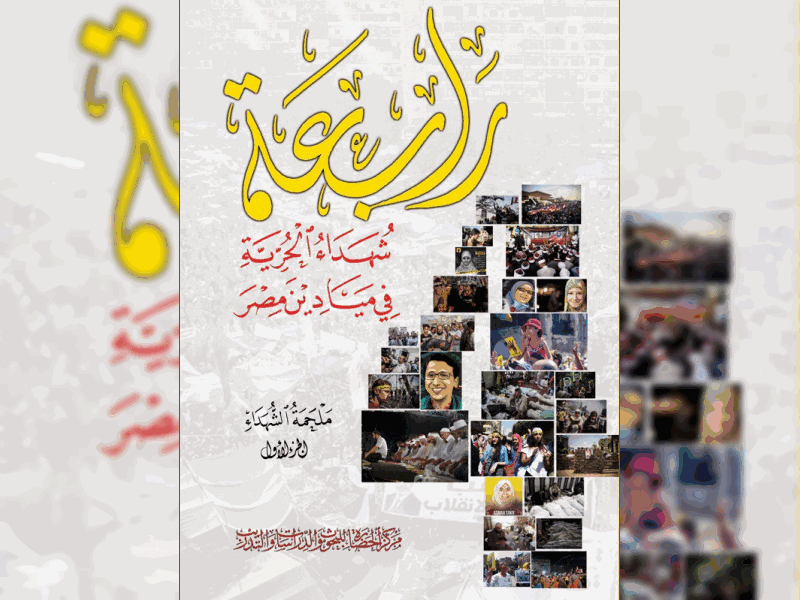
Although it bears the title of Rabaa as a symbol; However, it documents the lives of the martyrs of the Egyptian revolution in the period after the military coup that took place on July 3, 2013 against the elected president, Mohamed Morsi. Three parts of the series were published and include biographies of a number of martyrs. The authors (14 authors) indicated that it is a systematic documentary work aimed at protecting the biographies of the martyrs from disappearance or distorted, false history. The first book contains pages from 1 to 379 and includes three chapters: The first chapter is titled “Prostrated Souls, the Republican Guard Massacre, July 8, 2013,” and documents the biographies of 9 of the massacre’s martyrs. The second chapter is titled “Land of Resilience, the Memorial Massacre, July 27, 2013,” and documents the biographies of 16 of its martyrs. The third chapter is titled “The Pureest Blood, the Rabaa al-Adawiya Massacre, Part One,” and documents the biographies of 78 martyrs of the dispersal of the Rabaa al-Adawiya sit-in located in August 14, 2013. The second book contains pages from 380 to 960 and includes four chapters; The third chapter is entitled “The Pureest Blood, Rabaa Al-Adawiya Massacre, Part Two”, and the second part documents the biographies of the 64 martyrs of the dispersal of the Rabaa Al-Adawiya sit-in, and the fourth chapter is entitled “For Honor is a field, the massacres in Al-Nahda and Mustafa Mahmoud squares, August 14, 2013” and documents the biographies of 8 of the martyrs, and the fifth chapter is entitled “Resilience despite the blood, the Ramses Square massacre, August 16, 2013”, and documents the biographies of 18 martyrs, and finally the sixth chapter, entitled “On the Map of Persistence, Martyrs from All Governorates, Part One, 2013-2015,” documents the biographies of 11 martyrs belonging to the various Egyptian governorates who were assassinated by the military coup machine in various incidents. The second book contains pages from 961 to 1438 and includes the sixth chapter entitled “On the Map of Persistence, Martyrs from All Governorates, Part Two, 2013-2015”; It documents the biographies of 3 of the martyrs of the Rabaa Square dispersal, in addition to 96 in incidents in different Egyptian governorates. The authors pointed out that two main sources were used in collecting translation information: A) The Internet, represented by social networking sites such as YouTube and Facebook, and the information, testimonials and pages it contains dedicated to the martyrs in commemoration of their memory, B) Personal interviews with the families of the martyrs. Then the authors acknowledged the scarcity of data available in the first source and the difficulty of accessing the second source, and justified for this reason their inability to edit the biographies of all the martyrs, whose approximate number they indicated was (3250), and therefore the biographies were “randomly edited” according to those who had data available. The biographies in the book were divided into common and unified themes that contain the greatest amount of information and testimonies about the martyrs, which are: (personal data of the martyr, indications before martyrdom, story Martyrdom in time and place, the martyr in their eyes, after departure, life in a word). The authors also pointed out that some of these axes could not be fulfilled for some cases. The authors state that all of those whose biographies and biographies were documented in the series died in horrific massacres committed in cold blood by the Egyptian army and police against peaceful innocents who revolted to defend their freedom and will, and carried no weapons other than steadfastness, certainty, and loud throats chanting against the usurping military rule, in incidents in various governorates of Egypt. The dispersal of anti-coup sit-ins and marches, the attacks on student activities in universities, the deportation van, the deliberate neglect of detainees in prisons, and the killings at home, are just examples of painful events in which many innocent lives were lost. The authors believe that these biographies are the most worthy aspect of documenting and preserving in the memory of generations and the pages of history, of all aspects of the conflict between the revolutionaries and the coup in Egypt. This is the human aspect that analysts and historians may overlook, as they monitor the economic, political, legal, and other repercussions of that coup, and they consider that the values carried by the lives of the martyrs, such as steadfastness, steadfastness, sacrifice, detachment, courage, daring, and certainty in the inevitability of the victory of truth and the defeat of falsehood, are the true sustenance for all lovers of freedom in every time and place. The Awareness Foundation for Research and Development values this effort and considers it one of the awareness initiatives that address the human and social content in the history of peoples. It has obtained approval from the publisher to display the biographies of these martyrs on its website. You can click on the name of the martyr to view a brief information card or go to the full translation of his biography: