
On July 12, 2015, a group of Egyptian researchers launched an independent initiative aiming to launch a fact repository of alternative archives and open databases on social history and social indicators in Egypt after the January Revolution. The initiative turned into an official research center with its registration according to Egyptian law at the General Investment Authority in May 2016, under the name “Daftar Ahwal Center for Archiving, Documentation and Research (DCADR),” with its headquarters in the Egyptian capital, Cairo. The center defines itself as having “no connection to any opinions, trends, advocacy, or political, intellectual, religious, or personal positions,” and aims to “a more participatory, peaceful, just, and humane society, in which accountability, transparency, and freedom of information exchange are achieved for all.” The initiative adopts a number of values and messages, most notably: “providing free alternative knowledge in a professional, neutral and accurate manner as much as possible, providing an alternative archive for social history narratives from below, raising community awareness about political and social issues, and building data analysis and management capabilities within society.” The initiative also seeks to strengthen the bridges of collective memory between the past and the present within Egyptian consciousness, strengthen frameworks of participatory and institutional and community communication, support the freedom of information circulation and transparency, and advance the path of transitional justice. The initiative works on a number of documentary programmes, most notably:
Egyptian Memory Archive Program:
It works to build and make available a collective memory of political and societal changes in modern Egypt as an open alternative archive of social history from below. It includes the production of huge databases, archives of documents and visual materials about events, events, participating groups, and informal and official narratives about them, so that the individual and his relationship with the group/society is considered the basic element for making the historical event.
Social indicators programme:
It works on building and making available social databases, indicators and statistical forecasts on social issues and topics in Egypt, and considers the individual and his relationship with society as the basic element for making a social event. The program also works to establish participatory activities to enhance data analysis and management capabilities and build information design in a professional manner. The initiative also establishes a number of research values, most notably independence, freedom of information circulation, transparency, and accuracy, with neutrality, objectivity, and professionalism, innovation, flexibility, participation, and collective responsibility in work and management, while protecting privacy and not causing harm. With its publications, it targets Egyptian public opinion, decision-makers and officials, researchers and academics, various research centers, civil society and human rights organizations, support campaigns, activists in the public sphere, and all political parties and those concerned with political and social issues in Egypt, as well as those interested in archiving, statistics, data management, information systems, means of digital expression, journalism, and print, television, and digital media platforms. The initiative contributes to providing open databases for public opinion according to a coherent and accurate information and statistical structure with transparent standards, clarifying the sources of all information about the political and social spaces in Egypt and their relationship with the citizen during a specific period of time. It also aims to publish periodic publications in the form of comprehensive reports and statistical analysis, explaining the methodology and standards, producing static and animated visual displays of informational content, innovative, simplified and easy to browse for the average citizen, and building an open archive for collective memory of documents, documents, information, novels, visual, audio and written materials and other gray literature, with regard to political and social spaces in Egypt. In monitoring its statistics, the initiative relies on workshops on data management, information evaluation, archiving, statistics, building an internally coherent information system, and archiving, statistics, digitization, and data and document management services for institutions, campaigns, and active individuals within society.
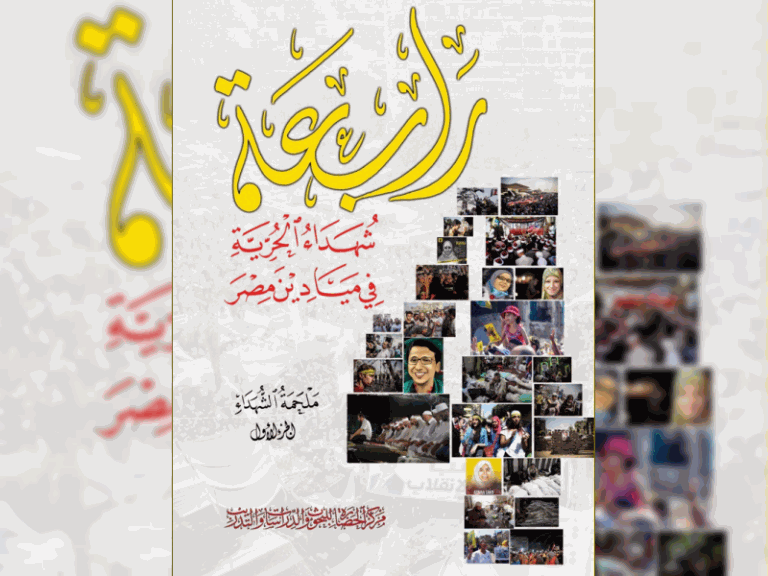
An example of the initiative’s publications
At the end of July 2015, the initiative issued a unique documentation of death sentences and referrals to the mufti on political grounds during the past 4 years of the Egyptian revolution, and divided it into three sections: Information archive: It includes a complete database detailing the report in Excel format. Statistical analysis: It is a separate statistical presentation that represents the incident and the legal status, the governorate of the incident, the time frame of the incident’s occurrence, gender, the date of referral to the Mufti, the status of the convict and his original domicile, and the type and grade of the court before which he appears. Graphs: It is a visual display that is divided according to the legal status, governorate of the incident, date of referral to the Mufti, time frame of the incident, original domicile of the convict, legal status and gender. Links to each part can be found here The comprehensive report is here
In general, this initiative can be considered one of the ways to enrich digital information content and provide free alternative knowledge for activists in the public sphere to use in their various activities and contexts, something that our Arab society lacks greatly.