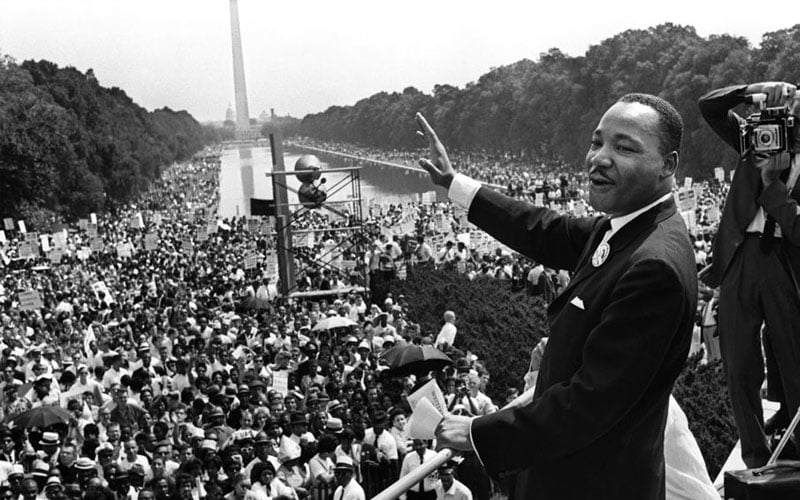

“My fellow man everywhere, you are not only accountable for what you say, you are also accountable for what you did not say when you should have said… In the end, we will not remember the words of our enemies, but the silence of our friends.” With these sincere words, the young political activist Martin Luther King, born on January 15, 1929 in Atlanta, Georgia, in the United States, inflamed in his most famous speech in 1963 near the Lincoln Memorial, within the largest demonstration in the history of civil rights. It seems difficult to place the name Martin Luther under one classification. He was a civil rights advocate, theologian, preacher, priest, writer, minister, pacifist, civil rights activist, peace activist, member of the American Academy of Arts and Sciences, holder of a Bachelor of Arts and a Doctor of Philosophy, a devout husband to his wife Coretta Scott King (June 18, 1953 – April 4, 1968), and a loving father of four children: Yolanda, Martin III, Dexter Scott, and Bernice. However, it can be said with some brevity that violates the history of its author that Martin was an American leader of African descent and a humanitarian political activist who called for an end to racial discrimination against blacks. In 1964 AD, he won the Nobel Peace Prize, and he was the youngest person to receive it, after he was considered one of the most important figures who fought for freedom and human rights. Luther founded the leadership of Southern Christianity, a movement that aimed to obtain equal civil rights for African-Americans. He became a victim of his cause, in which he rejected violence of all kinds. He himself was the best example for his companions and for many who were involved in the black struggle through his patience, kindness, wisdom, and reserve. Even the black war leaders did not support him, and they began to challenge him in 1965 AD. A difficult childhood in light of racism in the city of Atlanta, which was rife with the ugliest manifestations of racial discrimination. The boy (Martin) would often cry when he stood unable to explain why his white peers ostracized him, and why mothers prevented their children from playing with him. But the boy began to understand life, and knew the reason for these behaviors. However, he always remembered his mother’s words, “Don’t let this affect you. Rather, don’t let this make you feel that you are less than white people. You are no less than anyone else.” Years passed and King entered public schools in 1935, from there to the private laboratory school at Atlanta University, then he joined the Booker Washington School. His superiority over his peers was the reason for his enrollment in the university at the end of 1942, where he studied at Morehouse College, which helped expand King’s awareness of himself and the service he could perform to the world. In 1947, he was appointed assistant in his father’s church, became a Baptist pastor, and then obtained a Bachelor’s degree in Arts in 1948. He was only 19 years old, and he met a black girl named Corita Scott, and their wedding took place in 1953. He then obtained a doctorate in philosophy from Boston University. In 1951, he obtained a Bachelor’s degree in theology, and in 1955, he obtained a doctorate in the same specialty. In the first days of his university career, he studied the works of the American writer Thoreau, who believed in civil disobedience.
The beginning of the journey
In September 1954, Martin and his wife came to the city of Montgomery, which was the arena of Martin’s struggle, until the first Thursday of December 1955, when Mrs. Rosa Parks, a black woman, refused to give up her seat for a white passenger. The driver had no choice but to call the police, who arrested her on charges of violating instructions, and that was the beginning of his case. The situation was threatening a violent reaction that could have unleashed rivers of blood, had Martin Luther King not chosen a path other than blood to resist. He called for resistance based on the principle of “non-violence” or “peaceful resistance” in the style of the Indian freedom fighter Mahatma Gandhi. He always quoted the words of Jesus Christ: “Love your enemies and ask for mercy for those who curse you, and pray to God for those who mistreat you.” His campaign marked the beginning of a new era in the life of African Americans. The call to boycott the bus company extended for an entire year, greatly affecting its revenues, as Africans represented 70% of its passengers, and thus its annual income. There was nothing to incriminate Martin, so he was arrested for driving his car at 30 miles per hour in a 25-mile speed zone, and thrown in a cell with a group of drunks, thieves and murderers. This was Martin Luther King’s first arrest, which affected him deeply. He personally witnessed and suffered from inhumane conditions, until he was released on personal recognizance. Only four days later, on January 30, 1956, Martin was preaching to his supporters when a bomb was dropped on his house, as a result of which he almost lost his wife and son. When he arrived at his home, he found an angry crowd of armed Africans ready to take revenge, and Montgomery was on the verge of exploding in anger. At that time, King stood up and addressed his supporters: “Leave panic aside, and do not do anything that is dictated by a feeling of panic. We do not call for violence.” Days after the incident, he was arrested along with a group of prominent leaders on charges of participating in a conspiracy to obstruct work without a legal reason due to the boycott. The arrest continued until 4 women of African descent submitted a request to the Federal Court to abolish bus segregation in Montgomery. The court issued its historic ruling stating that this racial segregation was illegal. Only then did King ask his followers to end the boycott and return to using the buses “humbly and without arrogance,” and he was released. So. A month later, King’s house was blown up with dynamite by whites, and King formed the Southern Christian Leadership Conference to spread the method followed by Montgomery’s blacks to all parts of the South. King was imprisoned in 1960, just like Gandhi, for peaceful protest campaigns against racial discrimination, and began to demand that the federal government take the necessary measures against injustice.
Taking away the right to vote
In June 1957, Martin Luther King Jr. became the youngest person and the first priest to receive the Singarn Medal, which is given annually to a person who makes effective contributions in confronting racist relations. He was twenty-seven years old. On this occasion, in front of the Lincoln Memorial, King delivered a speech in which he attacked the two main political parties (Republican and Democratic) and repeated his famous cry: “Give us the right to vote.” His efforts succeeded in registering five million African Americans in the voter registers in the South. After Kennedy assumed the presidency, King redoubled his ongoing efforts to involve the federal government in the worsening racial crisis. However, John Kennedy was able, with political skill, to avoid King’s attacks, who did not stop describing the government’s inability to resolve vital matters. Hence, in the late summer of 1963, King decided to start a series of demonstrations in Birmingham, and he worked to mobilize social feeling with a symbolic demonstration on the public road. The next day, the first blatant battle took place between black demonstrators and white policemen who stormed the ranks of the demonstrators with sticks and fierce police dogs, but the scene was in full view of television cameras, and it was no longer possible to blind the people to the news. A court order was issued banning all types of protests, mass marches, boycotts and sit-ins; King decided for the first time in his life to publicly challenge a court ruling, and about a thousand demonstrators marched behind him, shouting, “Freedom has come to Birmingham.” King was arrested and placed in solitary confinement. He wrote a letter that later became one of the important references for the civil rights movement, in which he explained his philosophy, which is based on struggle within a framework of non-violence.
Subjecting whites to negotiations
After he was released on bail, he continued to lead the movement, and then an idea emerged to him that was summed up in this question: What are you doing with children? Only a few were willing to bear the responsibility that might arise from the killing of a child, but he did not hesitate much and allowed thousands of children to occupy the front positions facing policemen, firefighters, and brutal police dogs. The police committed their obscene mistake and used force against the children, some of whom were no more than six years old. Then the policemen stormed their ranks with their sticks and dogs; This angered millions, and pictures of police dogs mashing children spread around the world. Thus, King succeeded in creating the crisis he was seeking, and then announced that the pressure would not ease, adding: “We are ready to negotiate, but it will be a negotiation of the strong.” The white residents of the city could not help but immediately authorize a committee to negotiate with the African leaders, and after long and arduous negotiations, a program was approved to be implemented in stages with the aim of abolishing discrimination and establishing a just system as well as releasing the demonstrators. However, the extremists of segregation advocates took the initiative to attack bombs on the homes of the African leaders; the youth rushed in. The angry Africans confronted the police and firefighters, destroyed dozens of cars, and set fire to some stores, until President John Kennedy was forced to declare a state of emergency in the armed forces. King rushed to try to calm the revolt of the citizens. His consolation was that those who participated in the violence were not regular active members of the Birmingham movement. He soon toured several cities that revealed the volcano boiling in the chests of black Africans under the influence of a hundred years of oppression.
His union with other leaders
On March 26, 1964, Martin united with African American leaders such as African Muslim leader Malcolm In 1964, the Civil Rights Act was passed in the United States of America, and in the same year, “Time” magazine named King “Man of the Year.” He was the first man of African descent to be granted this title. Then, in 1964, he received the Nobel Peace Prize for his call to nonviolence. The matter was facilitated by the fact that he was a priest, so he was the youngest man in history to win this award (35 years old).
I have a dream
His sermon called “I Have a Dream” is considered one of the most famous sermons he delivered in terms of content and audience attendance. He delivered this famous sermon in 1963, attended by a large crowd of white and black citizens opposed to racial discrimination, which he derived from the Declaration of Independence drafted by Thomas Graveson in 1776, the content of which is equality among human beings: “I have a dream that has its roots in the American dream. The truth is clearly visible that all people are created equal.” “The children of slaves and the children of slave owners in the plains of Georgia will come together at the table of brotherhood. I have a dream that my four children will live.” In the future, in a nation that does not base its view of them on the color of their skin, but rather on their character, I have a dream that in Alabama, where hateful racism exists, the hands of black girls and boys will intertwine with the hands of white girls and boys as brothers and sisters.” He did not stop discussing black poverty issues and worked to call for a fair redistribution of incomes as unemployment spread among Africans, in addition to the annual defeat that Africans suffer at the hands of tax collectors, the monthly defeat at the hands of the finance company, the weekly defeat at the hands of the butcher and the baker, and then the daily defeats represented by collapsed walls, rotten sanitary ware, rats and insects.
Martin aimed at the arrows of racism
Because of these successes, right-wingers began to focus on King, led by FBI Director Edgar Hoover. Until the moment of King’s death, Hoover continued to pursue him, eavesdrop on his phone calls, and tried to recruit agents to penetrate his inner circle. Hoover formed a special unit to follow King and his men, and accused him of being a womanizer and an agent for the Communists. On the first day of April 1968, a young right-wing extremist named James Earl Ray drove to the city of Memphis. On the way, he stopped at a commercial store, where he bought a rifle with a telescopic scope and ammunition. At sunset on April 4, 1968, he took such a position that he was aiming in the direction of the king room of the Lorient Motel. Indeed, at 6 p.m., King appeared wearing a black suit, and was preparing to appear in front of a mass gathering that night. King leaned against the balcony wall to exchange a conversation with his assistant Jesse Jackson, who was standing on the floor. Suddenly a shot rang out, and King’s throat exploded. Then he fell to the balcony floor and blood spurted from King’s neck.
His departure and funeral
On April 9, 1968, a mass funeral ceremony took place in Atlanta, which symbolically represented King’s compassion for the poor. Among those attending the funeral, people saw Jacqueline Kennedy, wife of the murdered US President John Kennedy, and the opening of the annual basketball season in the United States of America was postponed. A week later, US President Lyndon Johnson signed the Civil Rights Act, which guarantees justice and equality between races, colors, and sexes throughout the United States of America, and requires the federal administration to implement the provisions of that law. After 14 years, Reagan abolished the mechanism of implementing the law through the federal administration, representing a final victory for Martin’s values, which he had not witnessed in his own life after he was assassinated by the right hand of racism.