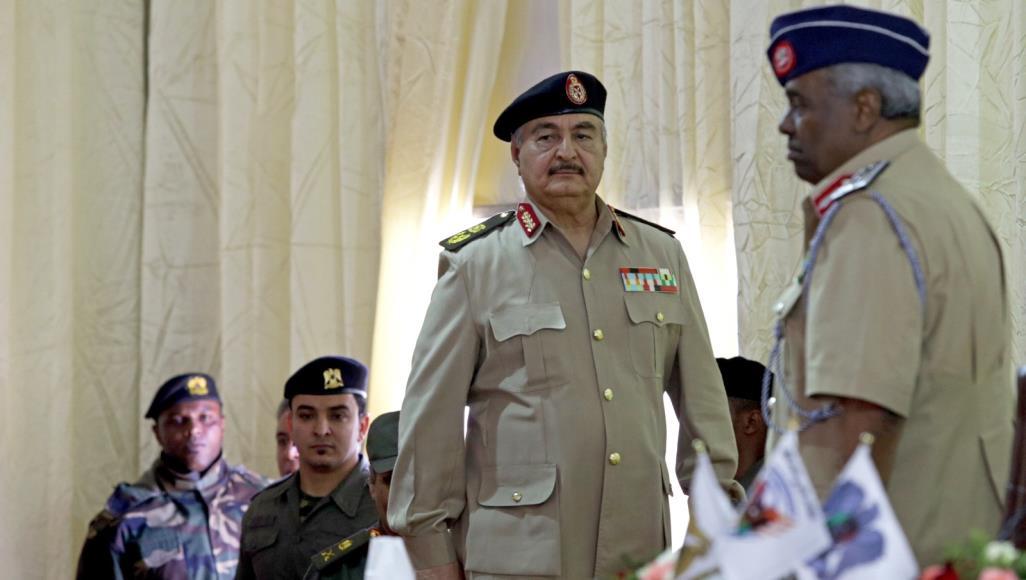
 On April 4, General Khalifa Haftar launched a battle to control the Libyan capital, Tripoli, which is subject to the internationally recognized Government of National Accord, headed by Fayez al-Sarraj. According to the “Skhirat” agreement. It seems that the former general, who disappeared behind the guise of revolution in 2011 during the fall of Muammar Gaddafi’s regime, wants to extend his influence and control over the entire Libyan territory, in an attempt to create a new reality on the ground, and force the world to recognize it. Before Haftar launched his military operation, he received significant financial and military support from three Arab countries, namely Egypt, Saudi Arabia, and the UAE, with the aim of eliminating political Islam and the revolutionary factions there.
Parties to the conflict
The first party that launched the operation is “Haftar’s forces,” which call themselves the “Libyan National Army” and say that they include about 85,000 fighters in their ranks. However, there are no accurate statistics for this. “Haftar’s forces” possess an important weapons arsenal, especially in the air force, and it includes former soldiers and fighters from tribes, and its most prominent components are the “Tariq bin Ziyad” battalion, the “106th battalion”, the Madkhali “Followers of the Righteous Salaf” battalion, and the “Martyrs of Al-Zawiya” battalion. “Haftar’s forces” also include in its ranks the “Awliya al-Dam” battalion, the “Thunderbolt Forces” battalion, and Saudi-style Salafist units that are anti-democratic. The second party is the “Government of National Accord Forces”, which includes revolutionary military brigades, at the forefront of which is the Tripoli Protection Force, which consists of four basic brigades: the “Special Deterrence Force”, the “Tripoli Revolutionaries Brigade”, the “Al-Nawasi Brigade”, and the “Abu Salim Central Security”. There is also the city of Misrata, the main resource for Tripoli’s fighters, which has more than 60 military battalions and brigades, part of which has united into what is known as the “Al-Bunyan Al-Marsous Force,” which is the largest organized and disciplined military force supervised by a group of professional officers. The number of Misrata fighters is about 30,000, and they own more than 11,000 military vehicles, including cars, armored vehicles, and tanks, in addition to an air base, and in the city there is an Italian military base.
Regional supporters
Behind all these military formations in Libya are regional supporters. There are two axes, the first includes “Egypt, Saudi Arabia, and the Emirates,” and the second includes “Türkiye and Qatar.” The first axis supports “Haftar’s forces” to a large extent, militarily and financially. Egypt carries out weapons transfers and trains pilots for Haftar. In addition to supervising the project to eliminate political Islam there. According to an interview with members of the Libyan negotiating delegation at the 2018 Rome conference for Al Jazeera, the Egyptian regime headed by General Abdel Fattah al-Sisi, following the army’s overthrow of the head of the Muslim Brotherhood, Mohamed Morsi, in July 2013, fears the success of the revolution in Libya and the experience of political Islam and its leakage into his country. The UAE also shares with Egypt some goals in Libya, which are eliminating the revolution and political Islam. It supports both Haftar and the militias of the city of Zintan with weapons, as well as money and salaries. Khaled Al-Mishri, head of the Supreme Council of State in Libya, told Al-Jazeera: “A strong supporter of Haftar has recently emerged, namely the Saudi Crown Prince, Prince Mohammed bin Salman, who pledged to him to provide financial support to finance his campaign to control Tripoli, during a meeting days before the battle of Tripoli.” On the other hand, Turkey, Qatar, and Italy support the forces controlling Tripoli, while Rome believes that Misrata is the strongest and most serves its economic interests. However, Türkiye and Qatar’s support for the Libyan National Accord Forces is minimal compared to the “Egypt, Saudi Arabia, UAE” axis. They are satisfied with political positions and media support, and there is no clear military support.
Battle scenarios
The battle in Tripoli is currently a “bone-crushing battle,” as so far Khalifa Haftar’s forces have been unable to achieve a tangible military achievement on the ground, while the Libyan Al-Wefaq forces are defending with all ferocity. Military estimates suggest that Haftar will lose the battle, thanks to Misrata fighters and weapons, and in cooperation with the Italian intelligence services, as there are 15,000 fighters from Misrata in Tripoli to protect it. It seems that Haftar, whom some describe as the new Muammar Gaddafi, surprised his allies before his opponents with his attack on Tripoli, and surprised the United Nations team concerned with finding a settlement to the Libyan crisis, which is likely to say the decisive word in cooperation with international powers.