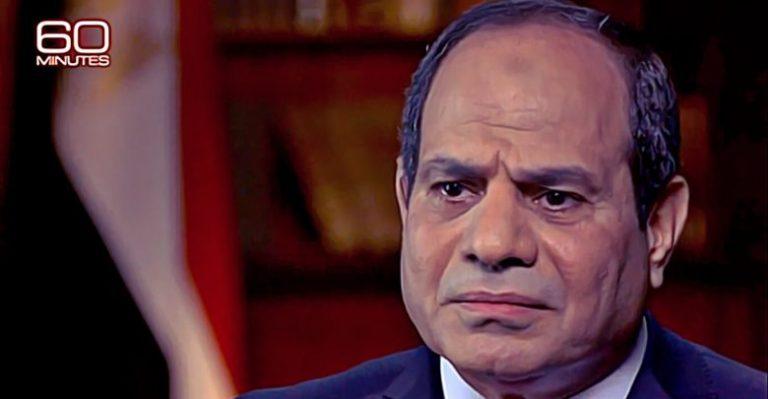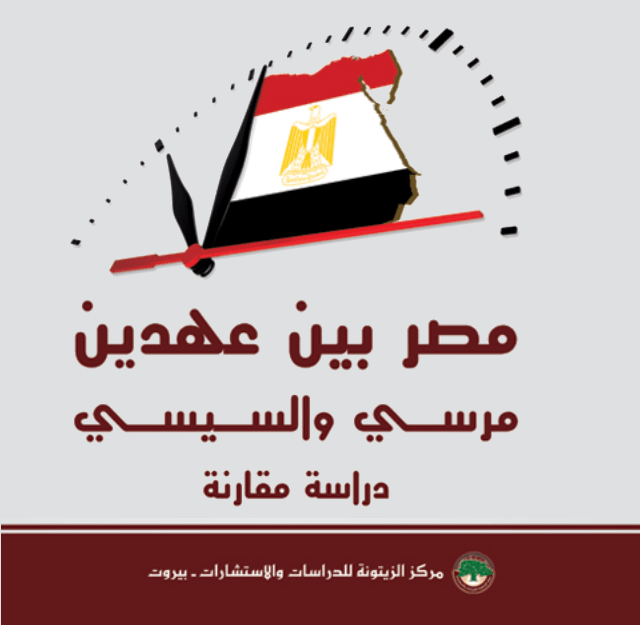
A study issued by the Al-Zaytouna Center for Studies and Consultations (based in the Lebanese capital, Beirut), prepared by researchers Rabih Al-Dannan and Bassem Al-Qasim, and supervised by Dr. Mohsen Muhammad Saleh – singled out the constitutional developments and electoral processes that Egypt witnessed in the period from January 25, 2011 until the end of 2015. The study was entitled “Egypt between two eras: Morsi and Sisi – a comparative study,” in 6 main sections (which were presented in the form of sequential episodes before being collected in a printed edition that was published The first, dated 2016), deals with the political, constitutional, security, economic and media situations that Egypt witnessed during the two presidents’ terms. The first chapter was titled “Constitutional Changes and Elections,” and its 79-page chapters showed that the constitution had been amended and referred to in a referendum on three occasions, legislative elections were held on two occasions, and three presidents ruled the country. As for the second chapter, it was titled “Political Parties and Forces,” and it emphasized that political and constitutional life was not prepared in a serious and easy way for President Mohamed Morsi when he assumed the reins of power. Morsi faced opponents and opponents of his rule, who opposed him based on political or ideological motives, or a conflict of influence and interests, and he did not have a democratically reasonable opportunity to implement the electoral program on which he won. Some of these opposition forces were visible and others were hidden in the structures of what is known as the “deep state.” The third chapter was titled “Economic Performance,” and emphasized that the major economic problems that Morsi faced at the beginning of his reign, some of which were the result of the economic policies that prevailed during the period in which President Mubarak ruled, and others were due to the political and economic conditions that arose after the January 25 Revolution, or because of the behavior of local, regional, and international forces and parties. Despite this, data indicated that economic conditions during Morsi’s era were better than during Sisi’s era. As for the fourth chapter, entitled “Managing the Security and Judicial File,” it emphasized that the security apparatus and the judiciary worked to weaken and undermine the authority of President Morsi, and in return, they supported the authority that turned against him. The irresponsible freedom during Morsi’s era turned into chaos and was exploited in order to implement the coup plot and support the counter-revolution, while Sisi’s era was characterized by the return of the practices of the security services to their previous era, and his era also witnessed cases of killing and arrests that affected thousands of civilians. The fifth chapter, entitled “Media Performance,” discussed the development of Egyptian media performance since the January 25 Revolution until the end of 2015. As for the sixth chapter, which Titled “Foreign Policy,” it discussed Egyptian foreign policy during the period extending from January 25, 2011 until the end of 2015. It discussed the Egyptian performance towards the Palestinian issue and its developments, and also talked about the Egyptian-Israeli relationship, and discussed Egyptian foreign policy with the most prominent Arab, Islamic and international countries. The Waei Foundation for Research and Development highlights the most prominent findings in the chapters of the rich study, through the following lines:
(1) Constitutional changes and elections:
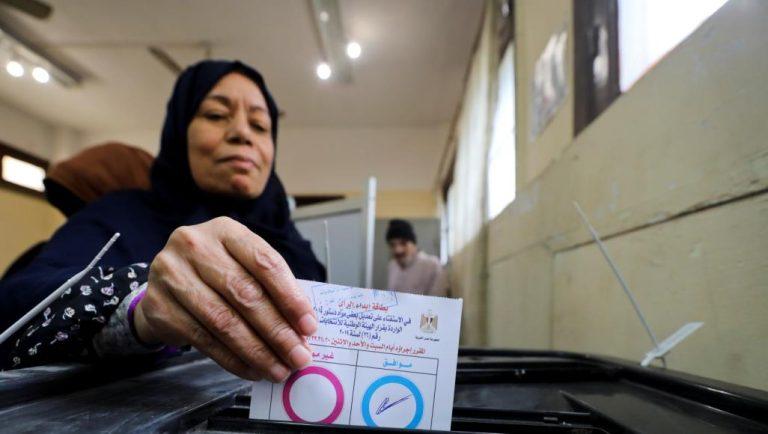
The study indicates that, until the date of the military coup against President Morsi in July 2013, the Egyptian people participated in five democratic electoral processes, which were known for their integrity and impartiality, as they were conducted under judicial supervision and with monitoring by local and international civil society institutions. All the electoral elections, most of which took place during the era of the Military Council, showed the strength of the Islamic movement and its supporters, led by the Muslim Brotherhood, as the funds said “yes” to amending the constitution on two occasions, and gave them a majority in the People’s Assembly and the Shura Council, and culminated in the victory of Mohamed Morsi for the presidency, despite the counter-media campaigns and inciting propaganda against the Islamic movements and their symbols, which did not stop with the coup against legitimacy, by nullifying the People’s Assembly, isolating President Morsi, and disrupting the constitution. The study showed that, despite the gains and successes that accompanied the January 25 Revolution, the course of Egyptian events after Morsi’s ouster witnessed a real crisis in the country, and the country remained subject to the military establishment, as the coup leader, Abdel Fattah al-Sisi, established his control over the reins of government by being elected president, in elections that reminded the world of the Egyptian scene before the January 25 Revolution. The results reached by the development of events were much lower than the aspirations of the revolutionaries and their hopes that they had for the January 25 revolution, and much lower than the sacrifices they made to make it successful. Also, there are no longer guarantees that if a candidate from outside the “deep state” system wins, he will not be overthrown as was done against President Morsi.
(2) Political parties and forces
The study says that President Morsi, at the beginning of his rule, relied on a strategy summed up in two paths. The first path was an attempt to co-opt the military establishment that was and still is holding the reins of power in Egypt, and adopting a policy of not directly clashing with it. In order to gain more time to stabilize the pillars of his rule and devote the greatest effort to political, administrative and judicial reform of the regime. As for the second path, Morsi turned towards the opposition political parties and youth forces that participated in the January 25 Revolution, in order to find a common national platform capable of developing a comprehensive national revival plan that would establish a truly democratic system of government that would meet the ambitions and goals of the January 25 Revolution, and place Egypt on the ladder of human, economic, and political development to achieve a state of welfare, sovereignty, and good governance. The study adds that narrow partisan interests and considerations played a major role in organizing the relationship and ways of cooperation between the opposition parties and Morsi. The large discrepancies that characterized most of the programs and visions held by the parties in Egypt at that period contributed to weakening any possibility of finding fertile ground for consensus. Which led to the clash in the end. She added that the difference was clear in the policy of these parties’ dealings and behavior with both presidents. While they opposed President Morsi in several positions and decisions, we find them strongly supporting the decisions of President Sisi in the same positions and decisions, and this was clearly demonstrated by the strong stance against Morsi when he issued the constitutional declaration at the end of 2012, while turning a blind eye to many of the legislations enacted by Sisi, which established his control and the control of the military and the decline of the democratic situation, as she stood. The parties stood in opposition to Morsi in his handling of the Renaissance Dam crisis, while praising Sisi’s wisdom in dealing with the crisis, even though Sisi was not more patriotic or extremist than Morsi. The parties also demanded their presence in the government of Hisham Qandil, while they had no representation in any government formed by Sisi until the writing of the study. The study shows that these forces and parties did nothing when President Sisi issued many legislations through which he restricted freedoms and placed many administrative, executive and legislative powers in his hands. He assumed the legislative authority in the absence of Parliament under the guise of the laws he was entitled to in exceptional cases. The study shows that despite the regime’s policy of exclusion and repression against its opponents and opponents, especially the Muslim Brotherhood, and its continued slogan “No reconciliation with the Brotherhood,” the political opposition, led by the Brotherhood, It continued to exert mounting pressure on the regime, through the street, in light of the regime’s inability to fulfill its obligations towards the people. The economic, security, and political conditions have worsened day after day. The study concluded this section by emphasizing that many of the gains of the January 25 revolution evaporated after the July 3 coup. Freedoms were re-restricted, some parties had their leaders imprisoned, others were marginalized, marginalized and excluded, and the forces that led the democratic path were eradicated. A group of supporters were suppressed, in addition to the militarization of the state’s components, and an attempt to produce a new, artificial opposition. Thus, the country entered into serious crises that affected its status and future.
(3) Economic performance
The study in Chapter Three indicates that from the first day of his presidency, Morsi’s opponents and opponents launched an organized media campaign against his economic policy, investing millions of dollars to make this media campaign successful, the most important manifestation of which was; Minimizing his economic achievements, and exploiting the stumble or slowness that accompanied the achievement of some of the economic goals he promised. This organized campaign, in addition to the means of power possessed by Morsi’s opponents, from local parties such as the military establishment, the rest of the deep state institutions, the remnants of the former regime, and regional and international parties, ultimately led to creating the conditions for the success of a military coup against Morsi, under the cover of a “popular revolution” entitled “million-man demonstrations.” It was exaggerated and the numbers of participants were doubled through the use of various media. The study shows that fuel shortages, electricity outages, and high prices were among the most present and influential crises in fueling the Egyptian street’s anger against the regime of President Mohamed Morsi. It adds that a number of these crises were fabricated and supported by internal and external parties, and that the end of the fuel crisis immediately days after the coup is the greatest indication of that. While the electricity crisis continued after the July 3 coup, the interim government experienced a difficult impasse, and the price of electricity rose at the beginning of Sisi’s reign by 27.9%, despite the fact that Gulf countries provided the government with aid that included petroleum products worth four billion dollars from Saudi Arabia, Kuwait, and the Emirates. Commodity prices also continued to rise during the era of Mansour and Sisi. The study adds that the strange thing is that the crises that toppled Morsi, most of which remained during the Sisi era, but the Mubarak regime’s media tools inflamed them during the Morsi era, and diminished their significance during the Sisi era. The study concludes that the coup in Egypt did not lead to extricating Egypt from its economic crisis, but on the contrary, it deepened its crisis more and more, as confirmed by economic data. The coup against the results of the 2012 elections also deprived the country of the possibility of progress through a democratic mechanism that guarantees the transfer of power and establishes the principle of accountability and accountability. Thus, the country became dependent on a specific group that manages the state’s economic capabilities and national wealth according to its interests.
(4) Security and judicial performance
The study shows in its fourth chapter that Morsi allowed his opponents to demonstrate and take to the streets, even though many of the demonstrations were aimed at embarrassing Morsi and weakening his rule. Also, the “factional demonstrations” carried out by a specific labor sector with the aim of achieving its own interests, emerged greatly during the Morsi era, and the members of the deep state and those affected by Morsi’s rule worked to stoke and inflame them, in addition to the exacerbation of the fuel and electricity crises, which were taken as one of the most important pretexts to turn public opinion against Morsi and the coup against him. One of the means they resorted to was the creation of a group called “Black Bloc,” which appeared on January 24, 2013, the eve of the second anniversary of the January 25 Revolution. Doubts surrounded the group about its role and background, and questions arose about the timing of the emergence of such a group, whose members covered their faces with masks to hide their identity, especially since there was no need to form such groups under the rule of law, and the protection of freedoms and the right to demonstrate during Morsi’s era. The study adds that the disappearance of this group days after Morsi’s ouster raised suspicion and suspicion around it, as if the goal of this group was to create organized chaos in the country to give these movements a military character. On the other hand, after the coup, the Egyptian authorities devoted most of their attention to limiting the growth of demonstrations opposing the coup and preventing their organization. The government issued the Demonstration Law, which tightened penalties on anyone who demonstrates without the approval of the Ministry of Interior, and violently responded to the demonstrations of the “Revolutionary Resilience Front” and the “No to Military Trials” campaign. The study shows that with the implementation of the demonstration law, the security grip returned to control the streets and squares, and the “Dawn Visitors” regime was once again accompanied by enforced disappearances, the intensity of which increased, while the security forces set out to confront the demonstrators in the same way as the Ministry of Interior did before January 25. According to Amnesty International in June 2015, the number of detainees in Egypt is estimated at more than 41,000 people. The study concludes that after the overthrow of Morsi, the Egyptian scene witnessed a rapid and massive return of security and police forces, in an attempt to demonstrate the return of security stability and the end of security chaos. Despite this, the cities and regions of the Egyptian state were not free of security disturbances, accompanied by a state of security chaos.
(5) Media performance
The study shows, in its fifth chapter, that state-owned newspapers maintained their loyalty to the Mubarak regime until a few days before his overthrow, and that they continued their previous discourse, with the only difference being that the Supreme Council of the Armed Forces was replaced by Mubarak. The same newspapers that glorified Mubarak and then the people of Egypt for a very brief period soon began to glorify the military council and its leader, while the authoritarian mentality remained in place as reflected in the media. The army became the savior, and anyone who spoke against it or attacked it was threatened with military trials. Although Mohamed Morsi assumed the presidency with a majority of votes, he became a favorite target for the local media, which broadly criticized and targeted him, even ridiculed and belittled him, as a series of well-known private channels owned by businessmen associated with Mubarak and his era competed. The matter did not end there. Rather, state-owned media outlets, including television channels, radio stations, newspapers, and websites, often participated to one degree or another in these campaigns under the umbrella of freedom. The study notes that the Egyptian media relied on rumors during Morsi’s era on three main strategies: challenging his legitimacy, challenging his patriotism and the patriotism of the Brotherhood, and comparing him to Mubarak and the Brotherhood to the National Party. The study shows that the media scene in Egypt has entered a new, very significant and dangerous phase after the removal of President Morsi. The media has clearly turned into an explicit tool in the political conflict between the new transitional authority and the Muslim Brotherhood and their supporters. The Egyptian army closed Islamic channels and those affiliated with the Islamic movement within hours of Morsi’s removal, censorship was imposed on media institutions, and other media offices were subjected to raids. The Egyptian authorities accused foreign media of providing biased coverage. The Egyptian media affiliated with the regime also deliberately attacked, mobilized, and beat the drums of war, using all methods. They excelled at lying, such as claiming that there were bodies under the Rabaa al-Adawiya sit-in platform organized by those who opposed Morsi’s ouster, which was not proven to be true. Some analyzes went on to confirm the “fabrication” and falsification of these images, passing through the claim of the presence of heavy weapons such as Locust missiles and chemical weapons, and all the way to the slander related to With “sexual jihad.” The study concluded that, nearly five years after the January 25 revolution, Egypt still suffers from the presence of an authoritarian media sector and restrictions on freedom of expression. The media in Egypt is characterized by its support for the regime. Despite the continuation, spread, and expansion of the crises during Sisi’s term, these media outlets defended Sisi, and saw what he did as an unrepeatable achievement, and impossible to achieve in any other era. It also portrayed Sisi’s promises in an exaggerated way, and built high hopes on Sisi.
(6) Foreign policy
The study shows, in its sixth and final chapter, that the Egyptian presidential institution was alone in determining Egyptian foreign policy and its general orientations, in a manner consistent with the interests of the ruling system. The presidency monopolized many of the files it considered vital, and the method and strategy of both President Mohamed Morsi and President Abdel Fattah al-Sisi differed in dealing with the management of the foreign policy file. While Morsi tried to establish relations with effective countries based on the principle of equality and parity, and that would benefit Egypt first and the targeted countries second, Al-Sisi used the state of targeting, rejection, and non-cooperation followed by many countries, especially those affected by the rise of the “Islamic movement,” with the Egyptian regime during Morsi’s era, to implement the coup plan with clear support from these countries. The study indicates that the way regimes in Egypt deal with the Palestinian issue varied between supporting the Palestinian issue, defending the historical rights of the Palestinian people, legitimizing their resistance to the occupation, and those who believe that resistance is not in the interest of the Palestinian state project. The study shows that Morsi’s victory represented a turning point in the relationship between Hamas and the government in Gaza on the one hand, and Egypt on the other. Whereas the only channel of communication between Hamas and Egypt was limited to the General Intelligence Service, the communication channels during Morsi’s era were now managed by the highest political levels on both sides. The Egyptian government and the Palestinian government in Gaza reached agreements on sensitive issues, including an agreement to form a joint security committee to monitor the borders, exchange intelligence information, and security cooperation. After the removal of President Morsi, a state of tension and mistrust prevailed over the relationship between Egypt and Hamas. This period witnessed a major incitement campaign against the Gaza Strip in general, and against Hamas in particular, launched by various Egyptian parties, media outlets and figures. The change in the policy of the new authority in Egypt towards the Gaza Strip began to appear noticeably a few days after the removal of President Morsi. This is through the increasing pace of demolition of tunnels, and the policy of irregular closing and opening of the Rafah crossing, which the Mubarak regime was adopting. The closure reached a stifling peak in 2015, for a total of 343 days a year, as the crossing was only opened for 21 days. In the file of Israeli-Egyptian relations, the study stated that “Israel” worked, since the first day Morsi assumed the presidency, to show that the relationship was normal between the two countries, by sending congratulatory messages to President Morsi on the occasion of his election, and on the occasion of the holy month of Ramadan. However, Israeli researchers and commentators saw that the relations between Egypt and “Israel” during the rule Morsi was fragile and in crisis, despite her preservation of the Camp David Accords. But this situation changed after the military coup, as the political, military and intellectual elites in “Israel” did not hide their satisfaction with what happened in Egypt. There is no doubt that a shift occurred in Egyptian-Israeli relations after the coup, as this shift came as a result of the considerations that governed both the coup leaders and the ruling elite in Tel Aviv. It was not surprising that the Israelis celebrated the coup, as the strategic assessment forums in Tel Aviv saw that the coup had greatly improved Israel’s strategic environment, which prompted its decision-makers to move effectively to help support the Sisi regime, by helping to secure international legitimacy for it, through active diplomatic and propaganda action in Europe, the United States, and international forums. As for the file of Arab, Islamic and international relations, the strategies of both Morsi and Sisi differed in dealing with Arab, Islamic and Western countries. Viewpoints also differed between the Egyptian authorities during the eras of Morsi and Sisi, between a supporter of revolutions and freedom of peoples, and a supporter of counter-revolutions, under the title of fighting terrorism. This was clearly evident in the statements of the two presidents and their positions on the development of events.