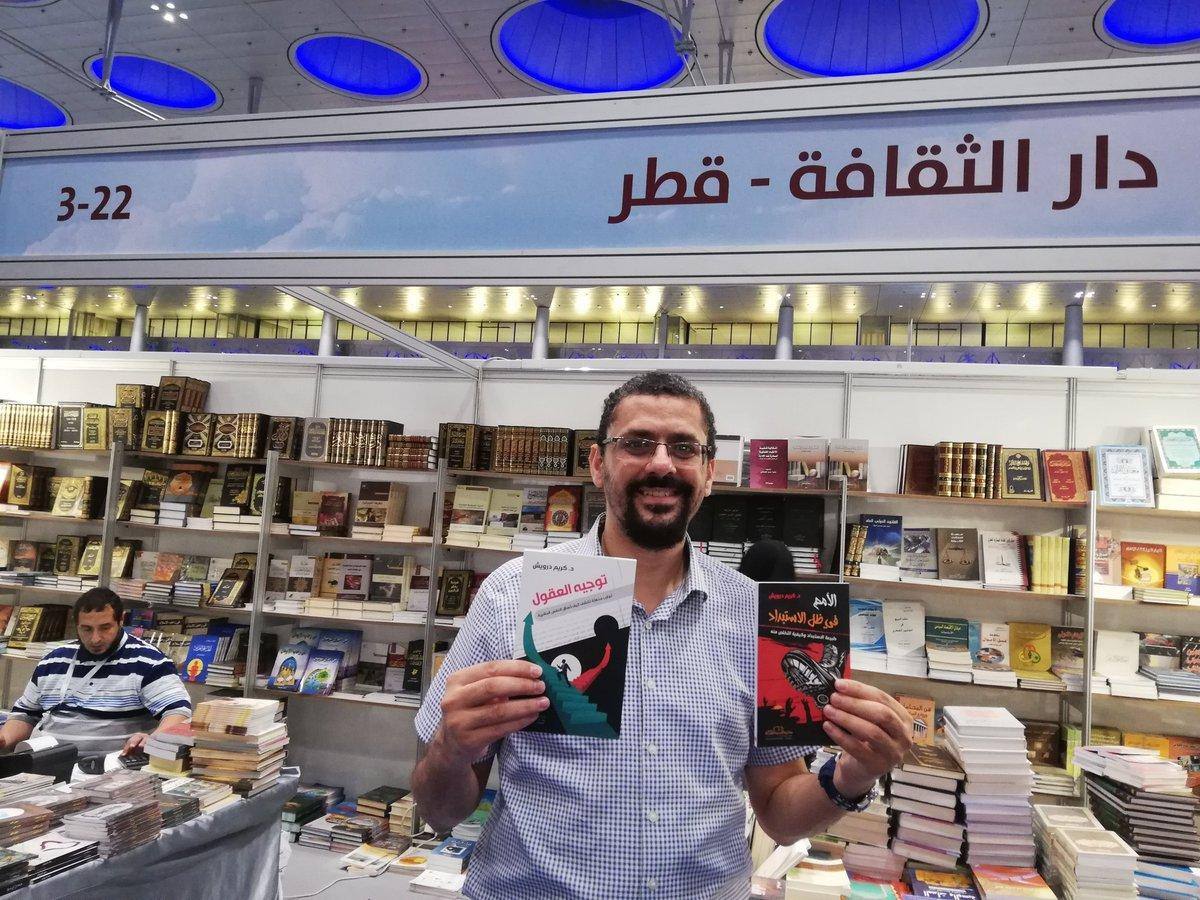
How does the media affect minds? Why do some people deny conclusive evidence? When and how do people’s opinions change? Why do children rebel after they were obedient? Why are rewards and punishment no longer effective in changing their behavior and convictions? How do we deal with adults and children when they fail? When do marriages last and when do they fail? Who are we and how do we see ourselves? How do we get out of cycles of failure? When can we be happy? Questions like these are raised by computational humanities researcher Dr. Karim Darwish in a series of episodes that he publishes periodically on his Twitter page, through which he presents an initiative that reviews amazing experiments that reveal how the human soul is led, shedding light in a more focused way on what is related to the work of the media on viewers, and what we can extract from those experiences in understanding hidden media messages. A more important matter that the initiative takes up is related to raising children, focusing on the psychological changes with which this generation was born that grew up in the overwhelming digital era, the impact of parental behaviors in shaping children’s awareness, and the most appropriate means of punishment that went beyond traditional discipline of beating and violence to more educational and hopeful forms.
Introduction to the researcher
Dr. Karim Darwish is a researcher in the fields of computational linguistics and computational humanities. His scientific specialization combines computer science, language, sociology, and psychology. He has published dozens of scientific papers in international conferences and peer-reviewed scientific journals, and has participated in writing many specialized scientific books. His published research has included topics such as: military intervention in politics, hostility against Muslims in the West, the impact of the Arab Spring on extremist groups, and the role of targeted propaganda on social media. Dr. Karim Darwish worked at the University of Maryland in the United States, Cairo University, and the German University in Cairo. He worked as a researcher at Microsoft and IBM, and currently holds the position of senior researcher at the Qatar Computing Research Institute of the Qatar Foundation.
Guiding Minds Initiative
The initiative relies on reviewing dozens of scientific experiments and theories, and clarifying them through real stories and life situations, while linking them to legal concepts as revealed in Qur’anic verses and Prophetic hadiths, in an interesting and enjoyable manner.
I am pleased to present to you the first video explaining the articles of my book, “Guiding Minds.” The first video is titled: Dissonance and the Secret of Unrequited Support, and it tells about the experiment of researchers Festinger and Clark Smith in 1959 about dissonance or rift in consciousness.https://t.co/mIQXU2FuS7
Looking forward to your comments— Kareem Darwish (@kareem2darwish) April 3, 2018
Thanks to him and your continued support, the number of subscribers to my channel (Guiding Minds) has exceeded 2,000 subscribers (an increase of 1,000 subscribers in the last two weeks). This is in addition to the wonderful comments from viewers. And a limited chance to be one of the first 5,000 subscribers. May God reward you! To watch and subscribe: https://t.co/AgrCnMcwM6 pic.twitter.com/jpivjP4YZA
— Kareem Darwish (@kareem2darwish) November 25, 2018
Praise be to God, Lord of the Worlds… My book “Guiding Minds” (formerly Speech on the Soul) is now in the markets pic.twitter.com/Yy7KbYrq2R
— Kareem Darwish (@kareem2darwish) March 9, 2018
This is how the media affects you
“How do you make someone turn a blind eye!” My latest video, “Guiding Minds,” presents one of the most famous and strangest psychology experiments to measure the influence people have on each other. Link to the episode: https://t.co/lgVhytAgVp
To subscribe to the channel: https://t.co/AgrCnMcwM6 pic.twitter.com/K9u9kfXBOx— Kareem Darwish (@kareem2darwish) September 24, 2018
The episode discusses the extent of society’s influence on a person, through one of the most famous experiments in psychology by the scientist Solomon Asch. This amazing experiment was conducted in 1951 to measure the effect of strangers on people who deal with them for the first time. https://www.youtube.com/watch?v=TYIh4MkcfJA According to the experiment, of which the researcher presented video clips, a large number of those chosen for the experiment were completely influenced by the strangers around them, simply because they all stuck to one answer to a question despite it being wrong beyond any room for thought or doubt. The researcher concludes from presenting this experience that the media relies on the technique of repetition and frequency in order to make you repeat to yourself: “Will everyone be wrong and I alone carry the truth?” Dr. Karim Darwish says that you must believe in your choice no matter how different it may seem to those around you, and answer yourself if you are asked such a question: “Yes… I may be right alone.”
To follow the initiative on Facebook: Here