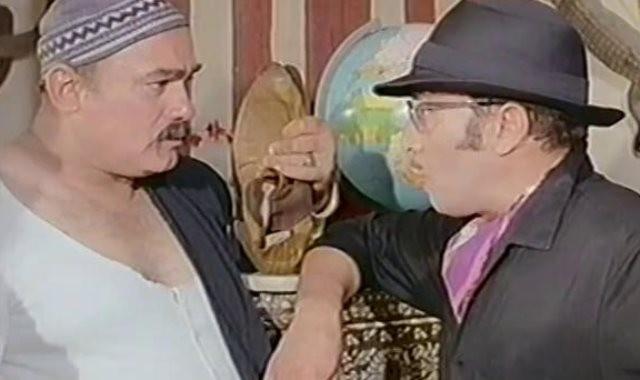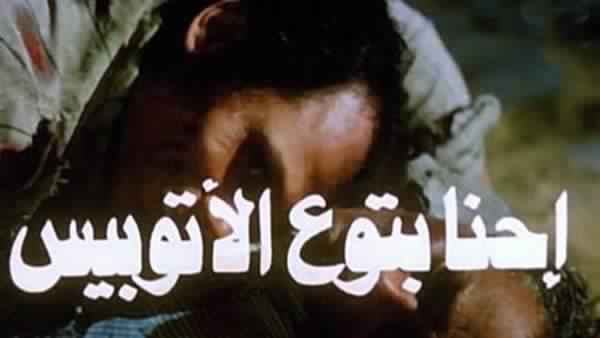
– Who taught you politics? – my father. – He was a politician? – You have no idea, Your Honor.. He was always telling me: Oh Jaber, you are the boss of people. With this sincere naivety, the simple rural citizen, Jaber (Adel Imam), responded to the questions of the intelligence officer, Ramzi (Saeed Abdel Ghani), who is trying in various ways to attach the charges written before him to the written report with his answers, even before Jaber enters the investigation room. The irony is absurd. Ramzi wants to pick semantic words from Jaber’s mouth that have nothing to do with politics in order to turn them into a political crime in order to show off to men in power and get a promotion at the expense of innocent people. While Jaber does not care about all of this, and focuses only on keeping up with the officer’s desire and saying what he wants, perhaps granting him permission to leave this grave, return home, and live again. We are the owners of the bus (in Arabic: We are the owners of the bus) is an Egyptian film produced in 1979 in 137 minutes. Its events revolve around the torture that occurred in the detention centers of former military president Gamal Abdel Nasser, and the extent of the disdain for human humanity under police rule and the state of military security services at that time.
Our Team
The film is based on a true story entitled “Dialogue Behind the Walls”, written by journalist Jalal al-Din al-Hamamsi, screenplay by Farouk Sabry, filmed by Mohsen Nasr, edited by Rachida Abdel Salam, and directed by Hussein Kamal. As for the cast, the cast included Abdel Moneim Madbouly in the role of Marzouk, Adel Imam in the role of Jaber, Mushira Ismail in the role of Mona, Gamal Ismail in the role of cell guard Abdel Muti, Saeed Abdel Ghani in the role of Ramzi, Wagdy El Araby in the role of Mahmoud, Aqeela Ratib in the role of Marzouk’s wife, and Younis Shalaby in the role of Ali.
Movie story
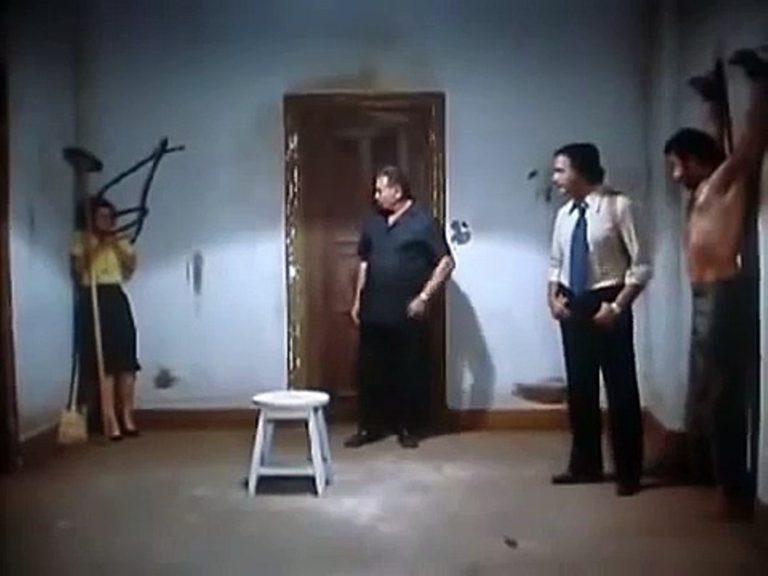
The film talks about a group of simple citizens who have no connection to politics. However, due to the excessive eagerness of the intelligence officers to maintain complete submission to the tyrannical leader, these citizens are arrested while carrying out daily activities, and are subjected to torture and abuse to confess to crimes whose meaning they do not even understand. The events of the film take place in 1967, before the setback of the Zionist occupation forces’ occupation of the Egyptian Sinai. It begins when Jaber (Adel Imam) and Marzouk (Abdel Moneim Madbouly) board the bus, before a quarrel breaks out between them and the conductor. So they all go to the police station. After days of detention, the conductor is released; While Jaber and Marzouk were detained by deliberate mistake, on charges of being hostile to the regime; Some officers resort to detaining anyone to close political cases. Accordingly, they were shipped to the military prison, a torture facility for opponents of General Gamal Abdel Nasser. In the military prison, “Ramzi” “Saeed Abdel Ghani” is the prison director, receiving Jaber, Marzouk, and other enemies of the homeland! Of course, the director of the military prison accuses Jaber and Marzouk of joining a secret anti-government organization and distributing leaflets calling for the overthrow of the regime. The officer asks them to sign a confession, but they refuse to sign and repeat: “We are on the bus.” Then Ramzi says to Marzouk: There are many crazy people who came here and said (We are on the bus, on the planes, on the car, but we rationalized them)! The torture he means is parties of torture, dragging, and humiliation. Difficult days for the famous bride (a tool of torture) in the military prison. Marzouk is dragged by his neck while being pulled with a rope like a dog. Ramzi orders him to say “ho ho” by opening the ha and lowering the waw like a dog. Jaber is humiliated and does what they order him to do on the ground, such as acting “peasant dough” and rolling over on the ground while acting as “sleeping insulator” other than torture on a tin. He was hot, and the executioners were calling him sarcastically and loudly, “Oh Maymun, Oh Maymun,” as if he were a monkey! Under the weight of horrific torture, Marzouk and Jaber sign the fabricated report condemning them, and are forced to confess to the crimes attributed to them, and accept their inevitable fate, before the film ends with the outbreak of the 1967 war and the rebellion of the detainees in the prison, but the two heroes of the film die at the end after 5 years of torture for no fault of their own.
Business messages
This film was a reflection of the violation of human rights during the rule of Abdel Nasser. We are facing a cinematic film that uses the torture of prisoners as a basic material for forming its events and facts. The film raises the three traditional issues in the field of the relationship between the security services and citizens – in this system – in the circumstances of arrest, arrest, detention, investigation, and treatment during these procedures, which are the issues of “enforced disappearance,” “torture,” and “confession under conditions of coercion.” During work, we encounter a new type of enforced disappearance of citizens. Jaber and Marzouk go to the police station in an ordinary quarrel. Due to the high activity of the security services in arresting a large number of people accused of participating in a conspiracy to overthrow the government, both Jaber and Marzouk find themselves among those arrested in this repressive security campaign. The reason for the forced disappearance here seems completely absurd, as once the character was present by chance at the police station headquarters, they ended up being arrested on political charges that neither of them had anything to do with at all. As for the torture in the film, it drove a number of prisoners to insanity, as happened with the prisoner who witnessed the death of one of his prison mates (Abu Fathi) due to torture, and he continues to imagine that “Abu Fathi” comes to him from the other world, from time to time, carrying newspapers and some food with him. Regarding forcing detainees to confess to charges under duress, the fabricated crimes in the film were extremely political, and were related to the idea of changing the regime by force, and the related crimes of incitement, broadcasting and possessing publications against the regime, possession of tools and materials for explosions, possession of firearms or knives, and so on. In the movie “We Are on the Bus,” the purpose of torture is limited to obtaining a signature on confessions on charges of attempting or conspiring to overthrow the government by force.
Criticism of the work
This film is considered the first black comedy in the history of Egyptian cinema. The events are tragic, but their presentation is sarcastic and funny. The film contained about 20 scenes of torture that were controversial with the censors, as they asked to delete them later, but the author refused, and says that former President Anwar Sadat intervened at the time and allowed the entire film to be shown without deletion. The film is criticized for not mentioning the sexual violations to which prisoners or their families are exposed at the hands of men in positions of power or their followers, which were widespread in Abdel Nasser’s prisons, according to the testimonies of hundreds of prisoners who documented their experiences during their detention journey. Although the duo, Adel Imam and Abdel Moneim Madbouly, are originally comedic actors, they excelled at mastering this tragic role to an impressive degree. Perhaps Adel Imam helped in mastering his role – in addition to his talent – his mastery of the role of the “overwhelmed” employee who gets into trouble because of his naivety and good intentions, as he did in several works, the most famous of which is the play “Watch What He Sees Nothing.” As for the character of the tyrant Ramzi, played by Saeed Abdel Ghani, he is a cinematic character that can be studied, and perhaps he can be considered the most proficient in his role among the actors of the work. We find that he suffers from psychological anxiety and a high obsession with personal hygiene. He always wipes his hands with a handkerchief with cologne on it and smells roses, but despite that, he is cold-hearted in dealing with the detainees, and hides within him his unjust components towards them. Sergeant Abdel Muti (Jamal Ismail), Ramzi’s right-hand man, who tortures prisoners. The film devotes marginal scenes to his personal life, and we discover that he is ignorant and naive, does not know how to read or write, and believes that authority is always right. However, when he tortured the imprisoned poet-actor Mahmoud (Wagdi Al-Arabi), who began uttering words that deeply affected him, doubts came to him about the fact that authority is not always right, to finally discover that he was serving a tyrannical and oppressive regime. Although the film was produced in 1979, it remains an icon of the Egyptian and Arab security reality and many countries in the world that are backward in terms of human rights, as those peoples are still experiencing its scenes to this day, and their oppressive regimes continue to violate human freedoms and the security authorities control their lives, ignoring the peoples’ calls for freedom and their attempts to obtain it. The slogans of “living,” “freedom,” and “human dignity,” which the Arab Spring revolutions called for, quickly dissipated after the violent resistance that these popular uprisings met with from the forces opposing them, and they took steps backwards, perhaps worse than they were before, and in which people were deprived of their right to dignity, justice, and decent living.