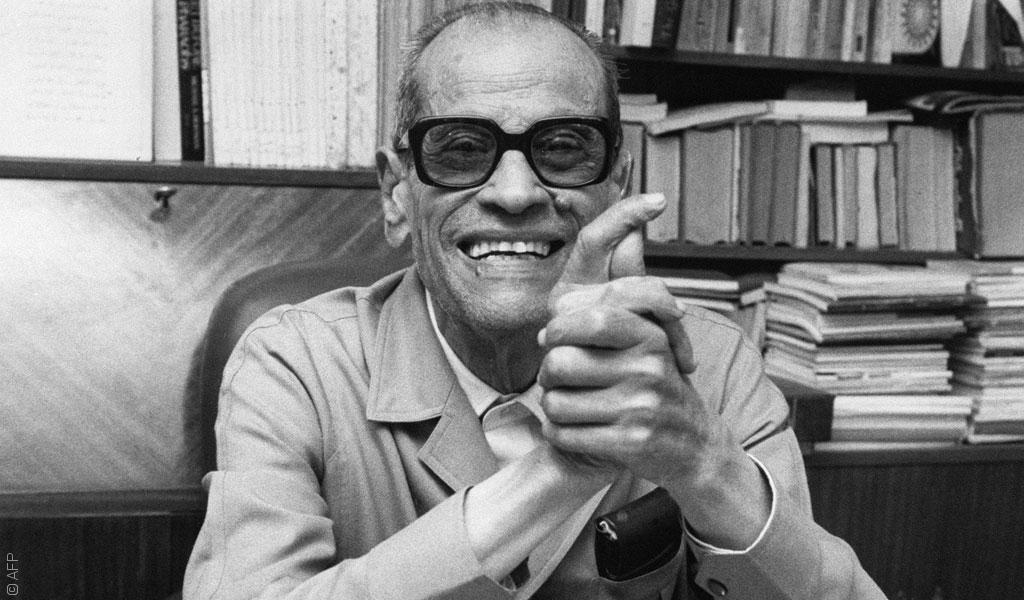
Naguib Mahfouz months before his death – Wikipedia
Military defeats in the history of any country are followed by a major intellectual and cultural shock resulting from the shock caused by defeat, especially in the Egyptian case following the 1967 defeat, where the shock was extremely severe, as it was preceded by continuous media talk about the imminence of victory, the resolution of the battle, and victory over the enemy. However, under the rule of Abdel Nasser, and the influence of his security and media apparatus, which was able to turn the country’s defeat into a personal victory for the president, and to create a state of hostility towards anyone who thinks of criticizing the leadership and exposing its role in the defeat, patriotism has even turned into solidarity and showing alignment behind that leadership. In light of these circumstances, the novelist Naguib Mahfouz was burning with pain for the bitter Egyptian affliction, but – like other writers at that time – he was not able to confront the masses with that burning intensity, but despite that, he did not prefer silence, but rather resorted to the most useful trick in such cases… symbolic literature. Amber Lulu… a story published by the great writer Naguib Mahfouz in Al-Ahram newspaper after the 1967 defeat in the summer of 1967 AD, in which he writes his sorrows about the country that emerged from the sudden war defeated and hopeless, and how that was reflected on the adult generation and the younger generation alike.
Introducing the writer
Naguib Mahfouz (December 11, 1911 – August 30, 2006), winner of the Nobel Prize in the world of literature, is the most famous Arab novelist, and one of the best novelists in Arabic literature. He is the most Arab writer whose works have been adapted into cinema and television. Mahfouz wrote from the beginning of the forties and continued until 2004. The events of all his novels take place in Egypt, and a recurring theme appears in them, which is the neighborhood that is equivalent to the world. Among his most famous works are: The Trilogy and The Children of Our Neighborhood, which was banned from publication in Egypt since its publication until recently.
Story summary
An old man (the regime) and a young girl (Egypt). The old man is over fifty years old, and the girl is still twenty years old. They work in one government administration. The girl suffers from family problems, as a result of her responsibility for her sisters (Arab nationalism) and the harassment of her stepfather (America) where they live with him. The old man lives with passivity after a history of heroism against enemies. They agree to meet in one of the parks. The girl wants to reveal her problems to him, and the old man wants to hear the girl. She could not reveal it to her friends except to two friends, one of whom encouraged her to get married (the Soviet Union) and the other to leave (America), and the girl wants to hear the opinion of wisdom. She took him or her to the park. And the garden appears to be a garden of lovers. Everyone is distracted by the girl playing and having fun (a symbol of the people’s busyness), and the old man and the girl are watching all of this as she talks to him about her problems, calling for fun, dancing and singing. She wants to escape from her captivity and tell him conflicting stories about a rich young man from Tanta (Israel), a well-to-do merchant who wants her without marriage or divorce, while the old woman restrains her. The old man takes his turn and says that he is in the Haram desert, where there is absolute freedom, there are flowers and jasmine, and there she can do whatever she wants without restrictions or supervision. He invites the girl to join him and marry him, but the girl refuses to go with him. During the dialogue, the sound of (war) shots is heard, and the dialogue is interrupted and the question arises: Are the bullets due to a fleeing criminal or due to another reason, training exercises or something like that… Then the dialogue continues between attraction and intensity, relaxation and repulsion between the old man and the girl… Then the dialogue is soon interrupted by the entry of a man panting (the sudden defeat), and he talks to them about the sound of the bullets and speaks in the capacity of the viewer and not the character of the perpetrator (the soldiers). The witness says that a man climbed onto the tower and fired bullets in all directions (a symbol of how war destroys everything) without a target and without hitting anyone. The old man tells him that there was once a man like him shooting at enemies (a symbol of the regime abandoning its slogans of struggle). The old man continues his confessions about the man who fired the bullets, until he finally admits that he was the one who did it (the regime is responsible for the defeat). The old man returns to his conversation with the girl and says to her: Let’s go to Lulu’s ward (the beautiful Egypt that the Egyptians seek) and she hastens to agree, so he explains to her that Lulu’s ward is a project or a dream that he and a group of his friends had during his imprisonment (the era before the 1952 revolution), but it has not yet been realized.
Characters
– The old man: In his youth, he was a hero and was seen as a repository of wisdom and opinion, but he became lustful. – A young girl who is faced with problems from every direction and searches for a solution. – A revolutionary young man on the run, declaring his denunciation without purpose. – Reckless young men and women having fun everywhere. – Police soldiers surround the park.
Story building elements
1- The narrative element
The story came in the conscience of the narrator himself, that is, in the conscience of the first person, and therefore we attribute all ideas to Guib Mahfouz in the end, and we also find that he has multiple descriptions of the girl, the old man, and the current events.
2- Characters
This story, as usual in stories, contains main characters and secondary characters. It contains both types, but what is new about it is that each person in the story has a symbol to symbolize him.
3- Time and place:
The writer took into account time and place in his story, so he came up with them appropriate for the short story. The time does not exceed a few hours, during which the girl sits with the man, telling him her problem, and searching for a solution to it. It did not exceed the time limit, and likewise the place, which is the booth in which he sits with the girl on the sofa, is represented by this garden in which he met her and its surroundings, so the story was woven wonderfully, in which the element of time and place complied with its specific rules.
4- Conflict in the story:
The conflict in Naguib Mahfouz’s story is a normal, quiet conflict, represented by the search for freedom and a solution to all the girl’s problems. Therefore, the knot continues until the end, and the solution of the knot comes at its end when the man and the girl leave the garden to Lulu’s dormitory, that is, to freedom, according to the phrase that he will shoot everywhere, “I will shoot in all directions, and we will dance, sing, and have fun.” So why does he want to shoot in all directions? This indicates that all parties are responsible for the defeat and everyone is involved in it.
5- Language and style:
The language of the story is the language of those who are jealous of the Arabic language, and its first-class defender who sees that writing in the colloquial language is a kind of reactionary and backwardness, and from here his language is eloquent Arabic, in which he does not use colloquial words at all, and it is a wonderful, palatable language that does not bear any difficulty in its words, and does not require referring to dictionaries to understand it. It contained some wonderful, beautiful expressions on his tongue, and among his own thoughts, even if they came on the lips of the characters, for example: “The time we give to a human relationship is not wasted,” “I did not have the audacity to ask to meet you except because I am in dire need of a wise opinion,” “It is a soul condemned to life imprisonment in constant misery,” “Sometimes it seems to me that modern evil is better than the good of the mind,” “These are the repercussions of a crisis that has blasphemed the wisdom of patience,” “Believe me, our life is an old, dilapidated endowment controlled by commandments.” Death”, “The mind can imagine everything if it abandons the strangling grip”, “And its motto is not written, do whatever you want”, “You are restoring to fire its dignity in relation to dust.” These are wonderful expressive methods, befitting only this wondrous storyteller. It is no wonder that Naguib Mahfouz, the winner of the Nobel Prize in Literature, relied in his story on the constructive methods, represented by the interrogative, the imperative for its purposes, and wishing and pleading in more than one place, along with the declarative methods, most of which came in the actual sentence. But there is one strange word, which is “Honolulu,” which is an island in the Pacific Ocean, belonging to the United States, and is reserved for those with a lot of money and the rich only, so they go there. They enjoy it, as they are an example of a garden that suggests freedom and unlimited pleasure.
Story message
The story expresses the frustration that dominated Egypt’s elite after the defeat of 1967, but despite that, it broadcasts messages about the desired solution. Mahfouz says that achieving the hopes of the oppressed, the young and the old, will only be achieved by achieving freedom, the freedom for each of them to do what they want. The writer shows that young people are confused, do not want or know what they want, and therefore he recommends that experience meet with young people, considering that they are the ones who can solve the eternal problem facing society.