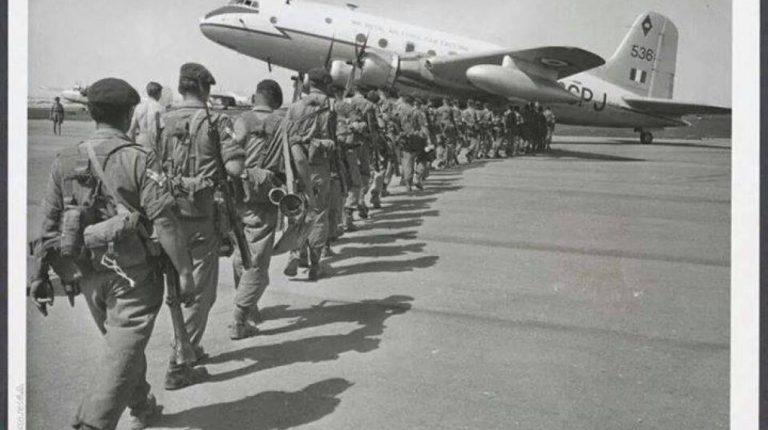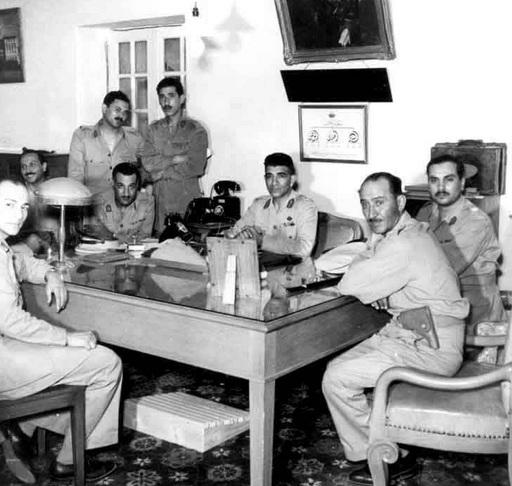
Perhaps it is a significant coincidence that the date of the fall of the first monarchy to rule Islamic Egypt was the same as the date of the fall of the last version of it. Centuries ago, specifically on July 23, 750 AD, the Umayyad King Marwan II ibn Muhammad, the last king of the Umayyad state, was killed. Thus, turning the page of the last king of the first royal state in the Islamic history of Egypt. Years and centuries passed, and the same day in the year 1952 witnessed the departure of the last king of the upper monarchy, after the Free Officers organization overthrew King Farouk I in a military coup and exiled him outside the country, thus announcing the end of the rule of the Muhammad Ali family, and the establishment of the Republic of Egypt that continues to this day.
– Signs of the beginning:
The Free Officers Organization appeared in the Egyptian army, led by Major General Muhammad Naguib and led by Bekbashi Gamal Abdel Nasser, after the 1948 war, which ended with the loss of Palestine and the inauguration of what is known as the state of “Israel.” The political and social situation in Egypt at the end of the reign of King Farouk I was turbulent and unstable, as Farouk continued to ignore the majority and rely on minority parties, with the outbreak of internal unrest and conflict between the Muslim Brotherhood movement and the governments of Nuqrashi and Abd al-Hadi, then the defeat of the Palestine War, and the king’s involvement of the country in it without preparation. Militarily, the size of the National Army units was reduced after the British protectorate was imposed on Egypt and most of its forces were sent to Sudan. Under the pretext of contributing to suppressing the Mahdi revolution, with the closure of naval and military schools, which led to the dismissal of a large number of the leadership of the Egyptian army. Although the value of the Egyptian currency has stabilized globally, the deteriorating economic situation in Egypt has begun to accelerate significantly, due to policies of injustice, the loss of social justice among the classes of the people, and the poor distribution of ownership of the nation’s wealth, especially with signs of widespread spending and extravagance on the palace residents. On July 23, 1952, the organization carried out an armed coup that succeeded in controlling vital facilities in the country. King Farouk I was forced to abdicate the throne to his crown prince, the infant Prince Ahmed Fouad, and to leave the country on July 26, 1952. The first statement of the revolution was broadcast in the voice of the organization’s member, Anwar Sadat, and it read: “From Major General Mohamed Naguib, Commander-in-Chief of the Armed Forces, to the Egyptian people… Egypt has passed a difficult period in its recent history of bribery.” Corruption and instability of governance. All of these factors had a major impact on the army, and the bribes and ill-intentioned people caused our defeat in the Palestine War. As for the period after this war, the factors of corruption combined and traitors conspired against the army, and either an ignorant, a traitor, or a corrupt person took over its command until Egypt was left without an army to protect it. Accordingly, we have purified ourselves and our affairs were taken over by men within the army in whose ability, morals, and patriotism we trust. All of Egypt must receive this news with joy. And welcome. As for the former army men we saw arrested, no harm will befall them and they will be released at the appropriate time. I assure the Egyptian people that the entire army today is working for the benefit of the nation under the Constitution, devoid of any purpose. I ask the people not to allow any of the traitors to resort to acts of sabotage or violence, because this is not in the interest of Egypt and that any such action will be met with unprecedented severity and the perpetrator will be punished as a traitor immediately and the army will carry out its duty Cooperating with the police. I reassure our foreign brothers of their interests, lives, and money, and the army considers itself responsible for them, and God is the Granter of success.” After Fouad’s departure, a regency council was formed for the throne. Then the monarchy was abolished, and the republic was declared on June 18, 1953, and the administration of the country was transferred to the “Revolutionary Command Council,” composed of 13 officers from the Free Officers Organization, headed by Major General of Staff Mohamed Naguib, and with the membership of Gamal Abdel Nasser and Abdel Hakim. Amer, Youssef Siddiq, Hussein Al-Shafi’i, Salah Salem, Gamal Salem, Khaled Mohieldin, Zakaria Mohieldin, Kamal Eldin Hussein, Abdul Latif Al-Baghdadi, Abdel Moneim Amin, Muhammad Anwar Sadat, Jamal Hammad.
– The turning point
Naguib was planning to hand over power to an elected civilian leadership, but the organisation’s most ambitious young member, Gamal Abdel Nasser, had a different opinion. He quickly seized the reins of power, and appointed Muhammad Naguib to reside in the palace of Zainab Al-Wakil, wife of Mustafa Al-Nahhas Pasha, in the Al-Marj suburb, east of Cairo, until his death. Gamal Abdel Nasser assumed the rule of Egypt until his death in 1970, deriving his legitimacy from what was called the July “revolution” in the media. With Abdel Nasser taking over the rule of the country, Egypt entered a new phase in its modern history, in what became known as the military state, as the army’s leaders continued to rule the country until today, in contrast to President Mohamed Morsi, who took over the rule of the country after the January 2011 revolution, which the army quickly overthrew again, and announced the overthrow of Morsi in the military coup of July 3, 2013, which was followed by the coup leader Abdel Fattah al-Sisi assuming the presidency of the country in 2014.
– Movement results:
An impartial view of the results of the army movement on July 3, 1952 requires distinguishing two stages in its history, as Abdel Nasser’s assault on power represents a milestone that can be considered a major turning point in the course of the pivotal event in Egypt’s modern history. The first weeks of the revolution witnessed important political, economic, and social decisions that were aimed at restoring lost dignity, independence, freedom, and fair distribution of wealth, especially with the issuance of the Property Law on September 9, 1952, which eliminated feudalism and removed agricultural property from its throne. Economically, in addition to the Egyptianization and nationalization of trade and industry that had been taken over by foreigners, the abolition of classes among the Egyptian people, and allowing the poor to work as judges, university professors, ambassadors, ministers, doctors, and lawyers, the social structure of Egyptian society changed, and the movement liberated the peasants by issuing the Agrarian Reform Law, and eliminated capitalist control in the areas of agricultural and industrial production, even if it replaced it with a socialist communist policy that was no less bad.
– The end: State of Generals
Egypt would have almost breathed a sigh of relief, had it not been for the coup of Abdel Nasser, who devoted himself to liquidating his political and military opponents to consolidate his rule, investing the momentum of the “revolution” in popular, populist decisions such as nationalizing the Suez Canal, signing the evacuation agreement after seventy-four years of British occupation of Egypt, and building an Arab nationalist movement that he led. Before Abdel Nasser’s death on September 28, 1970, of a heart attack, Egyptian political life had reached the end station, as he dissolved the political parties, abolished partisan and public work, placed the media, judiciary, and education under the control of the state, leaving the country in a state of surrender to military rule, whose efforts were crowned by the organization’s member, Mohamed Anwar Sadat, assuming the presidency of the country until his death in 1981, to be succeeded by military president Mohamed Hosni Mubarak, during whose reign the military state almost fell during a revolution. The Egyptian people for their corruption on January 25, 2011, had it not been for the army regaining control with General Abdel Fattah al-Sisi’s coup on July 3, 2013 against the only civilian president in the history of the republic, Mohamed Morsi. Nearly 66 years after the army movement that overthrew Farouk’s monarchy, Egypt is still under the tutelage of military rule, with the living conditions of Egyptians deteriorating politically, economically, and socially, especially with General Sisi adopting a security policy of extreme surveillance, tightness, and isolation toward his supporters rather than his opponents. Thus, Egypt finds itself on a slope steeper than the motives of the army’s movement against the king. Let the compass of the Egyptians’ struggle shift from the court of the “king” to the state of the “generals.”