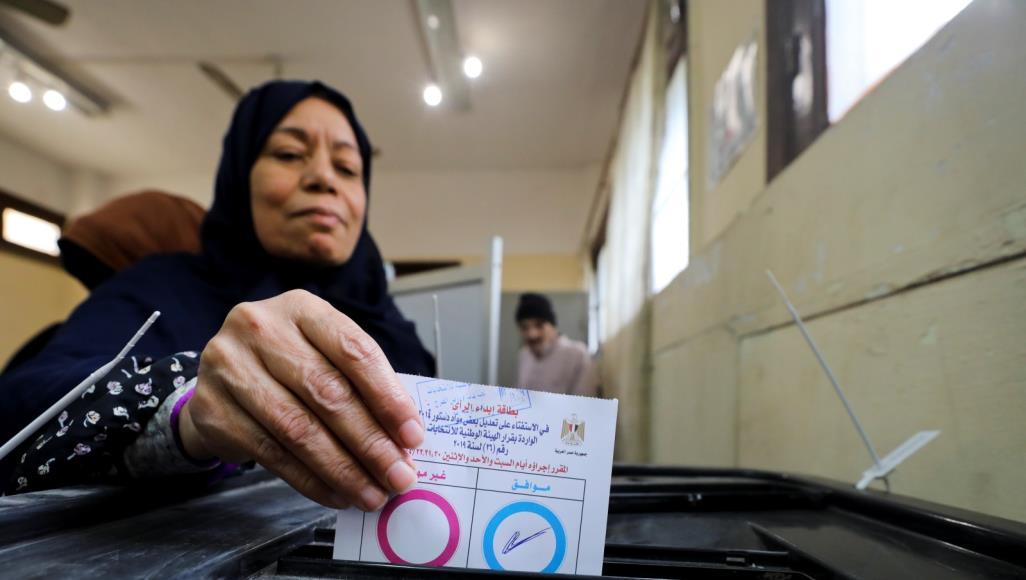
 This April, the Egyptian House of Representatives announced the launch of a popular referendum on the constitutional amendments approved by the majority of the House’s representatives, which include articles that allow the current Egyptian President, Abdel Fattah El-Sisi, to remain in power until the year 2030. Constitutional law is known as the basic law that outlines the form of the state and its system of government, regulates public authorities in terms of their composition, powers, and relationships with each other, determines the rights and freedoms of individuals, and establishes the basic guarantees for these rights and freedoms. The Constitution thus applies to all authorities in the state, and therefore it was natural as a result that a constitutional rule for laws would appear that stipulates that any law be issued through the Constitution, otherwise it is an invalid law and the judiciary must refrain from applying it. According to the constitution, issued five years ago, two-thirds of the Council’s members out of 596 members must approve the proposals to amend it in a final vote, then the approval of the majority in a popular referendum, for the amendments to become effective. The article says: “A fifth of the members of the House of Representatives must approve the proposals to amend them, before they can be discussed and voted on. Two-thirds of the members must agree to approve them, then the majority must approve in a popular referendum for these amendments to become effective.” It is noteworthy that Al-Sisi’s term began in 2014, and his current term ends in 2022, which is the second and last, according to the current constitution, but the recent constitutional amendments allow him to remain in power until 2030.
History of constitutional amendments in Egypt
The current referendum is the ninth in the history of Egypt, since the events of July 1952, which ended monarchy and established the republican system, as the country held 8 referendums on the Egyptian constitution in 54 years. All referendums on the Egyptian constitution ended with an overwhelming vote of “yes,” with approval rates ranging between 63.8% and 99.9%. In recent years, the phenomenon of boycotting referendums through non-participation or invalidating votes has emerged, in protest against its already known results in Egypt. The following is a presentation of the eight referendums: The referendum to amend the constitution The referendum in 1965, which was held to appoint Gamal Abdel Nasser as President of the United Arab Republic (now Egypt) for a second presidential term on March 15, 1965. The elections were held in the form of a referendum on the nomination of Gamal Abdel Nasser, who was nominated by acclamation. The number of participants reached 5 million 5.8 thousand and 314 people, with an approval rate of 98.8%. The referendum to amend the constitution in 1971 during the era of former Egyptian President Mohamed Anwar Sadat (1971-1981). The number of participants reached 7 million 867 thousand and 620 people, with an approval rate of 99.9%. The referendum to amend the constitution in 1980 took place in the late era of Sadat, and the number of participants reached 10 million and 467 One thousand and 443 people, with an approval rate of 98.9%. The referendum to amend the constitution in 2005 during the era of former President Mohamed Hosni Mubarak (1981-2011), and the number of participants reached 17 million 184 thousand and 302 people, with an approval rate of 82.3%. The referendum to amend the constitution in 2007 during the era of Mubarak, and the number of participants reached 9 million 701 thousand and 833, with an approval rate of 82.3%. 75.9% The referendum to amend the constitution in 2011 during the era of the Military Council, which ruled Egypt between February 2011 and June 2012, and the number of participants reached 18 million 537 thousand and 954 people, with an approval rate of 77.3% The referendum to amend the constitution in 2012 during the era of Mohamed Morsi, the first democratically elected civilian president in Egypt, and the number of participants reached 17 million 58 thousand And 317 people, with an approval rate of 63.8% for the referendum to amend the constitution in 2014 during the first term of the current Egyptian President Abdel Fattah El-Sisi (2014-2018). The number of participants reached more than 20 million, with an approval rate of 98.1%.
Global feedback
Human Rights Watch called on the US Congress to pressure Sisi to withdraw the amendments to the constitution. Michael Page, deputy director of the Middle East and North Africa division at Human Rights Watch, said: “Congress should use the influence tools at its disposal to pressure the Egyptian president to withdraw these constitutional amendments,” noting that “United States President Donald Trump has repeatedly avoided addressing the human rights problems in Egypt.” In Germany, the Foreign Ministry expressed its concern about the constitutional amendments that allow Egyptian President Abdel Fattah al-Sisi to remain in power until 2030. During a press conference held in Berlin, German Foreign Ministry spokesman Christopher Berger said that “it is feared that these constitutional amendments will lead to an expansion of the role of the executive authority and the armed forces.” He added that it may hinder the change in power through peaceful, democratic means. The spokesman stressed Germany’s support for stability in Egypt, but said that this requires making room for civil society and political dialogue in the country. Amnesty International also criticized the Egyptian Parliament’s approval of the constitutional amendments, saying that they represent a complete disdain for human rights.
Egyptian street reactions
The Egyptian opposition parties formed a coalition against the constitutional amendments, with 11 parties announcing their disagreement with those amendments, while opponents submitted a memorandum to the National Council for Human Rights regarding “political and security violations accompanying the coup against the constitution.” The Egyptian street did not witness anti-demonstrations against the constitutional amendments, but social networking sites erupted between supporters and opponents, as opponents of those amendments called for widespread participation in the referendum and voting against the constitutional amendments, which they considered to eliminate what remained of political life and put the country into a dark tunnel. Those supporting the option of participating with the refusal stressed that the boycott would facilitate what they described as the expected fraud process, pointing out that the boycott of all previous electoral elections did not succeed in stopping the regime’s plans and did not succeed in embarrassing it externally given the regional and international support it enjoys. Meanwhile, Sisi’s supporters cling to the demand to amend the constitution, stressing that President Sisi “has the right to continue ruling, due to his success in achieving achievements in various fields.” Haitham Hariri, a member of the Egyptian 25/30 bloc, confirmed a full version of the proposals that includes granting Sisi the right to run for a third term lasting 6 years, even though the current text of the constitution only allows him to run for two terms.