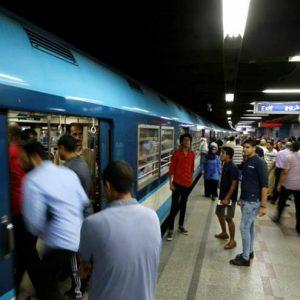
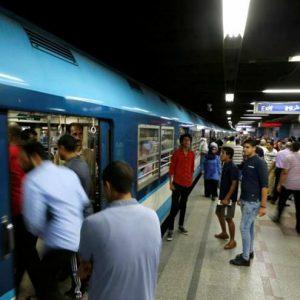
Hours before the beginning of the holy month, Egyptians were surprised by a shocking decision to increase the prices of metro tickets (the most widely used means of transportation in the Egyptian capital, Cairo) by 700% within two months, bringing their price to 7 pounds, after they were only 1 pound 8 weeks ago and no more. At a time when Egyptians are complaining about the sudden rise in the prices of basic commodities before Ramadan, and while they are waiting for decisions that will contribute to reducing this high wave of insane price increases… Egyptians have woken up to the high prices of a new sector in the country, which the government justifies as a continuation of the desired development plans for subway users and the development and modernization of its systems. The Egyptian Ministry of Transport published on its website that the Ministry – represented by the Egyptian Company for Metro Management and Operation – decided to raise the prices of metro tickets starting on the morning of the last Friday before the beginning of this Ramadan, with a transit ticket for nine stations becoming three pounds, 16 stations five pounds, and more than 16 stations seven pounds. The Ministry added that this increase comes within the framework of achieving social justice and to complement the desired development plans for subway users, developing and modernizing the metro systems, and to preserve this vital facility that serves millions of Egyptians daily and to provide distinguished service to passengers.
Public anger
The angry popular reaction began in the virtual world from the first moments of the announcement of the decision, as the new ticket prices resonated on its platforms through the hashtag “Boycott the Metro,” during which the voices of those opposing the decision rose, given that the metro is one of the most important means of transportation in the country and serves a wide segment of Egyptians. More than three million people use the metro daily, according to the official Middle East News Agency. The tweeters pointed out the timing of the decision, as it was taken hours before the advent of the month of Ramadan, with its accompanying high prices and increase in expenses at the family and personal levels, demanding action and boycott of gas stations and transportation companies as an expression of public rejection of the state’s action and its adoption of a policy of collecting money by all means.
Reality ground
Outside the virtual world, the Middle East News Agency said that the Supreme State Security Prosecution ordered on Monday the detention of 20 people for 15 days pending investigations into their role in protests in some metro stations after the government raised ticket prices. The agency said that the Egyptian authorities had strengthened the security presence around the metro stations to prevent further protests after the prosecution ordered the detention of 10 people for 4 days pending investigations on charges of participating in an illegal demonstration at a metro station the next day. The agency reported that on the third day of the decision, the Supreme State Security Prosecution charged 20 people with “committing crimes of association with a group established in contravention of the provisions of the law that works to prevent state institutions from carrying out their work, gathering that disturbs public security and peace, and resisting the authorities,” in reference to the Muslim Brotherhood, which some government officials blamed for the demonstrations.
Al-Sisi: “I don’t have the luxury”
For his part, Egyptian President Abdel Fattah El-Sisi defended the increase in metro ticket prices, saying that this move is necessary to stop the losses suffered by the network. He added at the National Youth Conference: “Do I have the luxury today if I postpone repairing the route like the metro for more than that? No, I don’t.. Are there people who will get tired? Sure. Do we want the country to rise up and remain significant or not?” Al-Sisi continued: “Was it a surprise to you? No… This is a plan that was implemented four years ago in all sectors… in electricity, water and sanitation… there is no other option.” In turn, the government says that raising ticket prices is a necessary measure to maintain the continuation of the service, which is incurring losses, and to finance expansions in the metro network. Government media spokesmen have also previously said to the press that the Ministry of Transportation is suffering from a 94% deficit in maintenance and renovation expenses required for the metro for the past and current fiscal years, in addition to the company’s accumulated losses estimated at approximately 620 million Egyptian pounds – losses that the government decided to compensate for from the pockets of Egyptians.
Where is the escape?
Academically, the head of the Egyptian Center for Media and Public Opinion Studies, Mostafa Khudari, believes that “Egypt is facing lean periods, as the regime seeks, in one way or another, by perpetuating poverty to eliminate what remains of the middle class seeking change,” expecting that this will lead to adverse results. Khudari added to Al Jazeera Net that strategic food commodities are sold in Egypt at a higher price than the world price, with the increase sometimes reaching double, considering that one of the most important reasons for this is “systematic corruption practiced by the ruling regime.”