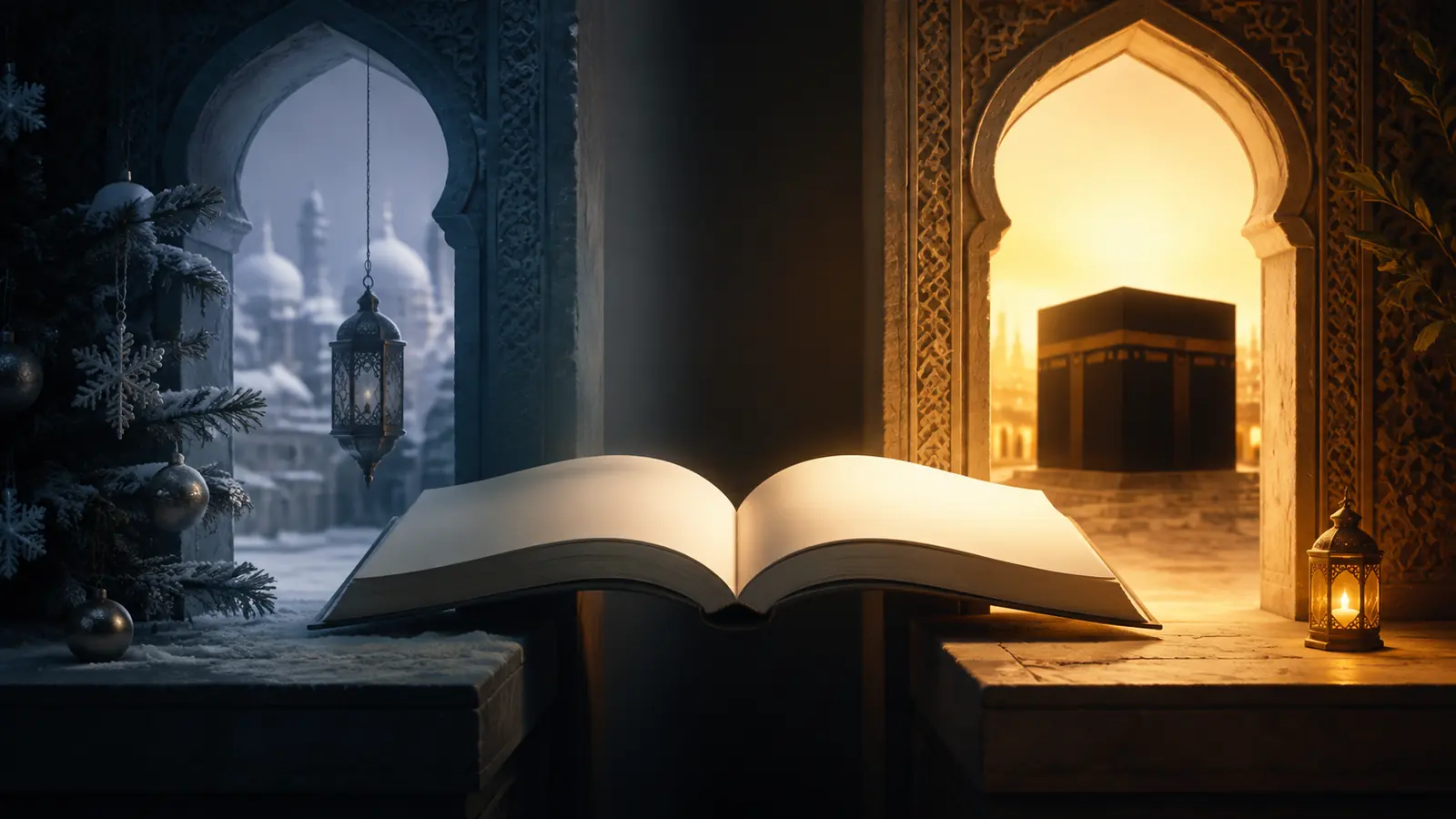

“This rupture between what I have to defend because it is part of my identity and what I reject inside me because I am not convinced of it, this rupture that I inherited from my environment, which has been providing me with contradictions all the time, contradictions that it seems that I will spend my life trying to reconcile or harmonize with.” With this phrase on the lips of the heroine, the writer Ahmed Khairy Al-Omari begins in his novel “Christmas in Mecca”, published in 2019 in 337 pages by the Book Juice Publishing House, to reveal a unique narrative experience full of contradictions and questions, knocking on many doors that no one would have imagined coming together in a single architectural building whose borders are leafy, and these contradictions are reflected on the reader who does not know whether he cannot be patient and moves forward out of excessive suspense, or whether he is afraid of getting closer to the end as he turns. Its pages so that everything and everyone in them does not leave them. This novel represents several situations that we go through in the reality in which we live in terms of our view of many things in common with other people. Each of them may see that he is right from his point of view, while the others from their point of view see that they are right as well. If each of us puts ourselves in the other’s place and sees the matter from his perspective, he will discover that he has even a little right in his position. It is one of the influential novels that can influence our outlook on things, and even open new ways of understanding the situations that we may face in life. In the beginning, the writer will attract the reader’s emotion toward one of the female characters in the novel, then as events develop, the story will appear to him from another angle that will make him realize the situation from the mouth of another party, so that the full picture will appear to him to show that his understanding of the matter was not complete, and therefore any emotion or reaction that he had while reading it was wrong. This is exactly what we experience a lot in our reality. We always hear the story and issue our opinions based on the words of one of its parties, while there are several other parties in the story, and if we heard them, our view of the situation and our perception of it would change.
About the author:
Ahmed Khairy Al-Omari is an Iraqi writer and dentist, born in Baghdad in 1970. He belongs to the Al-Omari family whose lineage goes back to Caliph Omar bin Al-Khattab. Among his notable works are: The Qur’anic Compass and The Borrowed Paradise. He was known as an Islamic writer through his works that combined an innovative approach in presenting topics with a distinctive literary style. In 2010, he was chosen to be the intellectual figure honored by Dar Al Fikr in its annual tradition.
About the novel:
“Christmas in Mecca” talks about events that took place during wartime in Baghdad and about a family that was affected negatively and positively after the events of the war in Baghdad. The family was dispersed until they returned and reunited years later under different special circumstances. The characters are the same, but they have changed over time. They gathered in Mecca, coinciding with the Christmas season, and each of them had a purpose! Events continued after the moment they arrived in Mecca, with them getting to know each other and bringing back the memories that had died inside them, so they revived them again after all these years. After spending some time with each other in Mecca, performing Umrah rituals at that time of the year, and recalling as many memories as possible, he had a nice, spontaneous and strange effect on their trip… It was a nice, emotional trip with deep meanings and experiences, both sweet and bitter.
Novel challenges
From the first threshold of the work – the title – the novel puts us in front of a set of challenges that the writer decided to join us in facing. In fact, the novel was issued in two editions bearing two titles, the first titled “Christmas in Mecca,” while the other edition was issued under the title “Christmas,” as a result of the publisher’s fear of banning the novel in some Gulf countries that might be sensitive to the title, or it is a precautionary measure to prevent the book from being banned from entering some Arab countries that find the title embarrassing.
Novel characters:
This novel has two sections: a historical section that talks about the fall of the last Abbasid caliphs in a poignant and sad way, with a huge amount of information from the character invented by the writer: “Ishaq,” who helped Caliph Ahmad al-Mustansir Billah, son of Caliph al-Zahir, to reach Egypt, and when he tried to return to Baghdad to liberate it, he was killed by the Tatars. In the other part of the novel, the writer talks about an Iraqi family that experienced bitterness, pain, and heartbreak due to sectarian and foreign wars. There is: the mother, Mayada, who is Shiite, married to Dr. Omar, “Sunni,” and she was living in a state of anxiety and asked her husband to leave the country, who in turn was hesitant because he did not want to leave his family and travel. Omar was killed, and Mayada experienced a strong shock, and she and her daughter traveled outside the country… and here the suffering began. As for Maryam, who was studying architecture, she was completely ignorant of the past that her mother lived in and did not know anything about her father’s family. She was the only Muslim girl studying engineering in its connection to Islamic architecture, and hence she needed to travel to Mecca to learn about the secrets of architecture there. As for her uncle, Haider, who lives in a deadly conflict between his conservative Eastern personality and his liberal personality in the West, he needed this ascetic trip to Mecca, to escape from the reality in which he lives. In prior communication and coordination between Mayada and her predecessor Saad, who is only left with him and his father from the Omar family, the meeting takes place in Mecca on Christmas Eve. The details are very beautiful and touching. It ended with the family being separated at the airport again, as if separation was their destiny.
Criticism of the novel:
The novel had positive repercussions among readers, which were reflected in digital book evaluation sites. The writer spoke about the spirituality found in the Grand Mosque, a sacred place with ancient history, architecture, and the peace that surrounds it. It also shed light on the human soul and how time can change it, even if just a little. It was clear in the novel the generational conflict between individuals. Between a university teenager in Britain, a mother from Baghdad who was forced to leave her world to leave behind what the war had left behind, and the aunt and uncle who faced war, death, and estrangement individually with their difficulties, and the grandfather who lived through many different generations and the number of difficult experiences he went through as a former military man. Iraq Army. This contrast in experiences is wonderful and beautiful to experience through a book like this. What is distinctive about this novel is the narration method followed by the writer, as he moved between events in the words of the heroes, to see the different points of view in one event in which there were multiple parties, and how each person is convinced in his point of view and vision of things, so that you reach a state of sympathy with all the heroes.