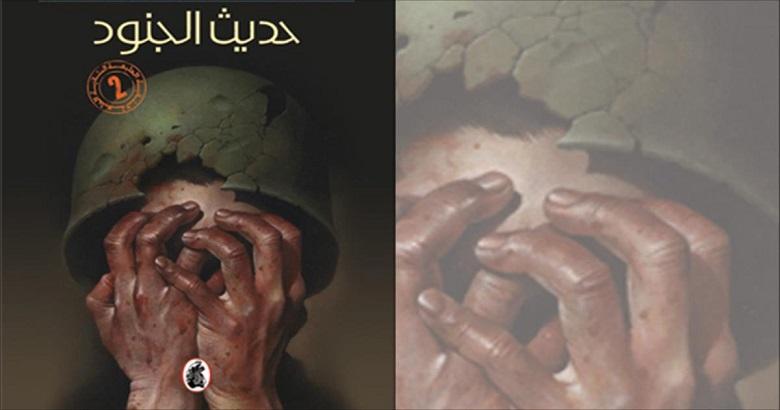
Some stations in life cannot be skipped by a person, and if this person is talented, then that station has attained immortality… because no matter how long time passes, this talented person will return to his memories one day, to bring the events alive again, and leave them on a clear page in which life comes to life until the end of time. This is actually what happened in 1986, when the Jordanian army stormed Yarmouk University to crush the raging student protests against the martial law that was being implemented in Jordan at that time… and between the panic of the students and the screams of the female students, the young student Ayman Al-Atoum was present in his memory amidst the dust of army vehicles that filled the place. Years pass, and Ayman Al-Atoum does not forget the incident, and he strives hard to document its events so that they are not forgotten or distorted. He says: “Whenever I intend to publish these memories, fear and terror rise again, coming from those past events.” Al-Atoum’s documentary work continued in silence, until 2014 came to culminate his endeavor By issuing The novel The Soldiers’ Conversation, in 63 chapters and 470 pages, was published by the Arab Foundation for Studies and Publishing in Lebanon. Three editions of the novel have been published so far.
Introduction to the author
The Jordanian poet and novelist, Ayman Ali Hussein Al-Atoum, was born on March 2, 1972, in the Jerash region in Jordan. He joined the Jordan University of Science and Technology to obtain a bachelor’s degree in civil engineering there in 1997. In 1999, he graduated from Yarmouk University with a bachelor’s degree in Arabic language. He then joined the University of Jordan to complete the postgraduate stage in the Arabic language and obtained master’s and doctorate degrees in the Arabic language, specializing in Grammar and Language in 2004 and 2007.
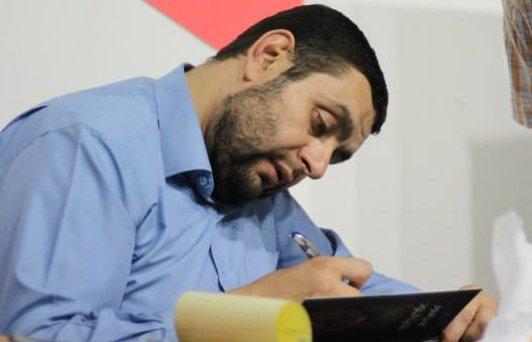
Al-Atoum is best known for his novel, My Prison Companions, which was published in 2012 and expresses the writer’s personal experience in Jordanian prisons during the years 1996 and 1997 as a political detainee, and the novels “The Soldiers’ Talk” and “They Hear Her Feelings.” He also has many poetry collections, the most recent of which is “Take Me to Al-Aqsa Mosque.”
Soldiers’ talk
“Homeland is not geography, it is a value, like love, dignity, redemption, pride, and justice.” This is how the novel begins to address Intrusion events Jordanian security forces and the army at Yarmouk University in 1986 after unprecedented student protests at the university. In his novel, Al-Atoum shed light on the causes of these protests and their consequences in light of the martial law that was applied in Jordan at that time, explaining the role of the leftist forces and the Muslim Brotherhood in the issue in a literary and artistic context. The students of the University of Jordan had revolted in 1978 against the martial law ruling the country, and it coincided with the signing of the Egyptian-Israeli peace treaty. formed”Yarmouk uprising“A special and unique case in the history of the student movement, and perhaps in the history of some political movements, especially the Muslim Brotherhood.” The “Yarmouk Revolution” was the beginning of the group’s return to mass action and protests after long decades of individual advocacy work. The student uprising lasted eleven days, ending with severe repression, arrests, severe beatings, investigation, complete expulsion, partial expulsion, and deprivation of scholarships. Then the page of this uprising was turned, and not much was written about it, even though its suppression marked the beginning of the decline in the Jordanian student community.
Feedback
The novel resonated Public approval With its release in Lebanon, and all copies of the first edition of the novel were sold out, its resonance began to rise until it reached the ears of the Jordanian security services, which quickly took a position on it that was evident in The writer was arrested He was referred to the judiciary for what she described as insulting the security authorities with the novel. The Jordanian Publications Department also banned the circulation and distribution of the novel, under the pretext of Otoum’s submission On trial The case is pending before the court “related to the novel subject to the ban.” The head of the Media Authority said Amjad Al Qadi The Authority’s Publications Department asked the publisher not to distribute the second edition until the judiciary decided on the violations it contained, “until a judicial ruling is issued regarding it by a court specialized in publications issues.” As for WriterHe described what is happening as a ban on a literary novel from circulation, noting that the first edition has been sold out of the market, which practically means that the novel is now banned in Jordan even though it is allowed to be circulated in Arab countries.
Criticism of the novel
Writing history in the form of a novel is one of the most difficult Writing formsBecause this matter is fraught with dangers, not the least of which is falling into the trap of transforming the text from a novel with its own structure, plot, and climax into a text that tells a history whose characters have no features, and the reader has no relationship with them other than the fact that they are the maker or narrator of this history. But Al-Atoum excelled at going beyond the adventure of documentation with the novel, making use of his rich Arabic language and his extensive citations, even though some passages of the novel were not free of useless fillers and descriptions that might force the reader to skip paragraphs and perhaps pages to reach the next step in the events. It is also clearly noted Absence of women Almost completely absent from the presence in the novel, in which we only find women twice, the first time in (Naima), the woman whose husband was martyred on the soil of Palestine and who was a surrogate mother for those who were meeting on the roof of her house to prepare for the revolution. Her personality was one-dimensional, predictable in behavior, full of wisdom, and fluent in language, without us knowing where she got all this wisdom and genius. The second woman was (Soha), whose mention in the last hundred pages surprised us, and who suddenly turned into a leadership figure without us knowing anything about her, and without her being mentioned in the first 300 pages. But in the end, Al-Atoum’s novel came out in a distinctive, creative artistic form, and we praise him for his efforts to document the facts of that neglected period despite its importance in the history of Arab and Jordanian student work, especially since those who committed this tragedy were not punished, but on the contrary; The one who forced the army and desert forces to attack unarmed students was promoted from the position of university president to later become prime minister. But the cruelty and importance of the event that the novel tells us is not an excuse to ignore the techniques that make the novel a novel, nor is it a justification for leniency with a text that is supposed to strive towards immortality.