She says Cinematic legend In the world of Hollywood, the golden age of crime films actually began after women writers entered the field, and the imagination of male authors remained pale in the face of the unprecedented creativity of women. You cannot review the history of detective work and crime cinema without pausing for a long time in front of the British writer Daphne du Maurier, the author of the film “Rebecca,” who won one of the oldest Oscars for best picture in 1941. The literary and fictional field has not been isolated from submitting to the same rule, since the English writer B. D. James, whose The policeman series Adam Dalglish, the American Patricia Cornwell, the author of the popular “Scarpetta” series, and her compatriot Mary Higgins Clark, the author of the novel “But Where Are the Children?” The most famous writer for creating mystery and suspense is the English writer Ruth Rendell, the author of the “Inspector Wexford” novels. But despite the overwhelming presence of women in crime works, the English Agatha Christie remains the greatest author of detective novels in modern history, with more than a billion copies of her novels sold, translated into more than 103 languages, and she dealt with crimes in all societies, even foreign ones, with high professionalism, as if she had lived for many years in those distant societies. Agatha was famous for writing the most popular mystery stories among the public. She wrote more than 66 detective stories that were distinguished by her ability to create imaginary characters, such as the frightening character of Miss Marple, who appeared in 12 of her novels, and the character of Hercule Poirot, and among her most famous works; “Murder on the Orient Express,” “Murder on the Nile,” and “The Curtain.”
Her birth
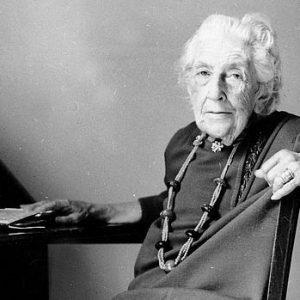
Agatha Christie was born in the British town of Torquay in 1890 to an American father and an English mother. Christie described her childhood in her novels as “very happy,” and she was surrounded by a group of women who gave her a strong and independent personality from an early age. Christie says about herself – in her unique interview with author Janet Morgan, which she turned into a book about her autobiography: “I spent a childhood filled with the utmost happiness, almost free of the burdens of private lessons. I had plenty of time to wander in the vast flower garden and swim with the fish as I pleased!” The credit for this goes to my mother, who facilitated my direction towards writing. She was a woman with a charming personality, a strong influence, and she firmly believed that her children were capable. To do everything.” As for her tendency to write horrific writing, she says: “One day, when I had a severe cold that forced me to bed, my mother said to me: ‘It is better for you to waste time by writing a short story while you are in bed.’ Then I tried and found pleasure in the attempt, so I spent the next few years writing heart-wrenching stories! Most of the heroes die! I also wrote pieces of poetry and a long novel, in which a huge number of characters crowded together so that they would mingle and disappear due to the intensity of the crowd. Then it occurred to me to write a crime novel. So I did, and I was very happy when the novel was accepted and published. When I wrote it, I was a volunteer in a Red Cross hospital during World War I.” Christie worked in a hospital during World War I before marrying and raising a family in London. She said that she had an unsuccessful start in publishing her work. But in 1920, her novel (A Mysterious Case) was published in Rais Badli newspaper, and from here her literary career began.
Her luxurious life
Agatha received her education at home, like many girls from well-off families, according to tradition at the time. Then she joined a school in Paris, combining learning and training in music with visiting many museums and exhibitions in France. She returned to England when she was in her twenties, until her first marriage was to the British soldier (Archie Christie) in 1914, and from him she took her surname, which remained with her throughout her life, until her separation from him in divorce after she gave birth to her daughter, Roseland, from him in 1930. Agatha Christie married for the second time to Max Mallowan, the well-known archaeologist, after she met him on one of her travels to the East, where she lived with him in Syria and Iraq while he was conducting his research. She was 39 years old at that time while he was 26 years old. Her second marriage allowed her to visit most of the countries of the Near and Upper East, so she toured the Levant, Iraq, Egypt, and Persia. This wandering provided her with excellent opportunities to write her most beautiful novels and stories, full of secrets and full of ambiguity, relying not only on the locations of the event in the magical countries of the East, but also on the writer’s wild imagination, her flowing, fluid language, and her unique ability to create mysterious and exciting characters and move them throughout the novel in different directions that amaze the reader.
Her work is writing
Christie officially joined the British excavation mission in Nineveh, northern Iraq, headed by Dr. Thomson Campbell, and then to the Arbajiyeh expedition in 1932, headed by her husband. In addition to her excavation efforts, she found enough time to write, so much so that when she did not have housing at the archaeological site, she would set up a special tent for herself, a little away from the noise of the digging, where she would write her novels and stories inside. Regarding his shared life with Agatha, Mallowan says in his memoirs: “We lived in a small house with a garden at the bottom of the hill of Prophet Yunus, and the hill also included the armory of Sennacherib – the Assyrian king. It took twenty minutes on horseback from our house to the top of Nineveh’s Qoysanjak Hill, and from the summit we overlooked a comprehensive view of the landscape and history, and from a height of a hundred feet above the plain to the west, we looked out onto the steep banks of the fast-flowing Tigris River. Not only this, but it was often… She prepared for the long Mosul winter by purchasing quantities of wood to seek warmth whenever the cold season approached, and she paid generously to the Kurdish caravans that sold the wood.” He continues: “And in this sparsely furnished house, Agatha once needed a table on which to write her novel (Lord Igwer Dies). So she went to the Mosul market and bought a table for three pounds, which Dr. Campbell, head of the excavation committee, considered an extravagance.
Agatha Arabic
Agatha Christie spent her honeymoon with her husband, Sir Malone, in the village of Ain al-Arous on the banks of the Balikh River and the beautiful forests of Ain al-Arous and its wonderful archaeological hills, where her husband was on an archaeological mission in the Syrian Jazira during her frequent visits to Syria, accompanied by her husband, an archaeologist who was working in one of the archaeological sites in northeastern Syria. Agatha Christie lived in a hotel in the city of Aleppo, the Baron Hotel, which was the destination of celebrities, especially from Europe, and those coming on the Orient Express to Aleppo. She wrote her famous story “Murder on the Orient Express” during her stay in Aleppo, and her memory remains in one of the corners of the ancient hotel, the Baron Hotel, to this day. She was fascinated by Aleppo, the grandeur of its citadel, and its magnificent eastern markets, and she wandered the ancient hills in central and eastern Syria. Christie toured in Syria, Egypt, Jordan, Palestine, and Persia, and in each archaeological site she had a novel or story, including her story (The Pearl of the Sun), which represented a recording of her visit with her husband to (Petra) around the years 1933 and 1934. As for the novel (Appointment with Death), in its fifth chapter in particular, it describes the splendor of the building of Al-Aqsa Mosque, the grandeur of the dome built on a high rock, and the beauty of its engravings. Likewise her conversation with the Arab guide who accompanied them in one of the archaeological hills on the Syrian Jazira, and she also did in her story (A Star Over Bethlehem) in 1965. The writer visited Egypt and studied its civilization and history and wrote the well-known novel (Death on the Nile), which was turned into a play in 1946 under the title (Murder on the Nile). She also wrote the second novel (Death Comes in the End) in 1945. She had also written the play (Akhenaten), the Egyptian king who imposed A new religion. Agatha Christie had been preparing to write this play since her visit to Luxor in southern Egypt in 1931. She used the expertise of archaeologists to draw the characters for the play, which was published by a publishing house in 1973. By the time she reached the age of eighty-five, she had produced (85) books at a rate of one book per year, a high number that reflects the ability to produce and write. Her husband (Malwan) asked in his memoirs: (How do we explain this phenomenon? It results from a permanent state of unbridled imagination).
The incident of her disappearance
One of the important situations in her life was that in 1926, Agatha Christie disappeared for ten days, and no one knew the reason for that disappearance, but speculation attributed the process to her fear of losing her mother or being affected by her loss, but Janet Morgan, who wrote her biography in 1985, attributed the reason to a great emotional shock due to the failure of her marriage to Archie Christie. She concealed many of the circumstances of her divorce as well as the details of her disappearance, which Morgan says was due to her shock. Agatha’s memory was partly so that she left her car on the road, went to a hotel and was asking people who I was until a relative recognized her.
Its written approach
In Agatha’s stories, novels, and plays, we find a huge amount of mysteries and mysterious plots, whether in the narrative structure, dramatic architecture, dialogue, or characters, but even in the choice of locations for events that are often interesting: archaeological sites, oriental cities, temples, palaces with character, distinctive hotels, trains or planes, cut-off desert fjords, rivers with a history. Usually, the writer resorts to a narrative technique based on trickery or trickery, as a method of excitement and suspense full of mystery, an engine for her fertile imagination, that lures her flowing language into a continuous stream of abstract prose narration, sometimes characterized by redundancy and prolongation, in order to keep boredom away from the reader. She intends to insert some puzzles and symbols that can be interpreted and contradictory at the same time, and in this way she draws the reader to follow the event without taking him away from the main focus of the dramatic structure that she planned with perfection, so that her work does not come out flat and crude. In a few cases, she intends to insert an incident from her life into a novel or story after a camouflage procedure that wastes the opportunity to reveal its truth. This is what Malwan pointed out in his memoirs regarding the novel (The Cavity). Al-Masrahah, he says, “There is a reference related to an event in my life that I would like to mention. Sir Henry says in the novel: “Do you remember, my dear, those wretches who attacked us that day on the Asian side of the Bosphorus? I was fighting two of them who were trying to kill me, and what did Lucy do? “I fired two shots. I didn’t know she had a gun… It was the hardest escape of my life.” This is a true story. The only difference is that Agatha, unlike Lady Ancatelle in the novel, had armed herself not with a pistol but with a round rock. Agatha Christie, as a crime novelist, did not take the events of her novels from police or court records, as did other crime novelists, such as Truman Capote’s novels “Premeditated and Premeditated” in 1967 and Norman Mailer’s “The Executioner’s Song.” 1979, (I Accuse) Graham Greene 1981, and (Murders in Atlanta) James Baldwin 1985, as well as various Somerset Maugham stories.
Distinctive curriculum
However, despite this, there is an approach that remains distinctive to Agatha’s writings. She stays away from the symbolic interpretation of the event and gives the reader the pleasure of reaching the realistic interpretation, deciphering the ambiguities, and diving into the sea of magical intertwining of the novel’s characters’ relationships with each other on the one hand and with the event on the other hand. She places everyone: the reader, the event, and the heroes of the novel, under the awe of the sanctity of the place she chose as the scene of her events. This location, as we mentioned, is often legendary and magical! Another advantage: she moves her heroes and characters according to dramatic formulas crowded with backgrounds and details, and the heat of events escalates to shock the reader with heartbreaking endings. However, the writer presents the tragedy of bereavement as a passing event that the entertained reader accepts as inevitable! This is what life is like in Agatha Christie’s opinion: “A continuous, sweeping stream full of details and vocabulary that does not stop to wait for anyone or to grieve for them, as if by doing so they predicted their endings.” Agatha Christie has been known as the “Queen of Crime Literature” for the plethora of classic forms that she has exhibited, or said she has provided the most famous example of. The course of his books was as follows: a murder occurs, many suspects, hidden secrets, and the detective gradually discovers these secrets throughout the story, and the most shocking secrets are discovered at the end. Also, the suspects are collected and the facts are revealed to them in a logical manner.
The writer’s demise
Her passing was on January 12, 1976, and Mallowan describes it by saying: “When I reached the last pages of this memoir, my dear Agatha passed away peacefully while I was pushing her wheelchair into the living room after lunch… Few people know what it means to live in harmony next to an imaginative, creative mind that inspires life with vitality.” Agatha Christie was a truly amazing novelist. She possessed her own language, style, and way of constructing the novel. She maintained a strong memory that served the succession of events in her novels and stories. She excelled at moving her heroes according to the dramatic context she chose for each novel… She used puzzles, myths, and historical or contemporary facts alike, with the same degree of clarity or ambiguity.