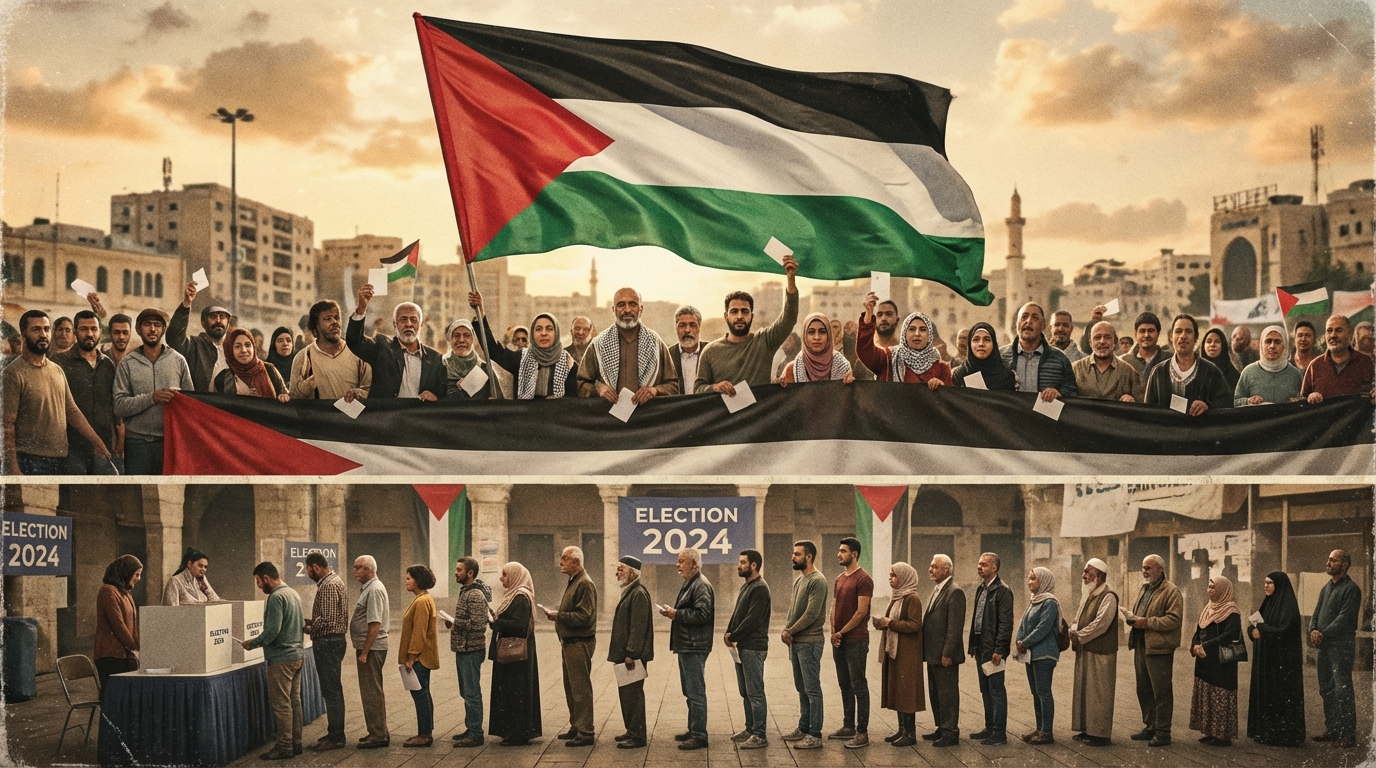
Hamas wins a majority of seats in the Legislative Council
The Israelis and their allies in Abu Dhabi remember well that in the last Palestinian elections held in 2006, Hamas With a majority of seats in the Palestinian Legislative Council, which put the resistance, for the first time, in the position of direct decision-making, which confined Israel to a corner, always ready in the face of constant expectations, of an official Palestinian escalatory step at any moment, in addition to Israel losing its permanent and continuing ally, in security coordination from Fatah movement Never lost him. Today, after the Central Elections Commission in Palestine completed the first phase of its ongoing preparations to hold the elections by closing the application window and officially receiving the final lists of competitors, talk began about the chances of the political forces to obtain seats in the elections, and it seemed clear that all indicators were pointing towards the winner, whom no one wants except the Palestinians: the Islamic Resistance Movement, Hamas.
Competition between Fatah and Hamas lists
36 electoral lists, which will compete for the 132 seats in the Legislative Council, were able to register for the elections, at a time when the last hours, before the closing of the application period, brought many surprises, the most prominent of which is the presence of 3 Fatah movement lists, competing with each other, which are: the movement’s central list, the freedom list headed by Nasser al-Qudwa, in alliance with Marwan Barghouti, and the Future List, affiliated with the Emirati movement, for the Fatah movement, headed by Muhammad Dahlan. This has opened the door to speculation about what the results of the upcoming elections might look like, and whether the dispersion of Fatah lists could serve the unified list of the Hamas movement. As well as the role of other competing lists, such as the four lists affiliated with the leftist forces, 28 lists affiliated with the Independents Movement, and the youth and trade union movements.
Scenario 2006
It seems clear that according to the competition map between the Palestinian political forces, expectations place a narrow margin of victory for independents, compared to higher chances of winning in relatively high percentages for factional-oriented lists, because the two poles of the Palestinian situation, Hamas and Fatah, will be within the circle of interest of the Palestinian voter, especially Hamas, which enters the elections with a unified list, and will be the biggest beneficiary of the dispersion of Fatah votes, which enters the elections with three competing lists, which means the dispersion of the Fatah voting bloc, in three separate directions. In the 2006 elections, the number of lists that competed for seats in the Legislative Council reached 11 lists, of which only 7 lists won, and the number of those entitled to vote reached 1.3 million Palestinians. As for the 2021 elections, the situation is significantly different, as the number of competing lists more than tripled, from 11 to 36, while only one Hamas list remained, and the number of those entitled to vote reached 2.5 million, according to the law. The election, which set the electoral threshold at 1.5%, means that each seat in Parliament needs 37,000 votes. These indicators lead to the possibility that we will witness a repeat of the 2006 experience, with Hamas taking first place, taking into account the difference in winning percentages, because the proportional representation system prevents any list from obtaining percentages exceeding 50%.
Dahlan.. The Emirates card
It seems clear to everyone, then, that Hamas is close to deciding the elections, which has led Abu Dhabi to try to put its mark on obstructing this democratic transformation that is dangerous to Israel’s security. It pushed a movement headed by Muhammad Dahlan, the representative separated from the Fatah movement, into the West Bank, to clash with the authority of Mahmoud Abbas and make him feel a real threat to the Palestinian presidency, which may prompt the latter to cancel the elections for fear of his position. Dahlan represents a real danger to the President of the Palestinian Authority, as Dahlan represents a suitable alternative to Abu Mazen, in the eyes of the UAE and Israel, in order to pass the deal of the century, which faltered with the departure of former US President Donald Trump. It seems that Abbas is aware of this danger, so he began a large-scale security campaign, inside the Al-Amari camp in the center of the city of Ramallah, to arrest a number of cadres and leaders of the Dahlan movement, and to close the institutions and associations that he supervises in the camp.
Emirati normalization
The Palestinian Authority believes that the UAE’s normalization of its relations with Israel is a prelude to bringing about changes at the level of the authority’s internal situation, by putting forward the name of Muhammad Dahlan as one of the alternative figures for Abbas, in the event that he is unable to continue performing his presidential duties, because he is over 85 years old, or has been absent from the political scene, due to external Arab-American-Israeli pressures. The authorities’ fears of this scenario increased after the US Ambassador to Israel, David Friedman, told the “Israel Today” newspaper that “the American administration sees in Dahlan a reliable person to lead the next stage after Abbas.” Perhaps also for this reason, the Authority began the option of going for an early reconciliation with Hamas, and agreeing with it to enter into a joint government, as this may not have stemmed from the fact that the Authority and Fatah were in a position of strength, as much as it reflects the Authority’s fear that Dahlan would seek to form political alliances that would allow him to reach the presidency.