The day the Ottoman Caliphate officially fell in 1924 AD, represented a turning point in the history of the Islamic nation, as its political, cultural and religious unity was broken, and it began to face an existential challenge that threatened its unity and identity. Despite the serious efforts to unify the Islamic nation after the fall of the Caliphate on the political and cultural side, which produced movements, most notably the Muslim Brotherhood (1928), the religious side has remained a major problem since the fall of the Sublime Porte (the official Ottoman religious institution), due to the multiplicity of Islamic sects and the reliance of Western powers on inciting strife and sectarianism. Therefore, the birth of the Union of Muslim Scholars (2004 AD) represented the most prominent of the completed attempts to eradicate sectarianism and unify the Islamic nation from a religious standpoint. This was evident in the speed of response it received from thousands of Muslim preachers and scholars around the world from various sects, and the extended relationships it established with inclusive Islamic institutions and bodies.
Definition
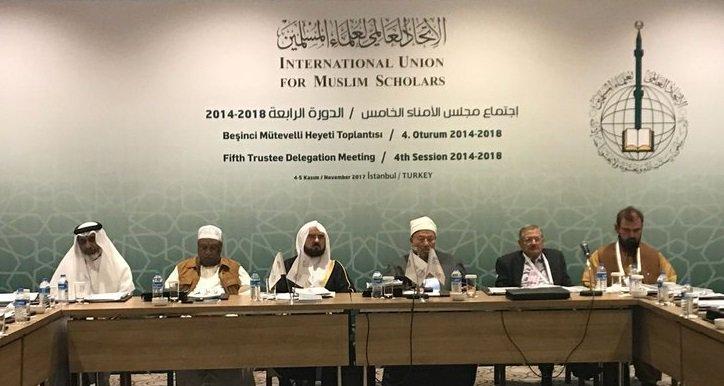
The International Union of Muslim Scholars is an Islamic institution that brings together Muslim scholars from various countries of the world. It was founded in July 2004 and held its first general assembly in the British capital, London. It was registered in the Irish capital, Dublin, and actually carries out its activities from the Qatari capital, Doha. It has been headed by Sheikh Ahmed Al-Raysouni since November 7, 2018, succeeding the founder, Dr. Yusuf Al-Qaradawi, and he is represented by the Shiite Sheikh Muhammad Waiz Zada Al-Khorasani, and the Ibadi Mufti of Oman, Sheikh Ahmed Al-Khalili. The Union was formed by scholars with knowledge and experience, and in a short time it became one of the largest unions of this kind in the Arab and Islamic world alike, after it included under its banner more than 90 thousand Muslim scholars from various sects, including Sunnis, Shiites, and Ibadis. According toUnion website On the Internet, its membership is open to scholars who have graduated from Sharia universities and hold a high degree in Islamic studies from various relevant universities. The Union also accepts membership for those who have a presence in the sciences of Sharia and Islamic civilization through their writings in this field.
His intellectual reference
The Union does not belong to any country, group or sect, according to its official definition, nor is it hostile to governments, but rather seeks to open windows of cooperation for the good of Islam and Muslims. Sheikh Yusuf Al-Qaradawi is the first president of the Union and one of the prominent symbols within it. He is an Egyptian scholar who lives in the State of Qatar. He has a very strong influence in all Islamic and Arab circles. He is one of the historical figures of the Muslim Brotherhood, although he has not been an organizational member within it since the end of the nineties.
Its definition and objectives
The Union is an open gathering for all Muslim scholars in the world. It is concerned with scholars who are graduates of Sharia colleges and Islamic departments, and everyone who is interested in Sharia sciences and Islamic culture, and has significant production or tangible activity in them. The Union has features and characteristics that distinguish it from others, according to the organization’s location, which are referred to as follows: – Islamic: It is a purely Islamic union, composed of Muslim scholars, works to serve Islamic issues, derives its approach from Islam, and is guided by it in all its steps. It represents Muslims of all sects and sects. – Global: It is neither local nor regional, nor Arab nor Persian, nor Eastern nor Western. Rather, it represents Muslims in the entire Islamic world, as well as Islamic minorities and groups outside the Islamic world. – Popularity: It is not an official governmental institution, but rather derives its strength from the confidence of the Muslim peoples and masses in it. But he is not hostile to governments, but rather strives to open windows for cooperation with them for the good of Islam and Muslims. – Autonomy: He does not belong to any state, nor to any group, nor to any sect, and he is only proud of his affiliation to Islam and its nation. – Scientific: It is an institution for the nation’s scholars, so it is no surprise that it is interested in science, teaching it, scientific heritage, reviving it, investigating it, and disseminating it. – Advocacy: It is an institution concerned with calling people to Islam by tongue and pen, and by all legitimate contemporary means, whether read, audio or visual, committed to the approach of the Qur’an by calling with wisdom, beautiful exhortation, and arguing in a way that is best. – Moderation: He does not tend toward exaggeration and excess, nor does he tend toward shortcomings and negligence. Rather, he adopts the approach of the middle nation, which is the approach of mediation and moderation. – VitalityIt is not satisfied with mere banners and advertisements, but rather it is concerned with work and construction, and recruiting scientific competencies and practical energies, led by a group of scholars known for their jurisprudence in religion, uprightness in behavior, courage in the truth, independence in their stance, and who have gained acceptance among the masses of Muslims.
Honorable positions
The first prominent positions of the Union towards the Palestine issue came when a jurisprudential controversy arose during the founding of the Union in 2004 over the ruling on martyrdom operations in Palestine, which the Palestinian resistance has resorted to since the Zionist forces led by Ariel Sharon invaded the Gaza Strip. At a time when international newspapers used the description “suicide bomber” when talking about martyrs, the Union, through its president Al-Qaradawi, issued a statement that considered martyrdom operations a sacred act that elevated its perpetrators to a high status of martyrdom. During an interview with the BBC, The broadcaster asked Sheikh Al-Qaradawi about the “suicide” attacks in Palestine, and he replied: “They are not called suicide operations, but rather they are martyrdom for the sake of God.” The Union also plays a political role in Arab countries through mediation efforts, but its ultimate and primary goal is Islamic issues, according to its official website. For example, the Union tried to mediate between the various factions in Egypt before the 2013 coup, and it also tried to calm the situation in Yemen before the Houthis seized power and the beginning of the Yemeni war.
Charges and penalties
The Union’s insistence on supporting the cause of Palestine and the resistance movements and rejecting their description of terrorism and extremism opened the fire of the international Zionist lobby against the Union and its president, and prevented a number of its members – led by Al-Qaradawi himself – from traveling to the United States of America and the United Kingdom, on various occasions. The Zionist media reported that the founder of the union had made remarks that clearly indicated his anti-Semitism and anti-homosexuality, and the latter was actually confirmed by the founder of the union in a statement in which he said that homosexuality is not human nature but rather an abnormality of nature. As for the Arab world, the Union enjoyed broad and strong relations with a number of Arab governments and bodies, but the position of the Union and its president regarding the Arab Spring revolutions, which he supported immediately after their launch, disturbed its presence in Arab governmental circles, and it began to face unprecedented restrictions and siege. With the beginning of the Gulf blockade of Qatar in June 2017, the blockading countries (Saudi Arabia, the United Arab Emirates and Bahrain) placed the International Union of Muslim Scholars on the terrorist list. On November 7, 2018, the president and founder of the federation, Yusuf al-Qaradawi, announced that he would hand over his presidency to Sheikh Ahmed al-Raysouni, a Moroccan scholar, and on his behalf would be the Shiite scholar Muhammad Waizzada al-Khorasani, and the Ibadi Mufti of Oman, Sheikh Ahmed al-Khalili, from the Ibadi community.