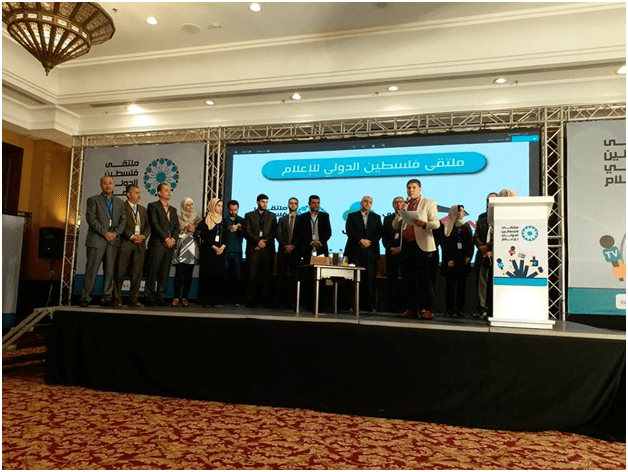
Part of the conference – Image source: Social networking sites
The Palestine International Media Conference, whose activities began for two days on October 15 and 16, 2018, shed light on the Palestinian scene in the local, Arab and international media, and presented many visions for overcoming the weaknesses found in “media of the Palestinian issue,” enhancing its strengths, and advancing the resistant media discourse at all levels. The conference, which is the first of its kind in Palestine, was organized by Zoon Media and Training Company, in the presence of Ghada Owais, news anchor for Al Jazeera, Ashraf Abu Al-Houl, deputy editor-in-chief of the Egyptian newspaper Al-Ahram, journalist Donald McIntyre from the British newspaper The Independent, and a number of Arab and Palestinian journalists. Its preparatory committee hopes that it will become an annual tradition. The first session of the conference discussed the standards for covering Palestinian news on Al Jazeera, as it is the channel with the highest presence in the Arab arena. In this context, Ghada Owais, a broadcaster on the channel, said: “We at Al Jazeera side with Palestinian news and support this issue, because the media must be objective and side with the truth, whatever it may be.” As for the second session, it touched on the presence of Palestine news in the international media, and journalist Donald McIntyre, who specializes in Middle East affairs at the British newspaper The Independent, gave a speech in which he spoke about the truth about the bias of the Zionist media at the expense of the Palestinian media. The speech of Palestinian journalist Abeer Ayoub highlighted the controls for Arab institutions’ transmission of news from the Zionist media, stressing that the most prominent of these controls is that “news that we cannot obtain ourselves can be taken from Hebrew sources and revised, and in the case of quoting, the journalist must be familiar with the Hebrew language, and not rely on translations.” For her part, Wafa Abdel Rahman, editor-in-chief of the Nawa Feminist Network, raised questions about the professionalism of the local Palestinian media, and the extent of its commitment to ethical standards, saying that “many of the local Palestinian media platforms are unfortunately unprofessional, as most of them are partisan and biased, mostly promoting hate speech and national discord.” Regarding how the Palestinian media can achieve professionalism, Wafa Abdel Rahman believes that “journalistic work must serve national goals and protect our humanity because we insist on our moral and human superiority as bearers of a just cause, and in order to restore the character of professionalism to the Palestinian media.” In turn, the head of the government media office in Gaza, Salama Maarouf, participated in a speech in which he stressed the most prominent problems of the Palestinian media, particularly the absence of a unified national strategy and vision agreed upon in the media, and the lack of common denominators of an agreed-upon media policy. According to national borders and the absence of a unified dictionary of terms. Marouf also confirmed that one of the most important problems facing the resistance media is dependence on the partisan and sectarian agenda and its directives at the expense of professional rules and ethics, and the structural defect in official, partisan and private media institutions, at the level of decision-making centers, their goals and content, in addition to the occupation’s violations that Palestinian work teams are exposed to. At the conclusion of the conference, the preparatory committee came out with several important recommendations, most notably the call to consider next year 2019 as the year of saving Jerusalem in the media, by calling on all media outlets to intensify work to develop a unified strategy, and to communicate with Arab media outlets to return the Palestinian issue to the forefront of the Arab media scene. The conference also called for adopting media policies that embody national unity and enhance the unified vision by presenting a message based on social and national responsibility and journalistic work ethics, paying attention to young male and female media professionals, working to employ their energies away from exploitation while guaranteeing their professional rights, and supporting the efforts of the Journalists Syndicate in seeking to achieve a collective work agreement that guarantees the dignity of the Palestinian journalist. He stressed the necessity of strengthening the presence of female journalists within the Journalists Syndicate and representing them by no less than 30% in all its bodies, standing up to laws, legislation and practices that restrict freedoms of opinion and expression, confronting internal violations against journalists, and working to issue an applied guide to publishing ethics, as well as appointing official spokesmen in different languages to communicate with the Western media according to its culture and language.