Islamic rule was established in India, its feet were established, and a state was established for it since the Mujahid Sultan Mahmud al-Ghaznawi began his great conquests in India in the year (392 AH – 1001 AD), and it extended for more than eight centuries, during which states and ruling families succeeded one another, and people were blessed with security, peace, justice, and equality, and civilization flourished in a way that its remaining traces in India still catch the eye and dazzle the minds and minds. The Mughal Empire was in India was the last Muslim country to rule India, and its rule lasted for about three centuries, since it was founded by Zahir al-Din Babur in the first half of the tenth century AH. A number of great sultans succeeded in ruling it, most notably Sultan Jalal al-Din Akbar, who led the country to a great renaissance and succeeded in organizing a government that historians agreed was accurate and strong, and Sultan Shah Jahan, who was famous for building the Taj Mahal tomb for his wife, Mumtaz Mahal. It is considered one of the masterpieces of architectural art, and one of the known wonders of the world. Sultan Aurangzeb adhered to the Sunnah and supervised the encyclopedia known as the Indian Fatwas or Alamkir, named after Alamkir, a name by which he was famous in India. Then, in the year 1009 AH, the state weakened after strength, and its men devoted themselves to caring for their own interests and devoting themselves to the treasures they obtained in their conquests, and Nader Shah the Persian took advantage of the decline of the Mongol state in the country. India, so he marched on it in the year (1153 AH – 1740 AD), and he caused destruction and devastation in Delhi, the capital of the state, and used the sword on its people. He returned to his country carrying huge spoils. These conditions helped the British to march to control India with their cunning policy and deceptive method under the guise of the British East India Company, and the situation ended with the British entering “Delhi” at the beginning of the nineteenth century AD, and extending their authority in Punjab. They aspired to occupy the country of the Afghans, but they were surprised by the courage and valor of its people, so they abandoned this plan in despair. During the period in which the British took control of India, the Muslims lost the authority and influence they had enjoyed, the control of the reins of affairs, and resort to the holy law in all matters, and the Sultans of Delhi had no power to rule, and the English persisted in their tyranny, so they intended to change the Islamic character of some of the Indian regions of great importance, such as, and to. Fighting Islamic education and seizing Islamic endowments, and fanning the fire of hostility between Muslims and other sects.
The last rulers of Beni Timur
Abul Zafar Siraj al-Din Muhammad Bahadur Shah Zafar, also known as Bahadur Shah or Bahadur Shah II (Doom) (24 October 1775 – 7 November 1862) was the last emperor of Mughal India. He was the son of Akbar Shah II and his Hindu wife Lalbhai. He became emperor upon his father’s death on September 28, 1838, and Zafar wrote his Urdu poems under the pseudonym (Takhlis). In light of this deteriorating atmosphere, Bahadur Shah II assumed power in India in the year (1254 AH – 1838 AD), succeeding his father, Sultan Muhammad Akbar Shah II. During his reign, the British had tightened their control over the country and imposed their influence on the Sultans of India, who were receiving financial salaries from them, and they became as if they were their employees, and their obstinacy and the extent of their influence were such that they controlled who entered “Delhi” and who left. Among them, the reign of Bahadur Shah II was not better than the reign of his father. The British policy is still based on placing the affairs of government in their hands, while the rule remains in the name of the Muslim Sultan, and his name is mentioned in the mosques, and money is minted in his name. This was a malicious act by which they differentiated between the ruler and the king, who was considered a symbol of Islamic rule, and they ruled in his name as his representatives. The Muslim scholars in India became aware of this deceptive act, so they opposed this policy and stood up to it. They said: “It is inconceivable that there would be an Islamic king without rule unless we imagine the sun without light.” When this situation became prevalent in India, they announced that it had become a place of war, and the Muslims must wage jihad against the British until they return rule to its people. Even this shameful situation of the Muslim rulers did not last long, as the British announced that they were on their way to eliminate him, so they issued a warning to “Bahadur Shah II,” who was a prisoner of the Red Fort in which he lived in “Delhi.” Influence or authority – that he is the last king to inhabit the castle, and that it will become a military barracks, and that the allocations he takes from them will be cut off after his death, and this meant the elimination of the Mughal state in India, and this news had a thunderbolt effect on the Muslim people in India.
Revolution ignites in India
There was general dissatisfaction in India with the presence of the British who were plundering its resources and practicing an arbitrary and unjust policy against Muslims. Souls were rippling with anger and experiencing revolution and boiling, waiting for the appropriate opportunity and a leader around whom they could rally and struggle under his banner. Northern India was the region most prepared for revolution, where Muslims were numerous, and the British’s oppressive policy that mocked Muslim beliefs and worship prevailed. There is a consensus that it was the Muslim and Hindu soldiers in the British army camped in its barracks in Mert, which is located about 90 kilometers north of Delhi, who started the revolution and fanned its flames. The stubbornness of the English officers and their disregard for the soldiers’ beliefs was behind their revolt and anger, after they forced them to cut off the congealed fat used to lubricate guns with their teeth. This fat was composed of pig and cow fat, so the soldiers complained about this, considering that cows were forbidden. It was forbidden for Muslims to eat pork for Hindus. However, this grumbling increased the English officers’ arrogance, so they punished the complainers. Soon, their colleagues broke out in a massive revolt in the camp, out of anger at their pride and dignity, on (26 Ramadan 1274 AH = May 11, 1858 AD), and they attacked their English officers, killed them, and set off for “Delhi” declaring the revolution, and it quickly spread. Its flames spread throughout Delhi and its environs.
Bahadur Shah, leader of the revolution
Muslim scholars called for a meeting in the Jami’ Mosque in Delhi, and issued a fatwa declaring jihad, which was signed by many prominent scholars. It had a great impact in supporting the revolution and bringing people together for sacrifice and jihad. The Muslim and Hindu revolutionaries united and chose Bahadur Shah as commander-in-chief of the revolution, and this was an indication of everyone’s satisfaction with Mongol national rule. The revolution took place in Delhi without careful prior planning, and it lacked a conscious leadership that could control the revolutionary movement. Bahadur Shah was not fit for this role due to his old age. The British were able to reorganize themselves and assemble Indian forces from loyal princes in some areas of India. The “Sikhs” joined them and were extremely hostile to the Muslims, which helped them resist the revolution and eliminate it in Delhi and other areas that broke out on the 28th of Muharram 1274 AH – September 19, 1857 AD).
The brutality of the English occupier
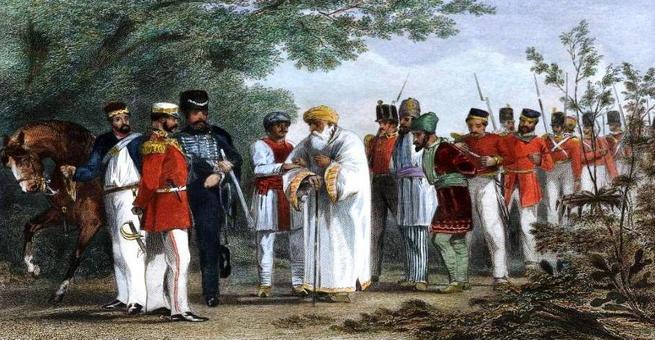
After the failure of the revolution, the British captured Bahadur Shah and his family as prisoners, and led them away in chains in humiliation and humiliation. On the way, one of the officers fired bullets from his rifle at the king’s sons and grandchildren, killing three of them and cutting off their heads. The English were not satisfied with their degrading behavior by mutilating corpses, but rather they surprised the king while he was in prison with something unimaginable meanness and disgrace. When they served food to the king in his prison, they put the heads of the three in a bowl, covered it, and placed it on the table. When he came to eat the food and uncovered the cover, he found the heads of his three sons with their faces covered in blood. But the nature of arrogance and pride rose above the event and above sadness and alarm, so he said steadfastly while looking at those around him: “The brave children of Timur come like this to their fathers with their faces red,” a metaphor for victory and victory in the Urdu language.
Trial of Bahadur Shah
After the arrest of Bahadur Shah, the British began a mock trial in Delhi on (10 Jumada al-Akhirah 1274 AH = 26 January 1858 AD), and accused him of cooperating with the revolution, along with his son Mirza Mughal, against the British, and that he had ordered and participated in the killing of British men, women, and children. It was a false accusation, and what is proven is that when he took over the leadership of the revolution, his orders were clear not to attack them. After the trial sessions, the judges issued a death sentence, then the sentence was commuted to the city of Rancon, the capital of Burma. The banishment was carried out on Thursday, corresponding to (9 of Rabi’ al-Awwal 1275 AH = 17 October 1858 AD), and he and his family and some members of his entourage departed to Burma and allocated a place for him to be imprisoned, and another place for his wife and children, and everyone was subjected to strict security and exile The Islamic state of the Mughals in India fell, and the last page of Islamic rule in India, which had stood tall for more than eight centuries, was closed. Then the British confirmed their plans and what they were trying to cover up in various forms. Queen Victoria issued a decree on (23 Rabi’ al-Awwal 1275 AH = 1 November 1858 AD) transferring the rule of India from the hands of the British East India Company to the British government, and thus India officially entered the British Crown Colonies, and remained so until the British were forced to evacuate it. In the year (1367 AH = 1947 AD)
Death of Bahadur Shah
Bahadur Shah remained in prison until he passed away on the afternoon of Friday, corresponding to (14 Jumada al-Awwal 1279 AH = 7 November 1862). He had reached the age of 89 years, of which he spent four years in exile. Bahadur Shah was a glorious poet, and his heart was filled with grief and sorrow for what he had become and for the fate of his state. He lived as a prisoner alone, with no one visiting him, and from his poetry that depicts his tragedy. He said: O Messenger of God, my only wish was for my home to be in the city next to you, but it became in Rincon, and wishes remained in my chest, O Messenger of God.. My wish was to roll my eyes in the dust of your doorstep, but here I am, rolling in the dust of Rancon, and instead of drinking Zamzam water, I remained here drinking bloody tears. Will you help me, O Messenger of God? I only had a few days left in my life