No one knows precisely where the Slavic peoples who settled the Balkan region came from and were known for their extremely complex human, ethnic, national, religious and cultural composition. They were also known for their rugged mountainous terrain, which represented a refuge for persecuted minorities or those outside power, despite the fact that its inhabitants mostly belonged to the Slavic race. But most historians believe that the Slavic peoples came from the cold forests of Russia, escaping hunger and searching for fertile land, and there is nothing better than the banks of the Sava River. The Romans tried to displace these migratory peoples to no avail. They settled and the Romans left, and the Slavic people differentiated into many nationalities that still remain to this day. The Balkans are a peninsula, surrounded by seas on three sides. It is an authentic Turkish word that means a rugged mountain covered with forests. Geographers describe it as the southernmost peninsula in Europe to the east, if we count the Italian Iberian Peninsula. The Balkan countries are Greece, Turkey (the European part), Albania, Bulgaria, and most of Yugoslavia, before they disintegrated in the late 1980s into several ethnic countries, the most important of which is Serbia.
The Ottomans passed through here
The Balkan region formed the southeastern corner of Europe, and over the centuries it represented a line of contact and tension not only between the Eastern Orthodox Churches and the Western Catholic Churches, as expressed in the dispute between the Serbian and Croatian “cousins,” but also between the Christian and Islamic worlds. The real beginning of the spread of Islam in this region dates back to the middle of the fourteenth century AD. The credit for this goes to the Ottoman Turks, who made this region a field for their conquests and activities in spreading Islam, at the expense of the Byzantine Empire, and they recorded many victories and glorious heroic epics that were immortalized in history, the most prominent and memorable of which is the Battle of “Quso” or Kosovo in the year 1389/791 AH. Although there are confirmations from writers and researchers in the region that Arab and Islamic influence reached the Balkan Peninsula before the Ottoman conquests through contacts that took place with the Arabs of Sicily, southern Italy, and Andalusia, those contacts were the result of individual efforts, and were on a narrow and limited scale, and were not the result of a broad and organized effort. The wars of the Ottoman Empire with its opponents in the Balkan region continued for a long time and took on larger material and moral dimensions than the Crusades in the Near East region. They were characterized by puritanism, fanaticism, and cruelty on both sides, devoid of battles and clashes in the Arab-Islamic region. Nor did it know the stages of a long truce of the kind that relations between the Crusaders and Muslim princes in our country knew.
A decisive battle
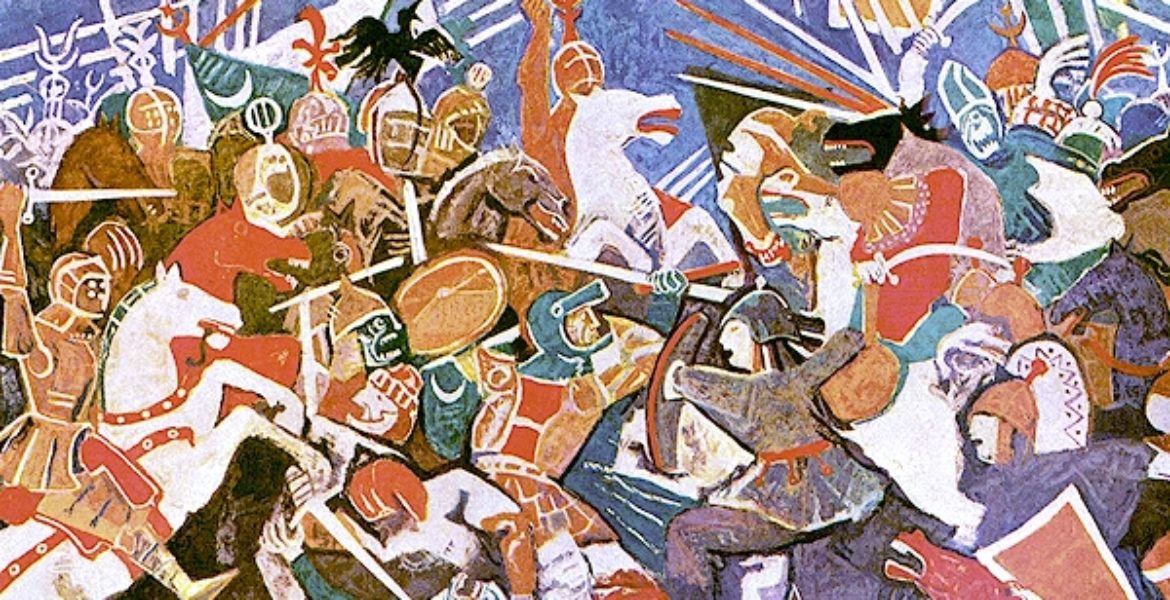
The Battle of Kosovo is considered one of the major decisive battles in history – and it is one of the most important and decisive confrontations between Muslims and Orthodox Christians in the Balkan Peninsula, in Eastern Europe, and it represents a decisive turning point in the history of the Balkan region and the Islamic presence in it. The battle took place between the alliance of the Orthodox Crusader army, led by the Serbian King Lazar on one side, and the Muslim Ottoman army, led by Sultan Murad I 1360-1389 AD. The Serbs – who converted to Orthodox Christianity in the sixth and seventh centuries AD, and were then able under the rule of the Byzantine Empire, whose capital was Constantinople – were able during their long history to establish an independent state for themselves during the twelfth century AD. That Kingdom of Serbia was the first independent state in the Balkans. The power of the Serbs reached its peak during the time of King Dusan, who declared himself Tsar in 1346 and made his capital the city of Pritzin, located west of the city of Pristina, the current capital of Kosovo. This Serbian king gave many privileges to the Serbian Church, and moved its headquarters, which was in Šij, to the city of Peja (a city belonging to current Kosovo). The Serbs showed fanaticism towards Orthodoxy, sought to impose it by force on the peoples under their control, and brutally persecuted all who refused to embrace it, especially the Kosovar population. This coincided with the rise of the Ottomans in Asia Minor, and the arrival of the vanguard of their armies to the Balkan region during the reign of Sultan Orhan bin Othman. Murad I, the third prince of the House of Osman, was able to enter the Balkans and achieve many victories that culminated in the conquest of the city of Edirne in the year 1361 AD, the defeat of the Christian forces, and the transfer of the capital from Brusa to Edirne, which was filled with mosques and schools and became a starting point for the continuation of the Islamic conquests in Europe. The entry of the Ottomans into the Balkan Peninsula and their incursion into it, and the spread of Islam at their hands in that region, resulted in a wave of fear and panic that swept the European countries, due to this growing power. Since the Serbs were the main force in the southern Balkans at that time, they were active in confronting the Ottomans and confronting them. They were the European powers most sensitive to their presence, the most enthusiastic about fighting them, and seeking to remove them by force, considering themselves protectors of Orthodox Christianity in Eastern Europe. On that basis, the Serbs began to prepare, mobilizing agents and allies around them and sending messengers asking for help from the Western Crusader kings and from the Pope of the Vatican in Rome, who were not unaware or oblivious to the movements of the Ottomans in that region. Indeed, the Serbian audacity reached an extreme He made them dare to attack Edirne, the capital of the Ottoman Empire at that time, while Sultan Murad I was busy besieging the city of Beja, in the year 866 AH – 1363 AD. Then in the year 773 AH / 1371 AD, when Sultan Murad was busy in Asia, the Serbs took advantage of the opportunity to attack the Ottoman forces, which were in their lands… In order to eradicate this rebellion… Sultan Murad prepared for war by equipping his Asian army, along with his son Bayezid and Yaqub, and in Europe, parts of his army joined him, and Sultan Murad I gathered these armies and headed to battle. Meanwhile, the Serbs had succeeded in forming the first Crusader alliance against the Muslims in the Balkans. This alliance was established by Lazar, King of Serbia, and Tuartko I, also King of Bosnia, joined it. Then this alliance expanded, and Albanians, Poles, and Bosniaks entered it. They gathered a huge army and placed it under the command of Lazar. This army was so large that the slogan (If the sky had fallen, we would have hit it with the tips of our spears) prevailed among the soldiers of this army. According to some estimates, that army consisted of more than two hundred thousand Serb fighters and their allies.
Decisive victory
Finally, when news came of the arrival of the Ottoman army to the Serb stronghold, the Serbian King Lazar declared a general mobilization and aroused the Serbian chivalry and religious enthusiasm to the utmost extent. He added to that by declaring publicly that “Anyone who was born with Serbian blood or lineage in his veins and did not come to fight the Turks in Kosovo, no boy or girl will be born to him, and no son will inherit his land.” The Balkan nobles marched with these forces from the north, to stop the Ottoman advance, and they camped with their massive armies in the Kosovo plain – north of the city of Pristina – and occupied the best hills overlooking the field, and thus their army achieved a positive point in its favor, and at that time the Ottoman army had completed its preparations, and it, in turn, marched from the south, quickly, on the morning of July 28, 1389 AD, corresponding to Shaban 15, 791 AH. After failed negotiations, tens of thousands of soldiers clashed in that same place, in a fierce and crushing battle that made the boys turn white, in every sense of what these words mean, and in which both sides fought stubbornly and ferociously, and the religious character was dominant in the slogans and chants of both sides in that battle. The battle soon ended with a decisive victory for the Muslim Ottoman Turks and a crushing defeat for the Serbs and their allies, who lost in this battle the flower of their youth and their senior leaders. Their head was the Serbian prince Lazar, in addition to the fact that it was the end of the independence of the Serbs and their loss of their state, which was invaded by the Turkish armies, which continued their advance in intermittent historical stages, until they reached the walls of Vienna. The southern Slavic peoples disappeared from history for three and a half centuries, and the Serbs did not have a state throughout that period, and the mention of this battle remained famous throughout all of Europe.