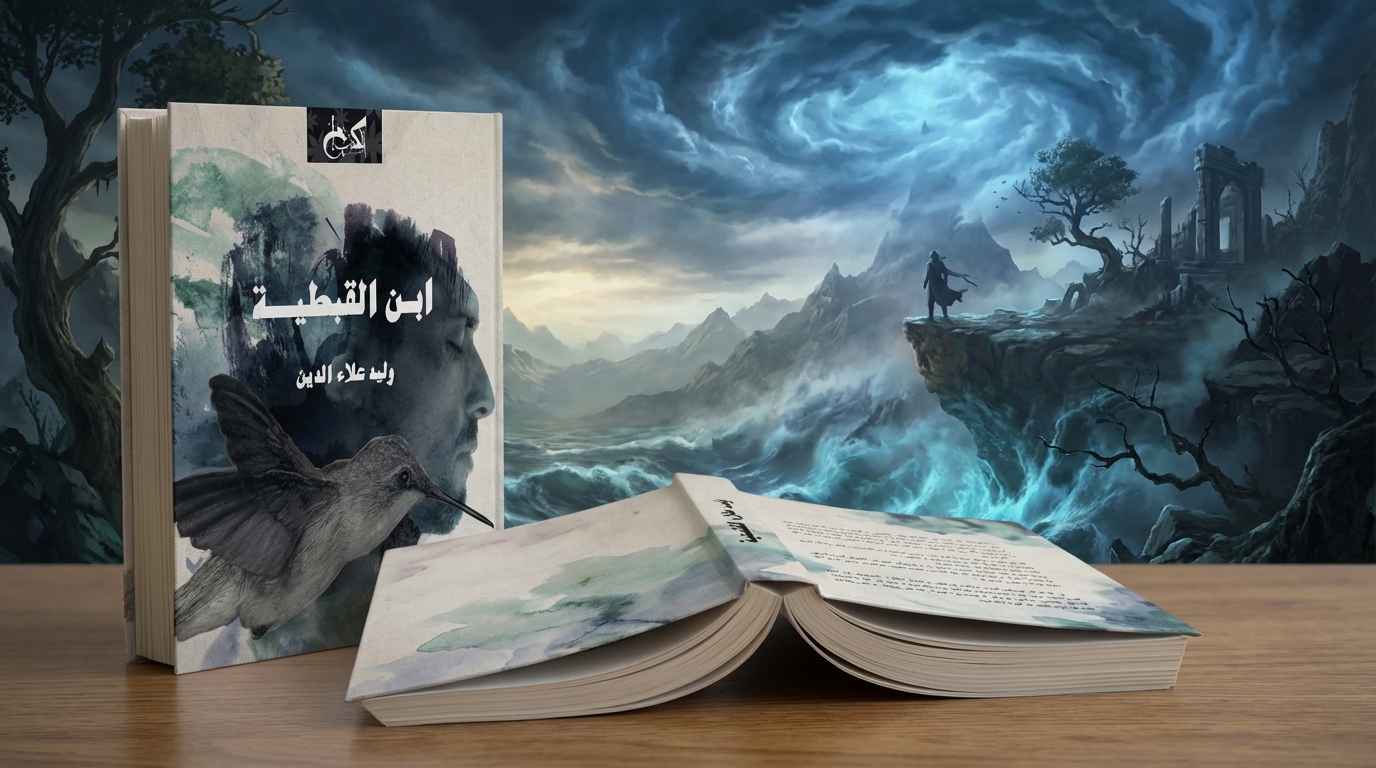

The events of the published novel “Ibn al-Qibtiya” by writer Walid Alaa El-Din take place In 2016, by Al-Kutub Khan Publishing and Distribution House, in 184 pages, about Youssef Hussein, who was born to an Egyptian Muslim father and a Coptic mother, and monitors his psychological and emotional crisis, which is manifested in the refusal of the family of his beloved (Amal) to marry her to him on the grounds that his maternal uncles are “Christians.”“.
The novel presents, in graceful language that sometimes approaches poetic language, an aesthetic treatment of a thorny issue that Egyptian society has long postponed consideration for generations after generations. Its author says that he is trying to address the issue of “exclusion, violence, and classification on the basis of religion, with the aim of passing this concern to public awareness so that it turns into material for thought in the hope that we will find solutions to it.”“.
As the protagonist grows older, he discovers that he is a victim of his dual religious identity, and because of it, he loses the love of his life: Amal, the daughter of a conservative Muslim family. Despite the long love story that has brought them together since childhood, “marriage” is another matter, as her family does not accept the infiltration of Christian sperm into the blood of their family..
The narrator’s story
When Amal marries Mansour, Youssef enters into a psychological crisis that leads him to schizophrenia, haunted by hallucinations and audio-visual obsessions. His treating physician takes advantage of his love for writing and advises him to write down these hallucinations and capture them in words, which is what Youssef does throughout the novel, revealing to us very complex aspects of his personality as a result of his dual religious identity..
Youssef surprises the reader with the story of how he fell prey to the seduction of a Jewish woman of Egyptian origin whose family was expelled from Egypt and lived in Israel. She also suffered from an identity crisis. The father classified himself as Egyptian and then as a Jew, while the mother – in a violent reaction to the Egyptians’ expulsion of them – adhered to religion as her sole identity..
The girl – whose name is Rachel – rejected religious classification and wished she could marry a man who combined the two religions, Islam and Christianity, so that she would have a girl from him who would welcome the world with the three Abrahamic religions.!
Youssef writes that she got to know him through her visits to Mansour Al-Sayegh, Amal’s neighbor and rival, and she plans to be alone with him, so she gives him a job in one of the tourist resorts in Sharm El-Sheikh, and there she seduces him to obtain from him her dream, which is the sperm with a dual religious identity, so that together they create the womb that unites the Abrahamic religions in one entity..
Neither the psychiatrist nor the reader knows whether Rachel’s story was Joseph’s imagination. He may have created it in an unconscious attempt to confront his crisis or escape from it..
The language of the novel
Writer Walid Alaa El-Din begins his narration using graceful, easy language full of feelings that sometimes makes it close to poetic language, and he mixes two writing styles, using the third person pronoun sometimes and the first person pronoun most of the time, especially when he quotes from the blue notebook of the protagonist of the novel who is in crisis with a dual identity crisis in a social environment devoid of compassion and tolerance..
The novel arouses interest because it coincides in the timing of its publication with the escalation of violence in the name of religion and presents a new aesthetic and literary treatment of the issue that has been troubling Egyptian society since ancient times. The writer says that he wants to return man to his original image, “human being,” away from religious and philosophical classifications, adding that this does not mean eliminating any of these religions or philosophies, but what is meant is to respect them all as long as they respect the human condition.Yes.