
On the morning of August 27, 1896 AD, something unique happened in the world of politics, recorded in documentary encyclopedias as the shortest war in human history. It lasted only 43 minutes, and it was a war that broke out between the United Kingdom and African Zanzibar, after the death of Sultan Hamad bin Thuwaini, as the country was ruled by the Sultans of Oman, and its people spoke the Arabic language. Despite the short duration of that war, its effects were very great, as it represented the beginning of the decline of Arab rule on the island, the complete disappearance of the Arabic language from it, and its official language is now Swahili, side by side with English, the language of the coloniser.
Starting whistle
Sultan Hamad bin Thuwaini Al Busaidi was loyal to the British, and after his death, his cousin and relative Khalid bin Barghash seized power, which the British considered a rebellion against them, as they tended to assign power to Hamoud bin Muhammad. According to the terms of the 1886 treaty, the condition of ascending to the throne of the Sultanate would be with the approval of the British Consul. Therefore, Khalid did not fulfill these conditions, which the British considered a declaration of war, and they sent a final ultimatum to Khalid bin Barghash to abdicate the rule. However, Barghash rejected their request and formed an army numbering 2,800 men, along with an armed yacht for the Sultan, which was anchored in the port. This force was entrusted with the task of fortifying the palace, and the warning period expired at 09:00 East African time on August 27.
The war starts
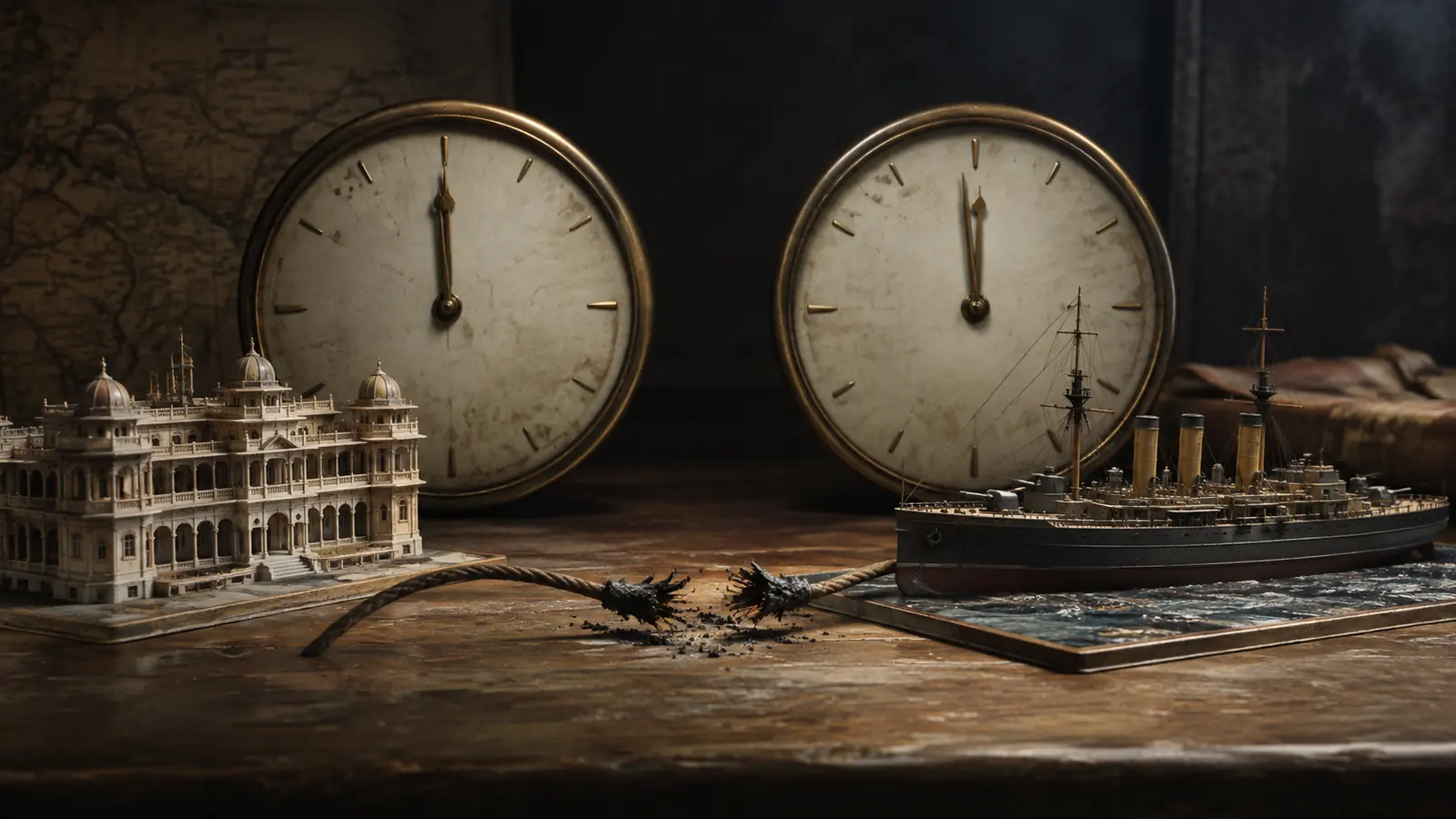
During this time, the British prepared 3 cruisers, two artillery boats, and 150 sailors from the Royal Navy in addition to 900 Zanzibari soldiers, and they gathered in the port area. The Royal Navy was commanded by Admiral Harry Rawson, while the Zanzibari Army was commanded by Brigadier General Lloyd Matthews. As for the force prepared by Sultan Khalid to protect the palace, it was composed of civilian volunteers and the Royal Palace Guard, in addition to hundreds of slaves and servants. The defenders took cover behind some artillery pieces and machine guns in front of the palace, directed at the British ships. By 09:02 in the morning of August 27, the Royal Army ships began bombarding the palace and destroying the defenders’ artillery. The Sultan’s yacht was sunk along with two small ships by a naval force. There was some intermittent shooting towards the Zanzibari force loyal to the British as it moved towards the palace, and the flag raised above the palace was bombed. A ceasefire was declared at 09:40.
End of war
The Sultan’s forces suffered about 500 people killed or wounded, and the British lost only one sailor wounded. The Sultan fled to the German Chancellor, where he was granted asylum and exiled to Dar es Salaam in Tanganyika. The British appointed Sultan Hamoud bin Muhammad to power and formed a nominal government for him. That war ended Zanzibar as a respectable country and began an era of direct British domination over it, which ended years later with the decline of Omani rule over it and the complete cessation of the Arabic language there.
From sovereignty to subordination to the occupier
Zanzibar Island is located near the coast of Tanganyika in the Indian Ocean. It used to be a sovereign country, but now it belongs to Tanzania. Zanzibar was subject to the Portuguese starting in 1499 AD, then the Omanis came, who expelled them from the island, and it was subject to them from 1698 AD until 1858 AD when Sultan Majid bin Said came and declared the independence of the Sultanate of Zanzibar from Oman. Britain encouraged this independence and separated the island, with its possessions overlooking the African coast, from the Sultanate of Oman, with its possessions on the Asian coast. The city of Zanzibar became the capital and the seat of government, where the Palace of Government overlooking the sea coast, which consists of: the House of Government, the Palace of Wonders, and between them is the Harem Palace, and it is considered the first building in East Africa to have access to electricity. It was built from local wood, so it was not designed as a defensive structure. The three buildings are adjacent to each other and connected by wooden bridges that pass over the streets below them.
The English occupy the country
The British had a long history of interaction with Zanzibar, and their state recognized the island’s sovereignty and sultanate in 1886 AD. This is due to their attempt to maintain friendly relations with that country and its authority. The Germans were also interested in East Africa, so these two powers competed to control trade rights and territories in this part of the continent in the late nineteenth century. After that short war in Zanzibar, no form of hostility occurred against the British hegemony during the period of their protection of the island, which lasted 67 years. This war, which lasted about forty minutes, is considered the shortest war in written history. You can through Documentary Find out more information about that war.