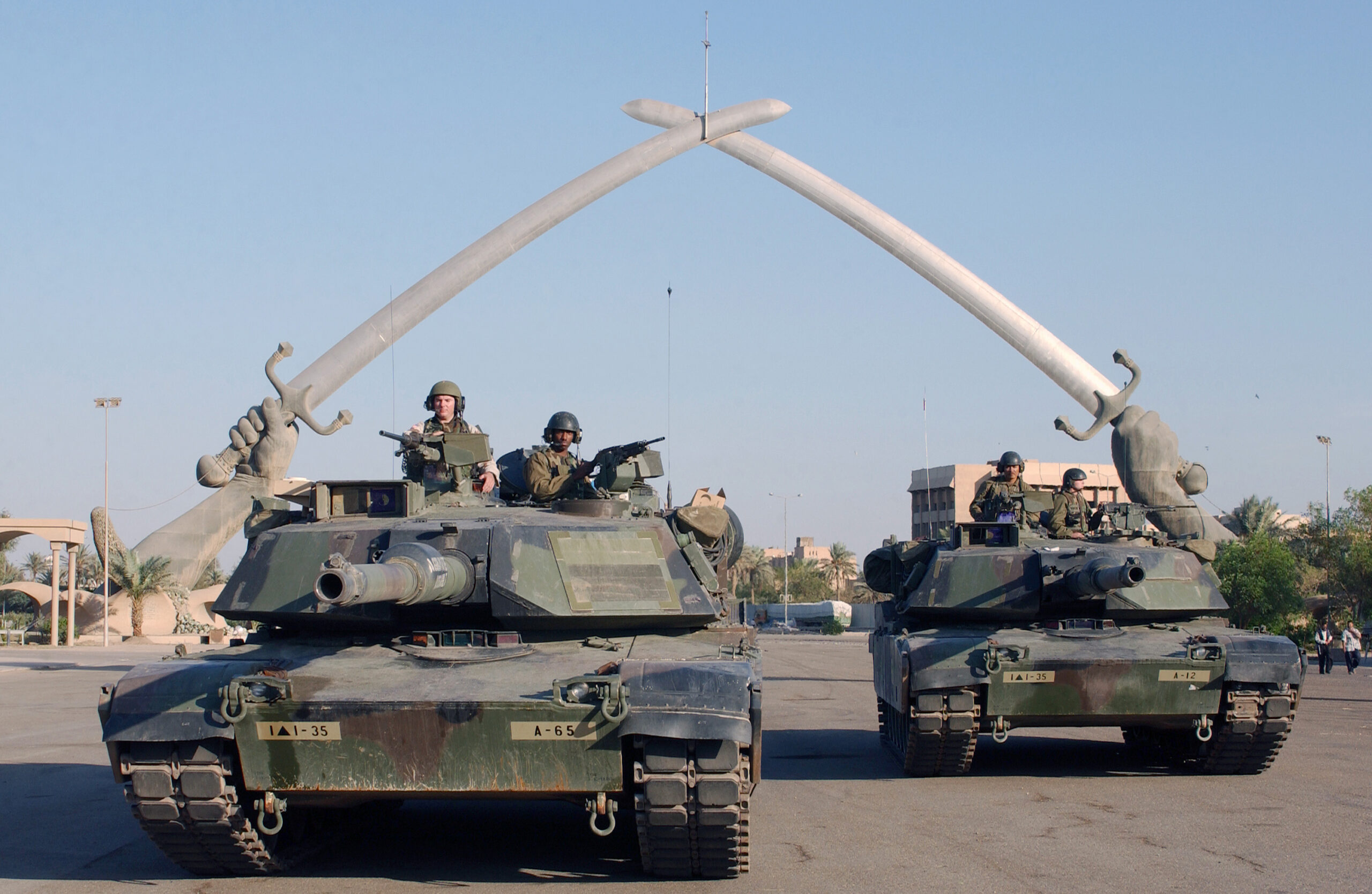

If you are looking for a date from which you can begin to narrate the current stage that the Arab region is experiencing, it would not be more appropriate than the beginning of April 2003, the moments that witnessed the fall of the capital of Iraq (Baghdad) at the hands of the occupying American army after a sudden defeat of the Iraqi army, when George Bush (Jr.) was president of the United States of America. Before that incident, the features of a new identity were emerging for the region, under old, aging regimes that had ruled most of them since the departure of the European occupation from the region, and a new generation of young people carrying greater ambition for freedom and democracy, and a great technological communications boom that allowed the Arab world to learn about the experiences of other peoples in seizing their complete independence and unique freedom. In that atmosphere, the President of the United States of America, George Bush (Jr.), decided to turn the tables upside down, and on March 19, 2003, he began bombing operations on Iraq with the aim of killing former Iraqi President Saddam Hussein, whom Bush accused of possessing a nuclear weapon for which no evidence has been proven to this day. The situation continued until March 21, before events changed all at once. At exactly 17:00 on March 21 (UTC), approximately 1,700 military sorties began, dropping 504 cruise missiles, and Baghdad was invaded 3 days after the airport battle, in which American forces fought battles with the Iraqi Republican Guard, before reaching the Tigris River from the southern suburbs of the city and moving west towards the airport, and with it the American advance began to the Al-Adhamiya and Al-Waziriyah neighborhoods, then west of the Al-Mansour neighborhood. On the banks of the Tigris River…then to the final threshold, Baghdad.
Reasons for the fall of Baghdad
The fall of Baghdad in 2003 was due to many reasons, the most important of which was that Iraq had been under an economic blockade since 1991 imposed by the Security Council on Iraq, which led to the killing of large numbers of Iraqi people from starvation or lack of treatment, in addition to the fact that it did not receive modern weapons militarily. Also, the US Air Force struck important military and economic areas, without regard to the numbers of casualties or securing quick exits for them, which raised the number of civilian casualties among Iraqis dramatically, and during this presentation we will be subjected to a detailed review of the casualty figures. Third, America did not fight alone, but American ground forces advanced with assistance Its allied countries are Britain, Australia and some Arab countries When the American army approached Iraq, It was The plan was for American armor to besiege Baghdad to force the Iraqi government to negotiate in order to preserve the lives of civilians, but the American forces headed towards Baghdad airport, occupied it, and began the process of marching directly to the capital.
Losses and victims
During this battle, Baghdad suffered great damage to its infrastructure and economy, in addition to the looting and theft that occurred due to lack of security, and what was described as American forces allowing thieves to enter ministries and government facilities at the time and not preventing them from stealing and vandalizing their property. Thousands of Iraqi armed forces and a small number of American forces were killed, according to what was reported by the American media. American forces entered the city of Kirkuk in northern Iraq on April 10, 2003, and the city of Tikrit, the birthplace of former Iraqi President Saddam Hussein, on April 15, 2003.
Anti-invasionists
The invasion of Iraq faced strong opposition from some US allies, including the governments of Germany, France, and New Zealand, who They stressed that there is no evidence that Iraq possesses weapons of mass destruction and that there is no justification for invading and occupying Iraq, especially And that The United Nations Monitoring, Verification and Inspection Commission failed twice Proof that Iraq possesses these weapons.
Global protests took place against the war in Iraq, including a crowd of three million people in Rome, listed in the Guinness Book of World Records as the largest anti-war march in history, as well as some 36 million people worldwide who participated in nearly 3,000 protests against the war in Iraq.
Supporters of the invasion
The United States was able to obtain support for its campaign to invade Iraq from 49 countries, and this coalition was known as the “Coalition of the Willing.” Alliance of the willing But this coalition was not as strong as the Second Gulf War coalition, where 98% of the military forces were American and British forces. The total number of soldiers has arrived Alliance The coalition numbered 300,884 and was distributed as follows: United States 250,000 (83%) United Kingdom 45,000 (15%) South Korea 3,500 (1.1%) Australia 2,000 (0.6%) Denmark 200 (0.06%) Poland 184 (0.06%) and 10 other countries contributed small numbers of “non-combat” forces.
The Arab position
In addition to global anti-war demonstrations in most Arab countries, Saudi Arabia announced that it would not allow its bases to be used to attack Iraq, and the Turkish Parliament rejected the same thing. The Arab League and the African Union countries expressed their opposition to the invasion of Iraq, but without activating any military defense agreement.
End of war
The American occupation of Iraq officially ended on December 15, 2011, with the lowering of the American flag in Baghdad and the last American soldier left Iraq on December 18, 2011, after completely failing to prove that Iraq possessed weapons of mass destruction. This is the reason confirmed by former US President George W. Bush and British Prime Minister Tony Blair, that the mission of the coalition forces was “to strip Iraq of weapons of mass destruction.” In the end, at that moment not only Baghdad fell, but all Arab capitals fell at his own hands External occupation No matter how different its forms and images were, it became clear to everyone that the defense of Baghdad at that time was not a defense of a regime or a president, as much as it was a defense of the entire region, and the thrones of its remaining rulers, in a more accurate and influential way.