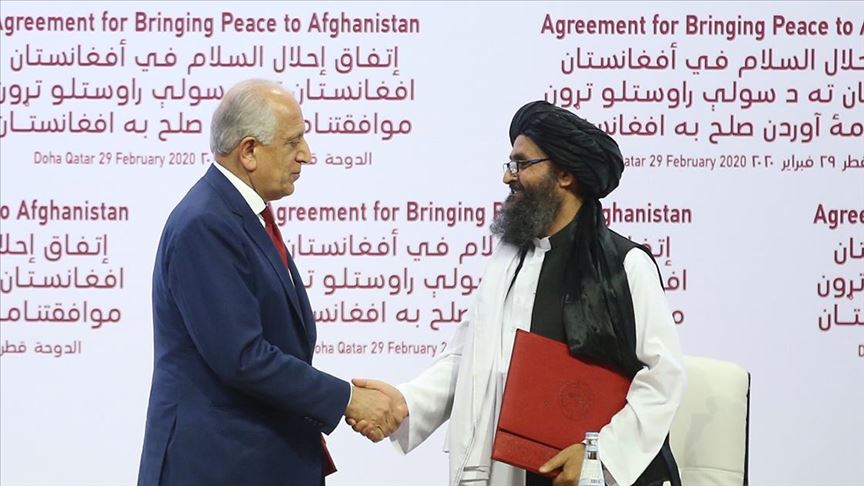

After many years of armed conflict between the Afghan Taliban movement and the United States Army on the territory of the Republic of Afghanistan, the announcement of the signing of an agreement between the warring parties in the Qatari capital, Doha, came to crown years of the people’s strong will for liberation and independence, which forced the world’s leading military power to negotiate with them and even obtain great gains as well. The signing ceremony in Doha was attended by the US special envoy to Afghanistan, Zalmay Khalilzad, and the Taliban’s political official, Mullah Abdul Ghani Baradar, and was supervised by US Secretary of State Mike Pompeo, who said that the agreement paves the way for the United States to withdraw from its longest war in history.
Remarkable presence of movement
After signing the agreement, the Taliban spokesman said, on Tuesday, March 3, 2020, that the movement’s chief negotiator, Mullah Baradar Akhund, held a phone call with US President Donald Trump that lasted more than 30 minutes. This was confirmed by the US President, in a statement to reporters at the White House when he said that he spoke with one of the leaders of the Afghan Islamic Taliban movement and that the talks were very good.
Terms of agreement
According to the agreement concluded between the two parties, the comprehensive and sustainable peace agreement includes 4 parts:
- Guarantees to prevent the use of Afghan lands by any international terrorist groups or individuals against the security of the United States and its allies.
- A timetable for the withdrawal of all US and coalition forces from Afghanistan.
- A political settlement resulting from dialogue between the Afghan president and the Taliban.
- A permanent and comprehensive ceasefire.
Big traffic gains
According to the terms of the agreement, the United States and its allies will commit to withdrawing their remaining forces from Afghanistan within 14 months after the announcement of this joint declaration, to create the conditions for reaching a political settlement and achieving a permanent and sustainable ceasefire. Regarding the prisoners’ file, the agreement included that the government of Afghanistan enter into negotiations conducted by the United States with representatives of the Taliban based on confidence-building measures, to include setting a schedule for the release of large numbers of prisoners from both sides. In the sanctions file, the agreement also included the United States’ commitment to begin diplomatic communication with members of the UN Security Council to remove Taliban members from the sanctions list, with the aim of achieving this goal by May 29, 2020, no later than 30 days after the completion of a permanent framework agreement and comprehensive ceasefire.
The landowner imposes his say
The signing of this agreement, according to a statement by the movement, represents the consolidation of the concepts of resistance and opposition, as the United States, which has the most powerful army in the world, found itself forced to negotiate with those it had described as terrorists for years, after it became unable to achieve victory on Afghan soil, even though Trump always raises the slogan of “excessive force” in his public speeches. This agreement proved that a simple military force supported by a popular will for liberation and independence could force the entrenched United States with all its allies to negotiate with it head-to-head, and emerge from those negotiations with something resembling complete defeat, but in a ceremonial ceremony to save what remained of American face. Perhaps the most prominent thing that reflects this defeatist spirit in the United States is the language included in the agreement that appeared in its concluding clauses, which stated: “Based on that agreement, the United States will refrain from threatening or using force against the territorial integrity or political independence of Afghanistan or interfering in its internal affairs, and the United States will continue to work to build a regional and international consensus to support the ongoing effort to achieve a political settlement of the main conflict in Afghanistan.”