
Muslims waited eight whole centuries, until the prophetic good news of the conquest of Constantinople was fulfilled. Its conquest by the Ottoman Sultan Mehmed the Conqueror had a great impact on the history of Islam, and it is a city that eluded all rulers. Attempts to conquer it began since the early Umayyad era during the caliphate of Muawiyah bin Abi Sufyan, and continued during the Abbasid era, until they were crowned with success in the Ottoman era at the hands of Sultan Muhammad the Conqueror.
Prophetic good news
The conquest of Constantinople was heralded by the Prophet, may God’s prayers and peace be upon him and his family, and that it would be conquered at the hands of a righteous prince. This came in the hadith of the Prophet, may God’s prayers and peace be upon him and his family, which was reported by Imam Ahmad from the hadith of Bishr al-Ghanawi, may God be pleased with him. He said: The Messenger of God, may God’s prayers and peace be upon him, said: “You will conquer Constantinople, and how excellent the prince will be its commander, and how excellent that army will be that army.”
Dream of conquest
Sultan Mehmed the Conqueror took full control of the Ottoman Sultanate after the death of his father on February 7, 1451 AD. He was 22 years old at the time, and since then he began implementing the dream of conquering Constantinople, and at the same time facilitating the conquests in the Balkan region for his young state, making his country connected and not separated by an enemy lurking in it, and so that he would be the place of prophetic glad tidings.
Preparation for battle
Mehmed the Conqueror began preparing for this matter, first working to secure and fortify the Bosphorus host, in preparation for imposing the siege on Constantinople, and about that, Dr. says: Muhammad Safwat in his book “Sultan Muhammad the Conqueror, Conqueror of Constantinople”: At that time also, engineers in the Sultan’s army began making cannons, and they accomplished a great achievement in this field. Safwat adds: “The Sultan also ordered the engineers to build ships, as Constantinople is a city overlooking the sea, and besieging it would be of no use without a naval siege. For this purpose, they prepared a huge fleet, the number of whose ships exceeded four hundred warships.”
Moving towards Constantinople
He continues in his book that the Islamic army led by Sultan Mehmed the Conqueror began moving towards Constantinople by land and sea, and the actual siege of Constantinople began on 4/6/1453 AD. At that time, the Sultan asked Constantine
Historic siege
Dr. mentioned. Ali Al-Sallabi, in his book “The Ottoman Empire: The Rise and Causes of its Fall,” stated that Sultan Muhammad the Conqueror marched to Constantinople and reached it on the 26th of Rabi’ al-Awwal 857 AH, April 6 of the year 1453 AD. He besieged it from land with two hundred and fifty thousand fighters, and from the sea with four hundred and twenty sails, and terror struck the hearts of the people of the city. They only had five thousand fighters in the garrison, most of them foreigners, and the siege lasted 53 days, during which the Ottomans did not stop launching bombs.
Innovative methods of siege
He added: “In the advanced stages of the siege, the Ottomans resorted to a new and innovative method in trying to enter the city; they worked on digging underground tunnels from different places into the city, whose residents heard heavy underground strikes that were gradually approaching from inside the city, so the Byzantine Emperor himself, along with his commanders and advisors, rushed to the area of the sound, and they realized that the Ottomans were digging underground tunnels. Al-Sallabi continues: “In addition to that, the Ottomans resorted to a new method of entering the city. Attempting to storm, they made a huge, movable wooden castle consisting of three floors, higher than the walls, and it was covered with armor and water-soaked skins to prevent fire. That castle was loaded with men on each of its floors, and the archers in the upper floor were throwing arrows at anyone who peeked his head over the walls.”
Opening day
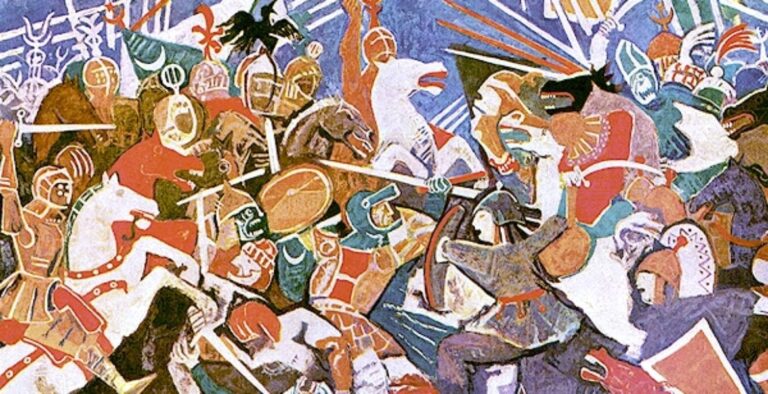
At dawn on Tuesday, corresponding to the 20th of Jumada al-Awwal 827 AH, the 29th of May 1453 AD, the Ottoman forces succeeded in storming the walls and dislodging their defenders after they were unable to stand firm and were forced to run away. The people of Constantinople were surprised by the Ottoman flags fluttering on the walls, and by the soldiers flowing into the city to fulfill the good news of the Prophet, may God’s prayers and peace be upon him and his family. He was greeted in the conquest of Constantinople by this young man at the age of 25 years.