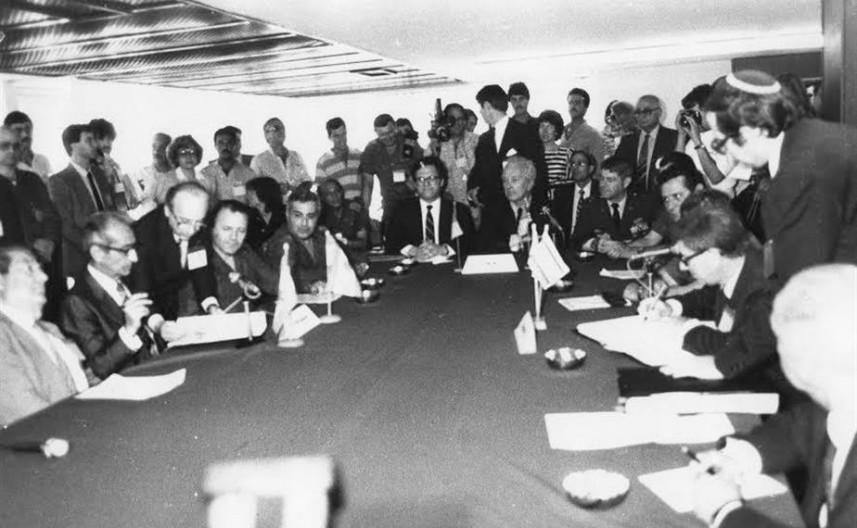
 Four years after the Egyptian-Israeli peace agreement, Israel sought to generalize its experience to all neighboring Arab countries, and one of its most important obstacles was the Lebanese neighbor, which has a strange composition, as Lebanon includes dozens of warring sects of Muslims and Christians, who differ in everything, and have one thing in common: hostility to Israel. Therefore, Israel decided to change the playing cards with its Lebanese neighbor, and the Israeli invasion of Lebanon and the siege of Beirut took place in 1982, before Israel forced the Lebanese parties to sit at the negotiating table to sign an agreement to create a peaceful relationship between Israel and Lebanon during the Lebanese civil war, known as the May 17 Agreement.
Reasons for agreement
Since its decision to invade and control Lebanon, Israel has sought several goals, the most prominent of which are strengthening and fueling the Lebanese civil war between the sects, seeking to destroy the Palestine Liberation Organization based in Lebanon, as well as forcing Lebanon to sign a peace agreement with it in a way that guarantees Israel the security of its northern borders, as well as establishing a Lebanese government that is loyal to Israel. In 1982, Israel carried out what was known as the Israeli invasion of Lebanon, where the occupation forces destroyed dozens of cities and hundreds of Lebanese villages, and succeeded for the first time in invading and entering an Arab capital outside the borders of the occupied territories, which is Beirut. It also succeeded in driving the Palestine Liberation Organization out of Lebanon. On December 28, 1982, negotiations between Israel and Lebanon began under American sponsorship at Lebanon Beach in the Khaldeh area, south of Beirut. After those negotiations, several rounds of negotiations took place in the Kiryat Shmon colony, north of the occupying state.
The fateful agreement
Negotiations continued until May 17, 1983, when a peace agreement was reached, known as the May 17 Treaty, which included the following provisions: – Canceling the state of war between Lebanon and Israel. – Complete Israeli withdrawal from Lebanon within a period of 8-12 weeks. – Establishing a security zone within Lebanese territory, within which the Lebanese government pledges to implement the security arrangements agreed upon in a special annex to the agreement. – Forming an American-Israeli-Lebanese committee to supervise the implementation of the terms of the agreement. From that committee emerges a Security Arrangements Committee and subcommittees to regulate relations between the two countries. – Forming liaison offices between the two countries and negotiating trade agreements. Abstaining from either Israel or Lebanon from any form of propaganda hostile to the other country. – Abolishing all treaties, clauses and regulations that prevent the implementation of any clause of the agreement.
Shame agreement
Despite the internal civil strife, the Lebanese met that agreement with strong rejection, considering the May 17 agreement to be an agreement of shame. Military operations by armed organizations inside Lebanon increased to the point that one of the negotiating rounds was almost prolonged. The most intense campaigns against this agreement were launched from Al-Rida Mosque in the southern suburb of Beirut, based on the decision issued by MP Nabih Berri, head of the Shiite Amal Movement, to the army, that the Lebanese army must rebel against the orders of its military leadership.
New infighting
The signing of the agreement had repercussions at the Lebanese internal level, most notably the outbreak of internal fighting and the division of the political scene between the government and President Amin Gemayel, who adhered to the agreement on the one hand, and the National Salvation Front, and behind it, Syria, who rejected it, on the other hand. From that date, the actual troubles began in Lebanon. On May 19, the Mountain War broke out, which ended on September 19, 1983, with the Progressive Socialist Party taking control of all the mountain villages, followed by the February 6, 1984 uprising in Beirut, and the forces rejecting the May 17 agreement taking control of the western part of the capital.
The last scene…the victory
During the period that witnessed an escalation in the targeting of Israeli and foreign forces inside Lebanon, especially after the killing of a large number of French marines and paratroopers, President Amin Gemayel decided to announce the cancellation of the May 17 agreement with Israel, and under the pressure of popular rejection, the Lebanese government and the Lebanese Parliament considered this agreement invalid and canceled it less than a year after its adoption, specifically on March 5, 1984. With the Lebanese’ success in canceling this agreement, Israel went crazy, and tried to US Secretary of State at the time, George Shultz, at the head of an international delegation that included Assistant for the Near East Richard Murphy, wanted to save the agreement, but the Lebanese position remained stubborn and refused to pass it. By ending this agreement, Lebanon restored its Arab status, especially after the shocking Egyptian position in signing the peace agreement with the Israeli occupation.