With the outbreak of the Arab Spring at the beginning of 2011, the problem of the constitutional crisis in Islamic civilization that was formed with the events of the Great Sedition emerged.
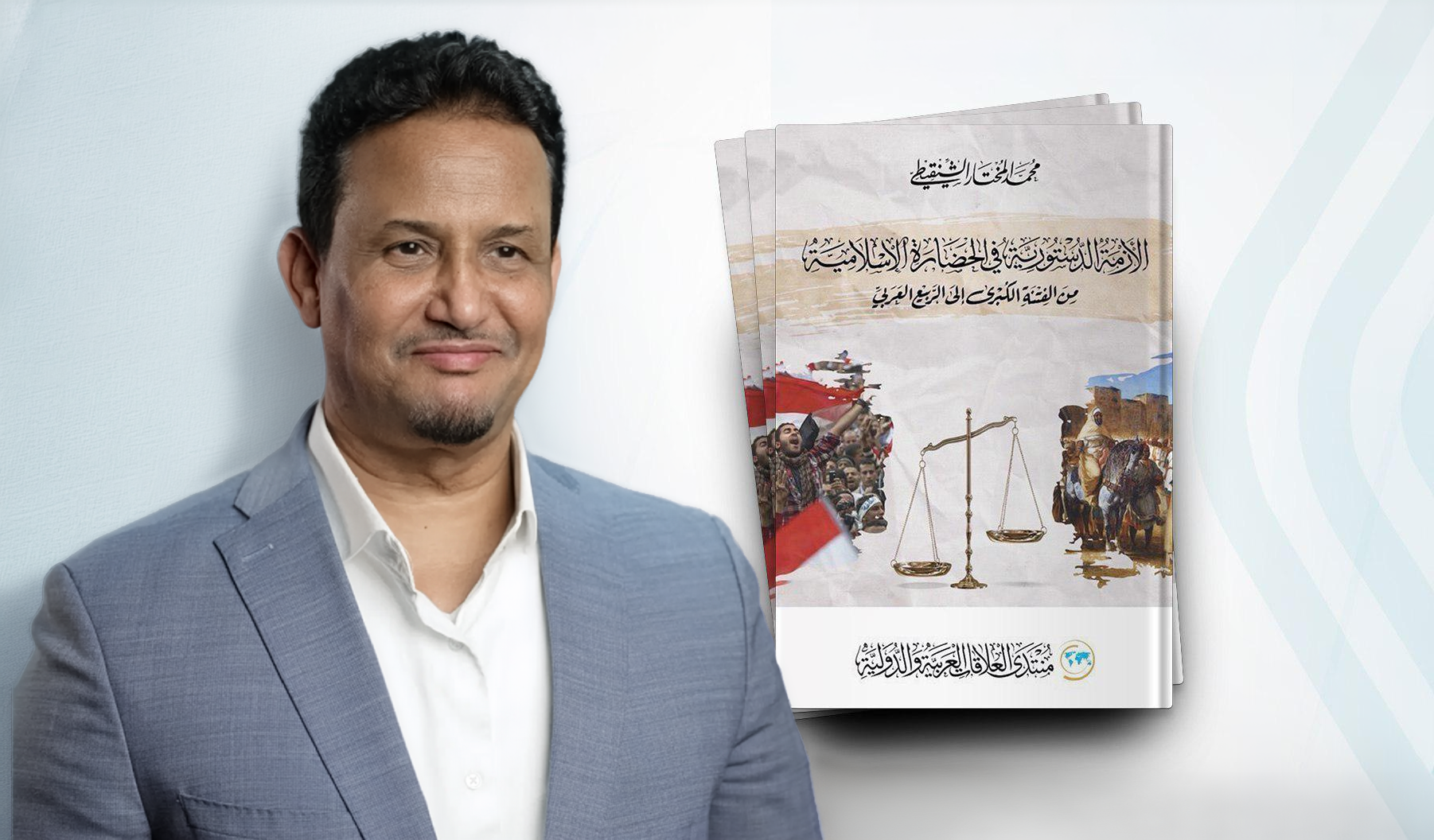
My new book: (The Constitutional Crisis in Islamic Civilization: From the Great Strife to the Arab Spring) was recently published by the Forum for Arab and International Relations in Doha. It is an extensive study that was the result of years of research, contemplation, and exploration into the heritage and history of Muslims, and into the books of major political philosophers throughout the ages, from the days of Plato to the beginning of the twenty-first century. Sheikh Rashid Ghannouchi honored me by writing an introduction to the book. This spring paper will be an introduction to the book to dear readers, as much as the condensation of six hundred pages into an article allows. The book is a study on the crisis of political legitimacy in Islamic civilization, adopting the Islamic text as a standard, the Islamic historical experience as a topic, and Muslims’ emergence from their political crisis as a goal. What is meant by the constitutional crisis in Islamic civilization is the paradox between the Islamic political principle and the historical reality that Muslims lived through politically, and are still suffering from its consequences until today, and then the bitter political conflicts that resulted from that paradox in the history of Islamic civilization from the middle of the first century AH until today. We have presented this paradox in the form of a constant tension between the requirements of the textual principle and the burdens of the reality that lags behind or resists it. This paradox between textual principle and political reality has left visible pain on the Islamic body, and hidden pessimism in the folds of the Muslim conscience over the centuries. It is not an exaggeration to say that all aspects of Islamic civilization – including its awareness of itself and its relationship with others – have been colored by its constitutional crisis, from the emergence of Islam to our present time. Therefore, we considered it a crisis of civilization, not just a crisis of a political system. The book began with an introduction that talks about “The drawn sword of the Imamate“on the necks of the nation of Islam throughout the centuries, and ended with a conclusion that included a glimmer of hope for… “Sheathing the sword of the Imamate“If Muslims were good at seizing the current historical moment, diagnosing the disease, and prescribing the cure. And the expression”The sword of the ImamateDerived from Al-Shahrtani’s saying:The greatest dispute among the nation is the dispute over the imamate, as no sword has been drawn in Islam over a religious basis like it has been drawn over the imamate in every era.“After the introduction, the book consists of an introductory introduction, three sections, each containing two chapters, and then a conclusion. If we want to put the three sections of the book in opposition, we can say – with shameful simplification – that the subject of the first section of the book is the Islamic political text, the subject of the second section is Islamic political history, and the subject of the third section is finding a way out of the Islamic political crisis. We have entitled the first section: “Conspiracy in the princeThe second section is entitled: “Conspiracy without command“, and the third section is entitled: “Exiting the jurisprudence of necessitiesThe first and second expressions are derived from the texts of the Prophet’s Sunnah. The first is taken from the report of Jarir bin Abdullah: “You Arabs will still be fine as long as you were, if one prince dies and you conspire in another(Sahih Al-Bukhari), and the second is taken from the saying of the Prophet, may God bless him and grant him peace, about the Battle of Mu’tah: “Then [=the banner] Khalid bin Al-Walid took it without a command, and it was conquered over him.” (Sahih Al-Bukhari). As for the title of the third section: “Exiting the jurisprudence of necessities“It is derived from the jurisprudential struggle with the turbulent political history of Muslims. Perhaps the most accurate description of the history of Muslims and their political present is that they are governed by the constant competition between the principle “Conspiracy in the prince“Which is the legal principle and a license.”Conspiracy without command“Which is the rule of necessity and exception. This competition between political principle and political license is the interpretive model that controls the book from beginning to end. He presented the introduction to the book entitled: “A possibility that refuses to be forgottenThe necessary definitions of the basic concepts referred to in the title of the study, an explanation of the nature, scope, and purpose of this study, the methodology followed in it, and its expected contribution to understanding the Islamic political issue, and a statement of the interpretive model prevailing in it. The introduction elaborated on explaining a number of concepts that the book borrowed from previous philosophers and researchers, and used as interpretive tools to support its basic interpretive model, in the hope of achieving what it seeks by explaining the paradox that exists between the Islamic political text and political reality. The introduction emphasized that the Islamic political principle is a “principle.”Conspiracy in the princeOr the nation’s control over its rulers – has remained a possibility that refuses to be forgotten in the course of Islamic civilization. The Muslim conscience – in its jurisprudential and hadith aspects at least – did not surrender to tyranny morally, but rather accepted it reluctantly in a practical and forced acceptance, imposed by the competition of values in unfavorable historical circumstances. Therefore, the tendencies of returning to the Islamic political values stipulated in the Qur’an and Sunnah remained. It was embodied by the state of the Prophet and the Rightly Guided Caliphate, alive in the folds of that Muslim conscience to this day. The first section of the book summarizes the features of Islamic political values in their standard textual form, and seeks to reveal their direct moral and legal meanings, and their meanings stripped of the veils of history, by liberating their original meaning in the Qur’an and the Sunnah, and then in the consensus of the Companions during the Rightly Guided era, before becoming confused with the imperial inheritances that preceded Islam. We have classified the values There are two types of Islamic politics:Values of political construction“It is the subject of the first chapter, and”Political performance values“It is the subject of the second chapter. Perhaps what is stated in these two chapters makes this book one of the broadest studies in introspection and consolidation of Islamic political values, especially from the Sunnah of the Prophet, the political contents of which Muslim political jurists have not given sufficient exploration and comprehension until now. In our review of Islamic political values in their standard textual form, we did not grant the heritage inherited from the jurists of Sharia politics and royal literature excessive authority, but rather we started from the fact that excessive confidence in the explanation obscures The text, and that the authority of the political heritage, if it is exaggerated, becomes a barrier between the people and the meanings of Islamic political values as they were mentioned recently in the revelation. Our review of Islamic political values in their founding textual form, and our revelation of their direct moral and legal implications, indicates that the constitutional crisis that has exhausted Islamic civilization throughout the ages was not the result of a void in the Qur’anic revelation, or a lack of prophetic guidance indicating a rational political system, but rather it was a result of it. This has historical and cultural reasons. A correct understanding of the constitutional crisis in Islamic civilization lies in observing two things: the first is the political vacuum in the Arabian Peninsula, in which Islam was born. The weakness of the traditions of politics, state, and order in the culture of the Arabs before Islam had a very negative impact on the way in which Islamic political values were received, and the inability of the early Muslims to preserve them for a long time, so their political experience was characterized by institutional fragility, despite its moral greatness, and the second is the influence of the imperial tyranny surrounding the Arabian Peninsula, which pressured the values Islamic political morally and structurally, which resulted in a conflict of values in the bowels of Muslim societies, in which Islamic political values of a contractual nature gave way to imperial values of a coercive nature, in an era in which the imperial spirit prevailed throughout the world, and if secularists studying the Islamic political heritage and Islamic political history started from the claim of “Absence of text“In the Islamic political issue, we demonstrate here that the problem lies in”Excluding the Text“Not in its absence. We have explained in the first section of the book the richness of the Islamic political text, in a way that leaves no room for claims.”Text space“What is claimed by those who take a negative stance on the message of Islam in public affairs, or by those who are betrayed by extrapolation of the Islamic text, so they talk about its defects in talking about what Islam has spoken and what it has remained silent about, without making the necessary research effort, so their judgments are arbitrary without evidence. The second part of the book – in its third and fourth chapters – deals with the movement of Islamic political values in time, and their interaction with place, by examining the historical context in which Islam was born, and what that context was. From a significant impact on the collapse of the political model that was founded on a foundation of Islamic political values, and which lived for only forty years – the lifetime of the Prophet’s state and the Rightly Guided Caliphate – and then the impact of that context on people’s understanding of the political values of Islam, disrupting its moral validity, and disrupting its legal obligation. In this second section of the book, there is an explanation of the Arab political vacuum in which the first Islamic state was born in Medina, and the imperial environment that surrounded that nascent state. The two chapters that make up this section aim to achieve a better understanding of the impact of the context Historical in receiving Islamic political values and transmitting them to the earth, through contemplation of the context in which those values interacted and were affected. If the first section of the book is closer to the philosophy of politics, then the second section is closer to the philosophy of history, because it traces the movement of Islamic political values in the contexts of time and place. The first section focuses on the rooting of Islamic political values from the text, and the second section focuses on the history of those values, their journey in time, and their rooting in place Title: “A void on the borders of empires“The Arab social and political reality before Islam. It began with theoretical introductions about the importance of a suitable environment for translating political values into practical institutions and procedures, and about the close relationship between social chaos and political tyranny, and how each feeds on the other, leading to the collapse of political society. The chapter then elaborates on explaining the manifestations of the political vacuum in the Arabian Peninsula at that time, and how that vacuum led to the outbreak of a number of destructive political strife in the heart of the nascent Islamic society, beginning with the protest against the policies of the elite at the end of the reign of the Third Caliph. Othman bin Affan, then the War of the Camel and Siffin, then the deal of the year of the group in the year 41 AH, which established the sacrifice of political legitimacy in favor of the unity of the nation, and it is the equation that governed Islamic political jurisprudence – in its Sunni and Shiite aspects – after that. This chapter explains what accompanied all these profound transformations of a revolution in political values, a split in the Islamic self, and a struggle between practical ability and moral greatness, which ended in the great strife that led to the victory of power over right, and oppression over. Justice, and kingship over the caliphate. The chapter also explains the development of the Islamic position on kingship, from its reluctant acceptance of a temporary solution to stop the civil war, as happened in the year of the group after the Battle of Siffin, to its permanent negative acceptance, as happened after the Umayyad massacres following the pledge of allegiance to Yazid ibn Muawiyah, to the control of concerns of fear of sedition in the Muslim mind, conferring legitimacy on the prevailing reality, and granting illegitimate kings the rights of legitimate caliphs, as happened in the Abbasid era and after it. As for the fourth chapter, entitled: “The Book of God and the Testament of Ardashir” It deals with the historical context with which Islam came into contact outside the Arabian Peninsula during its first surge of conquests. In this chapter, we have shown that Islam was born between ancient and modern times, and the Eastern and Western worlds, and that Islam’s political values make it closer to the ancient Western world (Greek and Roman) with its free political heritage, than to the ancient Eastern world (Persian and Indian) with its coercive, authoritarian heritage. After a brief pause on the withering of Greco-Roman democracy before Islam, and the weakness of the interaction between Islamic political values and the Greco-Roman democratic heritage, the chapter elaborates on the analysis of the impact of Sassanian culture on Islamic political values. In this chapter, we have detailed the Persian cultural contribution to Islamic civilization, with its bright and dark sides, and revealed a very ancient cultural phenomenon, which is the taming of Persia by its conquerors over two thousand years, from Alexander the Great to Ismail al-Safavi, and how the Islamic conquest was no exception to this taming. The Sassanian taming of Islamic political values led to the inclusion of the Islamic world – politically at least – in the ancient Eastern world, to which the German philosopher Hegel devoted his book on Eastern worldHe described the authoritarian culture deeply rooted in his soil. As for the third section of the book – in its fifth and sixth chapters – it sought to find a way to extract Islamic civilization from its constitutional crisis, and found that this exit cannot be achieved unless two conditions are met, the first of which is: transition.From strife to revolution“This is the title of the fifth chapter of the book, and what is meant is the need for Muslims to be liberated from the obsessions of fear of strife that has controlled their cultural and political mood over the centuries, and to adopt revolutionary action that refuses to coexist with tyranny and political oppression. The second condition is transition.”From values to actionsThis is the title of the sixth and final chapter, and what is meant is the necessity of activating Islamic political texts in the reality of contemporary life, by translating them into political institutions and practical procedures. The fifth chapter explained the centrality of the Great Strife and its foundational impact on Islamic political history, then reviewed the auspicious Hejaz and Iraqi revolutions in the first century AH, showing how the failure of those revolutions, and the killing and abuse that accompanied or followed them, led to the seeding of deep pessimism in The Muslim conscience is free from any reformist political endeavor, no matter how necessary, and from any revolution against political injustice, no matter how necessary. The chapter included this apprehensive position in an equation “Duty“and”Reality“which the people of Islam faced, making them accept coercive kingship in their minds as a necessity and interest, even if they did not accept it in their hearts as a legal principle. The chapter included criticism of the jurists who sometimes expressed permission in the language of resolve, and they fell into the trap of justifying submission to political injustice, while being careful to do justice to them by putting their statements in their context, and noting that they were better off in this regard than the authors of literature books. Sultanism with a Sassanian spirit, which took the justification of submission to political injustice as a principled moral stance, and did not content itself with accepting it with the logic of self-interested necessity. This chapter has monitored a new phenomenon in Islamic political culture, which emerged most clearly in the Arab Spring revolutions a few years ago, which is the beginning of the Muslim peoples’ liberation – finally – from the legacies of the great strife and its consequences, and their overcoming the obsessions of fear of strife that had arisen. It has taken control of the Islamic political culture since the Year of the Jamaat deal. This fear of the souls has disappeared, and it has been replaced by a new psychological-cultural phenomenon, which is standing up to political injustice and waging an existential war against it. We have found that the first of the two conditions for Islamic civilization to emerge from its constitutional crisis began to be fulfilled with the Arab Spring revolutions, when peoples were liberated from submission to the old psychological and jurisprudential equations that were restricting their freedom, and they realized that their plight was due to a crisis. Political legitimacy, and I understood that sacrificing political legitimacy destroys political society, or empties it of its moral and human significance. This is a revolution in political consciousness that Islamic culture has not witnessed since the end of the first century AH. This is sufficient evidence of the historical importance of the transformation that the heart of the Islamic world has been experiencing since the outbreak of the Arab Spring revolutions in the end of 2010. This fifth chapter presented an example of the major revolutions in contemporary history, and it concluded that the revolutions of the Arab Spring. The Arab League is on its way, despite all the confusion and turmoil that accompanied it. The issue is limited to time and price, and not the issue of the principle of peoples’ victory over tyrants. This is taken for granted. We have learned from the lesson of the history of contemporary revolutions that the Arab revolutions have only three ways to reach their goals, which are: preventive reform in which the ruler and the ruled meet halfway, and a long open war that exhausts the tyrants and transmits the sparks to their external demonstrators, so they are forced. To submit to the will of the people, and to democratic military coups – such as Portugal in 1976 and Sudan in 1986 – to save the situation from a comprehensive collapse. The sixth and final chapter deals with the condition The second is the emergence of Islamic civilization from its constitutional crisis, which is the transition from values to procedures, meaning the translation of the stipulated Islamic political values that we presented in the first section of the book into constitutional institutions and procedures that are consistent with the logic of the contemporary land state. The chapter presented criteria for the Islamicity of contemporary governance systems in the form of a table that translates thirty of the Islamic political values stipulated in the Qur’an and Sunnah into practical constitutional provisions in a contemporary state, indicating that the minimum Islamic rule of a system includes the two conditions for shura: that the state be democratic, and the reference: that the state be based on the Islamic text in morals and legislation, with the necessity of distinguishing between moral obligation and legal obligation, and the importance of moving from a culture of coercion, subjugation, and repression to a culture of persuasion and consent. The chapter elaborated on the cultural dynamism that emerged at the beginning of Islam, and the necessity of drawing inspiration from it in the present era, by investing in Western motivation, especially in the field of political institutions and procedures, which is a dynamic, cumulative field, and Muslims need to draw inspiration from the nations that preceded them on the path of political development. The constitutional crisis in Islamic civilization cannot be resolved except by drawing broadly from the theoretical and practical gains achieved by the democratic Western nations. This drawing will enrich the culture of Muslims if they deal with it with the humility of a learner and the confidence of an adult, far from complexes of inferiority or superiority. This drawing will alert them to disruptive capabilities in their religion that they would not have paid attention to otherwise. The chapter stressed the need for Muslims to sow seeds in their own cultural soil, and to own what they derive from other civilizations and cultures. Borrowing the idea in itself is not enough to make it a good source. Rather, the idea must be owned, soaked in the nectar of the borrowed culture, and subjected to its moral and practical logic. Finally, the chapter concluded the need for Islamic culture to move from the logic of the ancient empire to the logic of the contemporary land state, with what this means of equality between citizens – Muslims and non-Muslims – in rights and duties. It is a moral and logical contradiction for a Muslim to call for a state of justice and freedom, while he deprives those who differ from him in belief – who are united by blood, language, history and geography – from enjoying its fruits in this regard. This is an exaggeration that contradicts the words of the Qur’an. It places the Muslim in a moral paradox that is not worthy of him or his message, because it makes him a victim of injustice and a justification for it at the same time! The conclusion of the book is that any effort to extricate Islamic civilization from its constitutional crisis will not… It will succeed only if it is characterized by two characteristics, the first of which is that it is convincing to the Muslim conscience related to Islamic political values and the first political experience of Islam. This requires that the solution not be a secular solution stemming from the people’s conscience and their religious and moral mood. The second: that it be consistent with the logic of the contemporary state and not outside of it or against it, and this requires that the solution not be a Salafist solution that captures the historical memory derived from past Islamic empires. The secular option is Islamically impossible, and the Salafist option is humanly impossible. The solution is the synthetic Islamic approach that combines the religious and the civil. Muslims were not innovators in the decline of political values in their history in the face of imperial contexts. Centuries before Islam, the democratic values in Athens – and then in Republican Rome – receded in the face of the imperial spirit, and those democratic values continued to wait for their time in the form of a latent historical possibility, until the opportunities to achieve a living reality opened up before them with the modern European Renaissance. The revolutions and contemporary waves of democracy have created great opportunities for Islamic political values to revive. It seems that the Arab Spring is the beginning of a profound historical transformation that will lead to renewing the freshness of Islamic civilization, liberating it from its constitutional crisis, and from the exhaustion of the sword of the Imamate that has exhausted it over the centuries.
The post was published for the first time on the Al Jazeera Blogs website
Posts express the opinion of their author only, and do not necessarily express the opinion of the institution