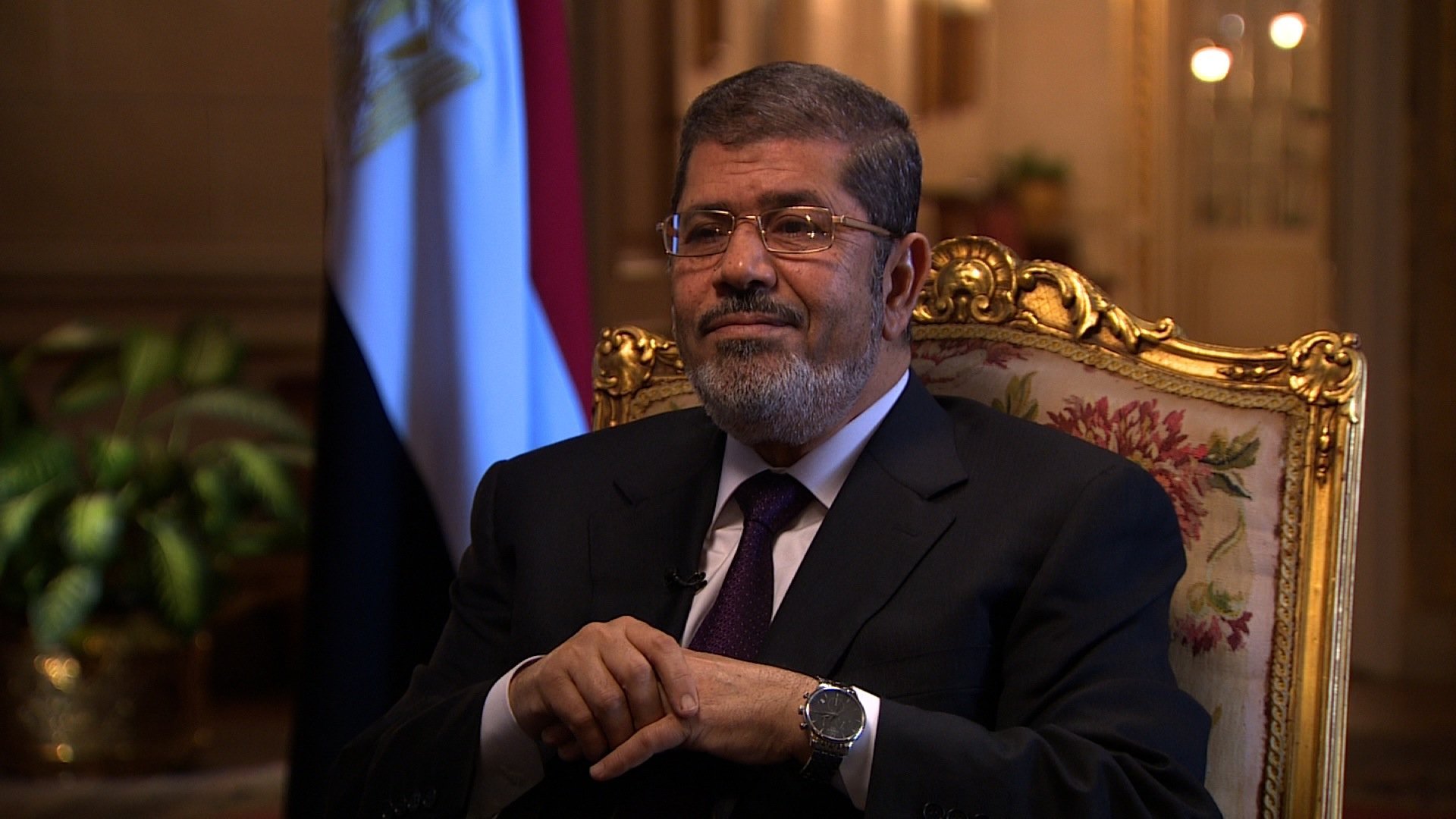

“The only democratically elected civilian president throughout Egypt’s long history.” This is how the late Egyptian President Mohamed Morsi secured for himself a prominent title in the history of Egypt and the region, a title that could not be taken away or circumvented. It remained in place for him until he fell unconscious inside the courtroom on June 17, 2019, and the military coup authorities later announced his death “due to a heart attack.” A whole year has passed in Egypt since the departure of President Morsi, slow as a moving mountain, during which the truth has become overwhelming for everyone. Morsi was deliberately killed, after six years of retaliatory solitary confinement, without the lowest requirements of humanity or the basic needs of a human being, as well as treatment befitting the status of an elected Egyptian president. Local Egyptian human rights organizations said that no one believed that the death of the late Egyptian President Mohamed Morsi was natural, after he spent six years in solitary confinement under harsh detention conditions. The statement issued by the International Peace Organization, the Adalah Foundation, and the Shehab Center stressed that the murder of Morsi requires a serious and impartial international investigation by the United Nations, provided that the investigation includes the violations he was exposed to throughout his years of imprisonment, since his arrest and forced disappearance. The organizations also called for allowing a team of independent United Nations experts to determine the causes of the death of the late President Mohamed Morsi, investigate the matter, and hold accountable those responsible for the medical negligence to which the former president was subjected. She said in a joint statement, “The fact of Morsi’s death in this shocking manner during his trial as a result of medical negligence and denial of health care exposes the current regime’s tendency to take revenge on its political opponents in prisons, with torture and neglect to the point of slow, deliberate killing and solitary confinement.” The organizations that signed the statement are the Egyptian Front for Human Rights, the Egyptian Platform for Human Rights, Committee for Justice, the Freedom Initiative, the Cairo Center for Human Rights Studies, the El Nadeem Center, the Adalah Center for Rights and Freedoms, the Egyptian Commission for Rights and Freedoms, the Belady Center for Rights and Freedoms, and the Foundation for Freedom of Thought and Expression. Human Rights Watch and FD International also held the Egyptian government fully responsible for the death of former Egyptian President Mohamed Morsi. According to the organization, the Egyptian authorities failed to provide him with adequate medical care or grant him basic prisoner rights. For its part, Amnesty International said that the news of the death of former Egyptian President Mohamed Morsi in court was “extremely shocking.” Amnesty International called on the Egyptian authorities to conduct a fair, comprehensive and transparent investigation into the circumstances of Morsi’s death and the grounds for his detention, including his solitary confinement and isolation from the world. Foreign Affairs, the medical care he received, and holding those responsible for his ill-treatment accountable. For its part, FD International condemned what it described as the “murder” of the former Egyptian president, and said it was a “premeditated murder.” Abdel Majeed Marari, director of the organization’s Middle East and North Africa department, held the Egyptian authorities fully responsible for the death of President Mohamed Morsi. He added that preventing a person from receiving medication with the intention of killing him and torturing him until death is a crime punishable by law in accordance with the text of the American Convention on Human Rights.
A loud memory

It does not take much research into the various engines to realize that the momentum of the issue of the death of the former Egyptian president has not diminished, and that he has triumphed over the strenuous attempts of the coup media to hide him from the news coverage and agendas of international events, but they have failed in the face of the interaction of the Egyptians and all the revolutionaries and free people at the world level, especially the Islamic and Arab world. The compassion and sympathy that President Mohamed Morsi received at the world level was a witness to the victory of his cause and that his memory will remain present in the hearts and minds of the free people in The world and others with painful memories. With the anniversary, voices rose again demanding an international and transparent investigation into the circumstances of his killing. The United Nations renewed the publication of the report of the United Nations expert specializing in extrajudicial killings, Agnes Callamard, in conjunction with a United Nations team concerned with arbitrary detention. The report concluded that Morsi was treated brutally. The UN report said, “Morsi was detained in solitary confinement for 23 hours a day, forced to sleep on a hard floor with insufficient blankets, and prevented from interacting with the rest of the prisoners.” The report stated that the killing of Morsi was an arbitrary assassination with a green light from the state. In the same context, the London-based International Justice Department published a report urging the United Nations to launch a comprehensive and transparent investigation into Morsi’s death. Toby Cadman, head of the International Chambers of Justice and a lawyer at the International Criminal Court, said: “A criminal investigation must be opened if it is proven that the Egyptian state was involved in the death of the late Egyptian president.” Turkish President Recep Tayyip Erdogan was one of the first international officials to question the Egyptian authorities’ account of the death of President Morsi, and stressed Repeatedly – since November 2019 – Ankara is still searching for facts about his killing. The journalist, Mohamed Gamal Hilal, confirmed in a press statement that “there are legal offices trying to study filing international cases in a number of countries with jurisdiction over human rights issues, medical negligence, and forced disappearance to which Morsi was subjected.”
Demands that the killers be tried

Legal experts believe that launching an international investigation into a human rights issue in Egypt is not an easy matter, because Egypt is not a member of the International Court. This was confirmed by Toby Cadman, a lawyer at the International Criminal Court. Cadman said, “There is very little hope for fair trials for any of the leaders of the Egyptian army or symbols of the current regime before the Egyptian judiciary, but we know that things can change in an instant and this regime falls and Abdel Fattah al-Sisi does not continue to run the country.” Cadman added that legal efforts seek to bring the leaders of the coup inside Egypt to international trial, and that “we cannot take the case of President Morsi’s death to the International Criminal Court, which does not have the authority to look into a case like this inside Egypt.”
A name that will never be forgotten

Several efforts have been made to revive the issue of the death of President Mohamed Morsi, the most prominent of which was the launch of a global human rights entity called “Morsi for Democracy,” which, according to its definition, is “a non-profit, international civil society institution with no party or political affiliation. It was established to commemorate the late man and consolidate his approach, for which he died, of the values of justice, human rights, public freedoms, and community development.” The statement revealed that among the organization’s goals during the first five years are “to occupy a strong center for supporting and making decisions regarding democracy and public freedoms in the Arab and Islamic worlds, and to commemorate the death of President Morsi, with the aim of becoming a tool for redressing his rights, and to rescue thousands of detainees in Egyptian prisons who face harsh conditions like those that Morsi experienced, and who are not subject to a similar fate.”