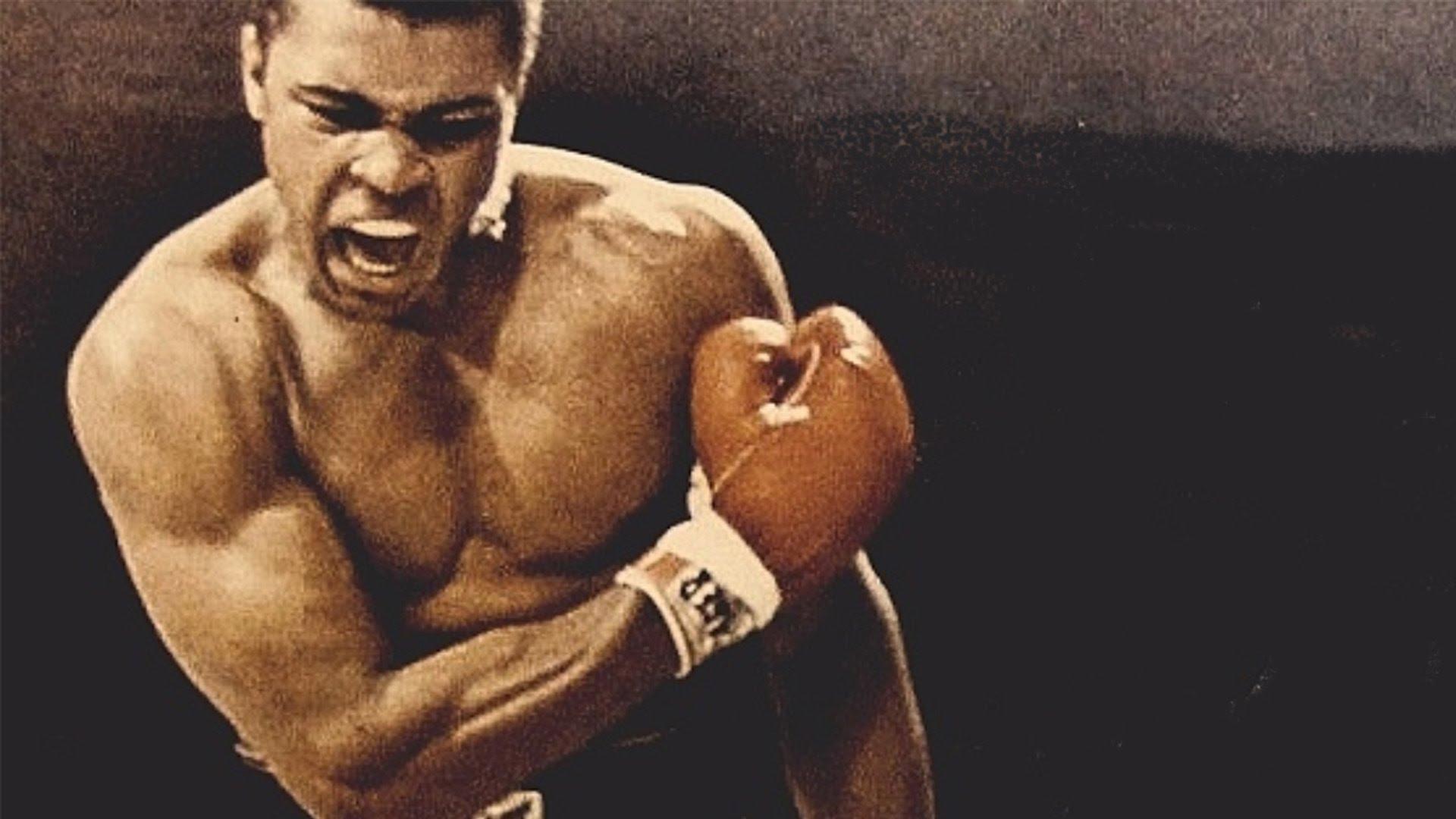
 His eyes knew nothing but looks of challenge. He challenged himself and his childhood, he challenged his country and its laws, he challenged his opponents, and he challenged illness, but from the beginning he knew that there was one thing he could not challenge, which was death, so he preferred to prepare for it early.. He is the “boxing legend” and the owner of the strongest and fastest punch, the American Muhammad Ali Clay.
Clay Jr
The brown child, Cassius Marcellus Clay Jr., born on January 17, 1942, chose from an early age not to be led by anyone. He decided that his decisions should stem from his choices, and he would not allow anyone to influence him. This is what happened when he decided to enter the world of boxing when he was twelve years old, to win the gold medal in the Rome Olympics when he was eighteen years old, and he succeeded in ascending the world boxing throne when he was twenty-two years old, after defeating Sonny Liston.
Entering Islam
At that time, the world began to follow the young man, with strong build and looks. He dazzled everyone, and one year after reaching the top, “Cassius” decided to declare his conversion to Islam, to change his name and the icon “Muhammad Ali” became the focus of the world’s attention. Barely another year passed, until the “legend” came out with something new to dazzle and amaze the world again, after he refused to join the American army in the famous Vietnam War, and said his most famous word: “This war is against the teachings of the Qur’an, and we – as Muslims – are not supposed to fight wars unless they are for the sake of God and His Messenger.” The gates of hell opened wide against Muhammad Ali, and the title of world champion was stripped from him, before he returned to sit on his favorite throne again, after he defeated Joe Frazier in the “fight of the century” in 1970.
Titles recorded by history
Muhammad Clay is considered one of the most prominent boxers known in the boxing arena. He began practicing this sport professionally at the age of eighteen in 1960, where he won the United States Championship, won the gold medal in the Rome Olympic Games, and was known for being the owner of the fastest and strongest hand punch, as its speed reached 900 km. This boxer achieved many successes and victories through which he won the title of Athlete of the Century, winning the World Heavyweight Championship three times over the course of Twenty years. This player was suspended from practicing his sport and his title was withdrawn from him in 1967 AD, when he was at the height of his victories, but he took up boxing in 1970 AD, and his first match was a match described as “the match of the century” against his counterpart, Frazier. It was given this name because both of them had never been defeated before. This match was divided into three separate matches, two of which were won by Muhammad Ali. Clay’s victories continued after that, as he defeated his strong opponent Foreman in 1974 AD and regained the throne of boxing in the United States and the world. He subsequently achieved fifty-six victories, of which thirty-seven were by knockout. In 1999, he was chosen by the BBC to become the best athlete in history. He was also chosen as the athlete of the twentieth century, according to “Sports Illustrated” magazine and “Gazzetta dellosport” newspaper.
His personal life
Muhammad Ali Clay married four times to different women. His first marriage was in 1962 AD to a woman who worked as a waitress in a restaurant, but he separated from her in 1966 AD and then married Belinda Boyd, who converted to Islam at his hands after marriage and changed her name to Khalila Ali, but their marriage ended after about ten years, in 1977 AD, and during this period they had five children. The reason for their separation was his marriage to Veronica Burch in 1975 AD, which also failed after they gave birth to two daughters and they announced their separation in 1986 AD. Clay married for the fourth and last time to Yolanda Ali, after a friendship that lasted for many years and began in the city of Louisville in 1964 AD. They did not have children, so they adopted a child named Asaad and raised two daughters he had fathered from other relationships.
Disease defeated him
Muhammad Clay’s professional career ended due to him suffering from Parkinson’s disease, which is a result of playing this game. This disease prevented him from continuing in it, so he announced his retirement from his favorite sport in 1981 AD, and he died on June 3, 2016.
Sayings of history
The death of the boxing legend did not leave him completely absent from his fans, and his championships and other things remained firmly established to immortalize his memory. In addition to his championships, his distinguished professional record, and his steadfast positions over time, Clay was articulate and skilled in issuing judgments and sayings that affected minds and captured hearts. One of the most notable things the legend Clay said was: “Beware of the punches of your obscure rivals, for punches are like stray bullets that, if they hit, kill.” “I know my way and I know the truth, and I do not want to be what you want. I am free to be what I want to be.” He also sparked controversy and admiration when he said: “I am not the best. Rather, I am twice the best because I not only hit my opponent, but because I choose when to end the game.” Among his sayings also: “A person does not become a champion in a gym. A person becomes a champion by what he feels, a desire, a dream, a vision. We must have talent and technique, but talent must be stronger than technique.” “My way of joking is to tell the truth. It is the best joke in the world.” “He who does not dream does not have wings.” “Whoever does not find in himself enough courage to take risks will not achieve anything in his life.” “We have one life and soon it will become a thing of the past and what we do for God is Which will remain.”