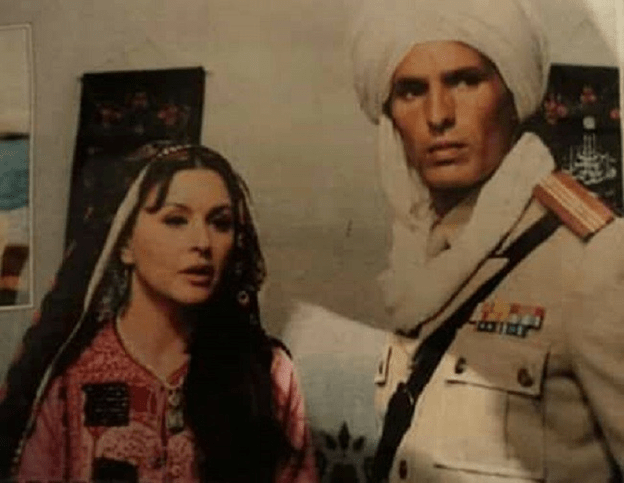
We all know the veteran director Mustafa Al-Akkad for his two famous films: Omar Al-Mukhtar and The Message…but what many do not know is that Al-Akkad directed a film no less genius than his previous two works, with the participation of director Abdullah Al-Mesbahi, in whose name the work was produced. It shed light on the Soviet occupation of Afghanistan and America’s plan to occupy the country after the expulsion of the Soviet Union, and predicted their collapse in the face of the struggle of the Afghans. “Afghanistan Why”, or “Afghanistan… God and His Enemies”, is an Arabic film produced in 1984 by directors Abdullah Al-Mesbahi and Mustafa Al-Akkad. It was filmed in the Moroccan regions of Tetouan M’diq and Chefchaouen, and deals with the Soviet occupation of Afghanistan. The film stars several Arab and foreign stars, such as the Greek Irene Pappas, the late Egyptians Abdullah Ghaith and Soad Hosni, in addition to the American actor Sean Connery. The film was banned from showing for political reasons, and remains in the safes of the Moroccan Film Center until today. In the following lines, we present the story of this film and the reasons behind its ban, to redraw a complete picture of one of the most mysterious films in the history of Arab cinema.
Film implications
The Soviets occupied Afghanistan in late 1979 to defend the ruling regime that was loyal to Moscow in the face of the protest movements that almost overthrew it. In light of the American-led international rejection of the Soviet occupation, Washington, Riyadh, and other capitals began to support the armed resistance movements of the “Afghan Mujahideen” against the Soviets. Cinematically, the Moroccan director and screenwriter Abdallah Al-Mesbahi, whose religious upbringing and firm belief in national issues influenced his cinematic intellectual formation, decided to make his contribution and participate with his weapons in a cause in which he believed in the justice, to begin his actual steps to make his film “Afghanistan… Why?” Trying to win the Afghan issue. In 1983, Al-Mesbahi traveled to Pakistan to meet with the Afghan jihadists who had fled their country, in order to collect from them real information about the nature of the events and what their country witnessed under the occupation, in preparation for writing the film’s script.
Movie story
The story of the film, written by Al-Mesbahi, revolves around a university professor – played by the veteran Egyptian artist Abdullah Ghaith – who works at Kabul University and opposes the Soviet occupation of his country. He openly condemned colonialism and described it as an attack on the freedom of a peaceful people, which was confirmed by the cruelty of the occupying tyrants, who deliberately exaggerated their abuse of the Afghan people and provoked them by insulting their sanctities, such as burning the Holy Qur’an in public. In the face of this discontent, the university professor decides to gather a number of citizens and demands that they leave Kabul and head to Peshawar on the border with Pakistan. On their way, the university teacher spreads his call to confront the occupation, and within a short period this small group becomes a large force that includes hundreds of thousands who have decided to challenge the Soviets and expel them from their lands. But soon disagreements erupted between the Afghans themselves, as each group wanted to seize power and have the upper hand, and it was this internal conflict that later facilitated the penetration of American forces into these Afghan groups resisting the Soviet occupation.
Search for financing
Al-Mesbahi failed to obtain funding from the Arab League to film his film, which refused to participate in the production of a film that would anger the Soviets, so he decided to go to Saudi Arabia, but the spread of Wahhabism hindered the financing of a cinematic work that the Saudis still believed was forbidden at the time. But the writer’s insistence led to him succeeding in convincing some of his wealthy Saudi friends to contribute to financing the project, and through them he collected two million US dollars, to begin the first steps of production.
Mujahideen are artists!
At first, Al-Mesbahi agreed with the Pakistani government to film the film in the city of Peshawar, with the participation of the Afghan mujahideen themselves and with the help of the Pakistani army. However, he quickly changed his mind and decided to film the entire film in his country, Morocco, specifically in the city of Tetouan.
Akkad intervenes
At this time, veteran director Mustafa Akkad participated in establishing the film’s directorial work, giving it a global dimension, after his two experiences, “The Message” and “Omar Al-Mukhtar.” Akkad and Al-Mesbahi chose Chuck Conners, an American athlete who was famous for playing basketball and baseball and entered the field of acting in 1952, but he did not achieve great fame in cinema, and his roles on television were more important, and Giuliano Gemma, an Italian actor who found his opportunity in American cinema, where he was famous for playing cowboy roles and participating in historical war films. The Greek star Irene Pappas, who was famous for playing the roles of Arab characters in the films of director Mustafa Akkad, Al-Resala and Omar Al-Mukhtar, and the two Egyptian stars Souad Hosni and Abdullah Ghaith, in addition to a French actor named Marcel Bouzoufi, and more than 30 Moroccan actors, led by the actor Hamidou Benmesoud, in addition to thousands of extras from the city of Tetouan, also participated in the film.
Forbidden from displaying
Al-Mesbahi intended for the duration of the film to be 3 hours, like any major production, and he was able to complete 70 minutes of it, meaning approximately two and a half hours. All that remained were the battle scenes that relied on weapons, tanks, and army trucks, which would have taken the remaining half an hour. However, the Moroccan army refused to allow him to use military vehicles in filming without explaining the reasons, so filming stopped completely. The film stopped completely at this point, as problems arose for Al-Mesbahi, and in the midst of the struggle over the film, the head of the Moroccan Film Center decided to withdraw Al-Mesbahi’s license to work as a director and closed his film company. He also seized the parts of the film that had been filmed, declaring a ban on its showing. Since then, the film – of which Al-Mesbahi did not own any other copies – has been imprisoned and detained inside the drawers of the Moroccan Film Centre.
Evaluation of a work that was not shown!
The major crisis in the film was its extraordinary ability to read reality to anticipate the future, which was proven by the following events in a way that raises astonishment, and invites those interested in studying the history of cinema to pause for a long time in front of the film “Afghanistan… Why?”, which analysis of the ideas presented by the film can invite us to reconsider the role of cinema and its ability to read reality and the future. What reveals the film’s ingenuity is that it is still banned from showing until now. All films that were banned for political, religious, or other reasons came at a time when the equations changed and time changed and they became available for showing, except for the movie “Afghanistan… Why?”! The more they thought about showing it, the more they discovered that it was still not suitable for viewing, and they discovered that it was still an exceptionally revealing and scandalous film that would be difficult to make available to an audience who wanted to receive a specific dose of awareness.