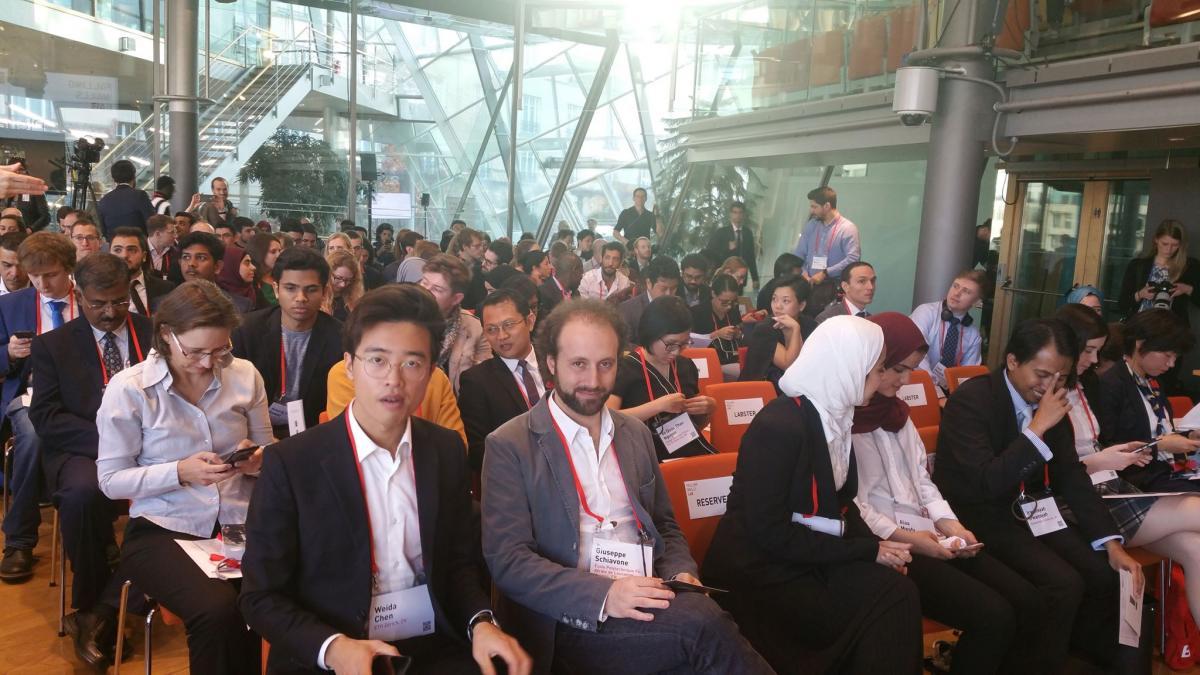
Part of the conference attendees – social networking sites
The German Falling Walls Foundation organized the Falling Walls Conference, which the Foundation holds every year on November 9 – the anniversary of the fall of the Berlin Wall in 1991. The conference is an annual and global gathering of future ideas, during which 20 of the world’s leading scientists are invited to Berlin to present their advanced research, with the participation of 80 countries with their youth and researchers, with the aim of addressing two questions: What are the next scientific walls that will fall? And how? According to Omar Al-Hayani, a Yemeni journalist specializing in scientific affairs in Germany, the conference reflects the transformation of the memory of the falling walls in central Berlin into a window to science, a memory that since the unification of Germany represents an occasion to look toward the future with science, as the fall of the walls had another meaning in the minds of scientists and an attempt to break the stagnation of scientific ideas and reach a deeper and global understanding of scientific problems. As a symbol of the fall of walls and the reunification of Germany, the philosophy of the conference stems from adopting the overthrow of barriers that arise between scientists and scientific centers in different countries of the world by considering science a human right for all. Chairman of the Board of Directors of the Falling Walls Foundation, Professor Jürgen Melnyk, said in press statements that “scientists must intervene more,” and that there is a need for “European cohesion and solidarity, with which we need better scientific cooperation, otherwise we will not be able to keep up with the United States and China.” However, “even these large countries are not able to confront future scientific issues and challenges alone.” He continues, “It is necessary and important to bring forces together in various parts of the world, and to put aside partial and private interests. Here, falling walls can play an important role, with scientists from all over the world displaying to everyone the social value of their work.” 100 contestants from 60 countries participated in the conference, the result of researchers who were selected through local competitions that took place over a period of months, among more than 3,000 contestants around the world. Each participant received only three minutes to present his idea to the committee of contestants and attendees, during which the contestants presented their innovations and solutions from artificial intelligence, to coffee tree medicines, to models that simulate the human body and help surgeons and medical students in education and carrying out operations in a scientific and accurate manner. The presentation concluded with the announcement of the winning innovative projects, where the Egyptian doctor Ahmed Ghazi, a professor at the University of Rochester, USA, won first place, for inventing a medical model that simulates the organs of the human body in an attempt to help surgeons by simulating operations before performing them, which helps them carry out delicate operations in a practical and accurate manner, in addition to being an ideal model of the human body that medical college students benefit from in their training applications.