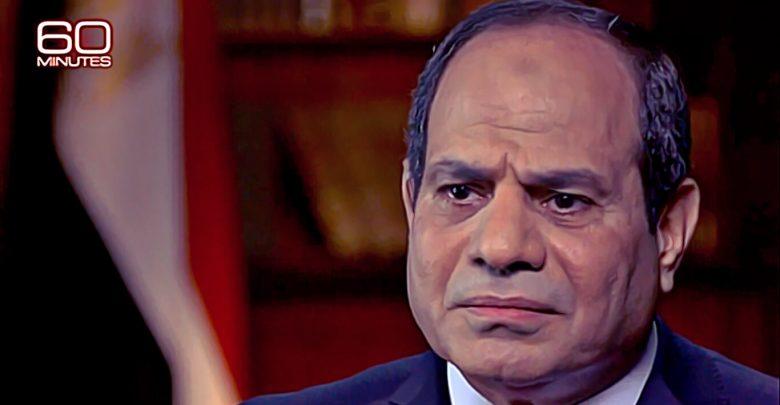
Al-Sisi in a 90-minute interview – social networking sites
“The interview that Egypt requests not to be broadcast.” With this exciting title, the American network CBS led the interview it conducted with Egyptian President Abdel Fattah El-Sisi, and broadcast it on the 60 Minutes program on January 6, 2019, after confirming the request of the Egyptian ambassador in Washington not to broadcast the interview, which opened the door to speculation about what El-Sisi said during the meeting and prompted him to demand that it not be broadcast. The 60 Minutes program has been broadcast every Sunday evening on CBS for half a century, and the serious program has succeeded in being at the top of the viewership with 14 million viewers weekly, and has become the most important program on American, and perhaps international, screens, as described by media researcher Muhammad Al-Minshawy, in his article “Half a Century of Sixty Minutes.” Middle Eastern leaders had a large share of the interests of the 60 Minutes program, and former President Hosni Mubarak appeared with them, and before him President Anwar Sadat, and because of the program’s stature and glamor, both Presidents Barack Obama and Donald Trump chose it for their first appearance after achieving victory in the 2008 and 2016 elections. Hence, the importance of this program comes as it is one of the most important pillars of international investigative journalism, the most watched program in American society, and the most prominent presence in the world of American politics. What did Sisi say during this meeting?
Cooperation with Israel
Al-Sisi revealed that the reasons for military and intelligence cooperation with “Israel” are to maintain the security of Sinai, while he refused to answer the question about the reason for not eliminating militants yet in Sinai, citing America’s failure to also eliminate terrorism in Afghanistan, ignoring that America is an external occupying party, while the Egyptian army is supposed to be the national army with absolute control. In response to a question about whether cooperation with “Israel” is the deepest and most intense in the history of the relations of two former enemies who were at war at one time, “Al-Sisi” said: “This is true,” and added: “The Egyptian Air Force sometimes needs to cross the border into “Israel,” and that is why we have broad cooperation with the Israelis.” He added: “The Egyptian army works with Israel against terrorists in North Sinai.”
High treason
Al-Sisi’s statements in Egyptian law can be considered an admission of the crime of high treason, as he acknowledged the use of a foreign army in targeting Egyptian citizens on Egyptian territory, especially since most of the victims of the operations in Sinai were unarmed civilians. This also constitutes an implication of Israel itself in what some see as crimes against humanity, according to Al-Sisi’s admission. Al-Sisi’s statements regarding military and intelligence cooperation with Israel were also in contrast to those statements in which the Egyptian regime has always denied any form of military cooperation with Israel, and emphasized that operations in Sinai are carried out by the Egyptian army only.
Political prisoners
Al-Sisi stressed that there are no political detainees or prisoners of conscience in Egypt, but rather he stands against extremists who are trying to impose their ideology on people, and they are subject to fair trials that may last for years. When asked about the Human Rights Watch report that says, “Egypt has 60,000 political detainees,” Al-Sisi said that he does not know where they got this number from, and that if there is a minority trying to impose its vision, we must intervene regardless of their number. Al-Sisi denied that the reason for banning the Muslim Brotherhood is that they are the main opposition in Egypt. Sisi continued: “We only deal with extremists who carry weapons and we welcome them to live among the people, but we do not want them to carry weapons and destroy the Egyptian economy.”
Ignoring the facts
These statements represent an acknowledgment by Sisi that there are prisoners not because they are politicians, from his point of view, but that they are extremists and carried weapons. He did not mention the number of prisoners, and Sisi ignored the fact that President Morsi was in the presidential palace and did not carry a weapon, as well as the elected Speaker of the Egyptian Parliament, Dr. Saad al-Katatni, who was arrested on the night of the coup, and other leaders of the Alliance to Support Legitimacy. He also ignored Lieutenant General Sami Anan, Dr. Abdel Moneim Abu Al-Futouh, Ambassador Masoum Marzouk, Counselor Hisham Genena, and other leaders and symbols of civil forces, which gives the impression that Al-Sisi’s definition of extremism is the one who opposes it.
Dispersal of the Rabaa sit-in
Al-Sisi refused to comment on a question related to the refusal of a number of Egyptians to describe him as the president and described him as a military dictator. He merely pointed out that there were 30 million Egyptians who took to the streets to reject the ruling regime at that time, and that it was necessary to respond to their will, and restoring security again required some measures. He refused to answer a question regarding his giving orders to disperse the Rab’a sit-in, as he was responsible for security at that time. He merely asked the program presenter a question about his careful monitoring of the situation in Egypt, and about the sources from which he obtained information. Sisi then pointed out that the Rab’a sit-in had contained thousands of armed men for more than 40 days and said: “We tried by all peaceful means to disperse them,” which directly means that he used something else after the 40 days. Al-Sisi denied what was stated in the Human Rights Watch report that the dispersal of the Rabaa Square sit-in was carried out using troop carriers, armored vehicles, bulldozers, ground forces and snipers, and that police and army men attacked the sit-in and killed hundreds by shooting them in the heads and necks. Al-Sisi confirmed that there were police personnel trying to open safe corridors so that people could go safely to their homes.
Mass murder
Al-Sisi’s response here also represents an indirect acknowledgment of the crime of mass murder in the Rab’a massacre, as he did not deny, despite being asked a question, his responsibility for what happened in Rab’a, and he defended himself by saying that thousands were armed at the Rab’a sit-in, despite the television report showing the Minister of the Interior at that time talking about only 12 weapons that were seized, so the report clearly confirms Sisi’s lack of credibility.
The program reveals more
The 60 Minutes program not only showed the episode, but also showed a video recording explaining some of the behind-the-scenes and circumstances of his meeting with Sisi, through a set of questions directed to the program’s presenter, “Scott Pelley,” and the program’s producer, “Rachel Moorhouse.” The most prominent thing in this video was Billy and Rachel’s astonishment at the Egyptian embassy’s request not to broadcast the episode, something that had never happened to them during their years of work on the program. Morehouse pointed to the strong pressure that continued to stop broadcasting the episode, and the Egyptian delegation, through the Egyptian ambassador in Washington and the head of Egyptian intelligence, to negotiate with her in this regard. At the same time, Billy pointed to Al-Sisi’s horrific record of abusing human rights, according to reports from the United Nations and the US State Department, and his killing of eight hundred demonstrators in the streets of Cairo, which Billy saw as an opportunity that must be seized by asking questions about these practices, which no one could ask Al-Sisi inside Egypt. Billy wondered how a president could be a guest on the 60 Minutes program without expecting questions of this kind to be asked.
Foreign media monitors the dialogue
The British newspaper The Daily Mail published a report entitled: “Egypt is trying and failing to stop the broadcast of an interview with Sisi on the “60 Minutes” program. The report indicated that Sisi completely denied the presence of political prisoners in his prisons, despite documented reports by Human Rights Watch and other human rights organizations. As for the Financial Times, it published a report entitled: “Egypt is trying to prevent the broadcast of Sisi’s interview with the 60 Minutes program,” in which it focused on the conflicting statements of Sisi about close cooperation with Israel and his denials. Egyptian army press reports circulated in February last year about security cooperation with Israel, which reached the point of Israeli aircraft carrying out air strikes against targets it claimed were ISIS in Sinai, with the approval of the Egyptian authorities, as stated in a New York Times report in this regard. The Voice of America website published a report entitled: “The Egyptian authorities are trying to stop the broadcast of Sisi’s interview with the 60 Minutes program,” which dealt with the interview and the Egyptian authorities’ request not to broadcast it. The report added that the producer of the “60 Minutes” program said in a video clip posted to her on Twitter, “We understood that he was fond of.” He loved appearing, and he wanted to appear as a prominent figure among some of the powerful leaders in the Middle East, so we informed him that powerful leaders always attend the interviews conducted by the “60 Minutes” program. As for the BBC website, it published a report entitled: “Why does Sisi want to stop the interview conducted with him by CBS,” saying that Sisi’s confirmation of military cooperation with Israel in North Sinai may be a controversial matter in Egypt, where the two countries fought four wars before signing a peace treaty in 1979. As for the New York Times, it published a report titled: “Sisi acknowledges close coordination with Israel in Sinai.” The report stated that Sisi made a rare acknowledgment of close security cooperation with Israel in the Sinai Peninsula during the television interview, and that acknowledging this cooperation with Israel could be a sensitive issue in Egypt. The Washington Post published an article by former Egyptian Minister of Investment, Yehia Hamed, entitled “Why is Sisi afraid of broadcasting his interview with CBS?” The article stated that confronting the free media, Sisi showed himself to be fragile and afraid of being held accountable for his crimes, and that the support that Sisi received from people like President Trump and Western leaders was what emboldened him for his actions, noting that Sisi’s story that he was “fighting” was believed. Extremism” in a way, and Sisi believed that this gave him carte blanche to do as he pleased.
Sisi got himself into trouble
Al-Sisi responded to the trap of wanting to appear on a program in which celebrities appeared, and relied on himself without the presence of institutions advising him on how to deal with professional programs such as 60 Minutes, which had a negative impact on the appearance that Al-Sisi appeared during the interview, as his body language, the sweat that was pouring from his face, and the way he sat appeared as if he was being interrogated in front of the program presenter. In general, this episode would contribute, with its strong influence, to presenting a negative image of Sisi, which may be reflected in his relations with American decision-making institutions in the coming period, especially the Democratic majority in the House of Representatives, and its opposing tendencies to Trump’s foreign tendencies, and his relations with regimes with a negative human rights record, including Sisi’s regime.