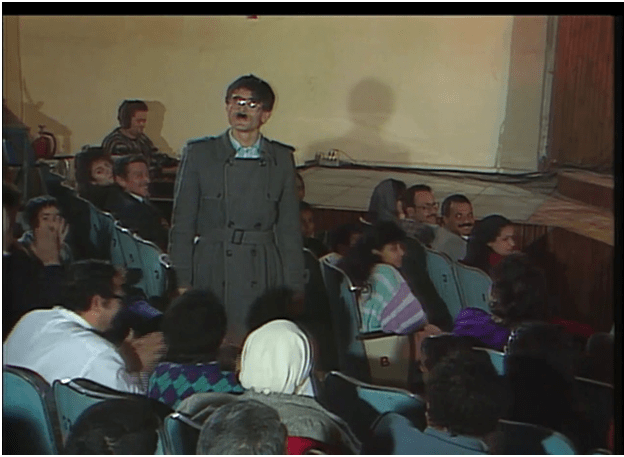
- Sobhi among the audience of the play – Image source: social networking sites
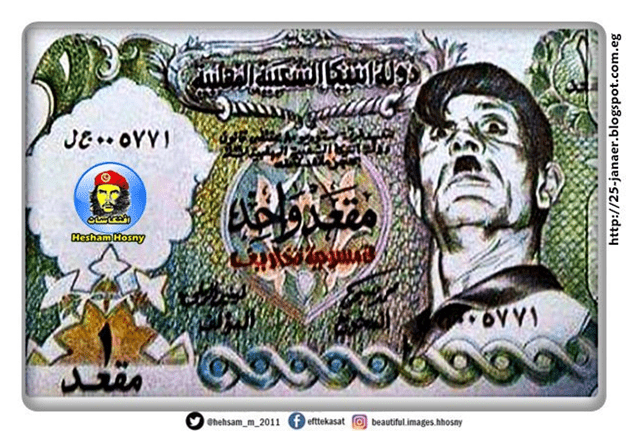
What would you ask if a goblin appeared in Aladdin’s lamp to grant you one wish and fulfill it instantly? Could that wish reflect your hidden secrets? Can your ambitions in life be reduced to harming another person? The comedy play “Takareef” puts you in the atmosphere of an imaginary experience of this situation, and reveals to you the depths of people’s souls when they seize a once-in-a-lifetime opportunity to fulfill their lifelong wishes in the blink of an eye. The play “Takhareef”, a theatrical work of the type of satirical comedy, was shown on January 13, 1988 at the New Opera Theater, in Cairo… Written by Lenin Al-Ramli, starring and directed by the artist Mohamed Sobhi, and co-starring with Hanaa El-Shorbagy, Shaaban Hussein, Azza Labib, Abdullah Musharraf, Abdullah Saad, Hani Ramzy, Yasser Sadiq, and Mustafa Taha… It was directed for television. On March 9, 1989, directed by Jalal Al-Sharqawi. The play has achieved great success since its launch in 1988 AD, and in order to preserve the comedic sense of the play, the entry ticket carried a sense of humor and fun, as the phrase “The Pudding Popular State of Antica” appeared on the front of the ticket, and next to it was a picture of the play’s star, Mohamed Sobhi, portraying one of the play’s characters.
Story of the play:
The play tells the story of six brothers to whom a demon appears to grant their wishes immediately. Each of them requests a different wish, in which it narrates the thoughts and dreams that come to a person in a comedic context. The play came in five chapters, each of which presented a wish for one of the brothers, and came as follows: – The wish for power: One of the brothers asks to dominate and control the people, so he asks to be the ruler of a country without any knowledge of politics or even obtaining any respectable degree or completing his education, so he turns into an unjust dictator who tortures and starves his people until they revolt against him. It presents an imitation of the Nazi leader Hitler and some Arab leaders in a comedic context. – The Wish of Strength: It tells the story of one of the weak brothers. He asked the genie to make him strong, but when he granted him his wish, he found that the strength of the body is not the most important, but what is important is the strength of the mind, and Mohamed Sobhi ably imitates the American actor Sylvester Stallone in the movie Rocky. – Attractiveness Wish: One of the brothers asks to attract and charm women because he cannot fall in love or have any relationship because of his long nose. – Wealth Wish: One of the brothers wants to be rich and has a very large fortune, and believes that everything can be bought with money and that money is the most important thing in life, but he loses all his wealth and falls ill. – The Equality Wish: The only daughter of the brothers asks to be equal in everything with men, especially her husband, and she turns into a monster, half man and half woman.
Theatrical messages
The play reveals man’s inadequate view of life, and how his pursuit of perfection is mixed with naivety that hides from him the most important aspect of the page he is searching for. Power without awareness is destruction, power without knowledge turns into absolute dictatorship, and a woman’s escaping her femininity turns her into a monster lacking identity and mission. The work in general is good, and it was able to convey its message in a satirical, comedic manner, with frequent political and social projections. However, the flaw of the play – as is usual in Sobhi’s theatrical works – is excessive essayism, as it began with a long introduction by the artist Mohamed Sobhi in which he explains the goal and message of the play, and it would have been more appropriate for the work itself to explain its aim and purpose through the scenario. The play is also criticized for the weak presence of the second-line actors, and the control of the artist Mohamed Sobhi over it, but he is forgiven for his proficiency in the five roles that he presented during the work, among which was a complex female character…but the work as a whole is distinguished in terms of its material, its idea, and the message that it carried.
Its approach to the Egyptian Theater
But what is striking is that the play is closer in form to the Egyptian theater model presented by the artist Ashraf Abdel Baqi with his young theatrical team, which restored the Egyptian television theater’s momentum despite the widespread criticism launched by Mohamed Sobhi against Abdel Baqi’s experience, accusing him of being the reason for the weakness of Egyptian theatre. In general, the play represents one of Sobhi’s creations during his golden age on the stage. It received the approval of audiences since its first showing, achieved wide interaction and good reactions, and maintained a recurring presence on the silver screen. To this day, it still represents an icon in the history of modern Egyptian theatre.
Link The play on YouTube