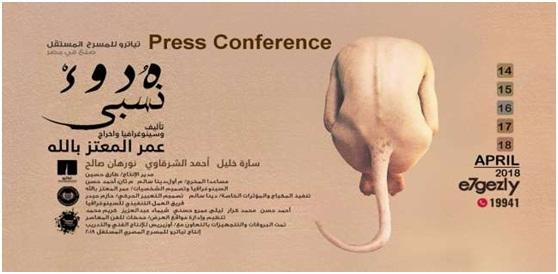
Do you remember the deadly chaos in the global cinematic horror icon “House of Dead” with its strange characters and its author’s imagination steeped in structure and complexity? The directors say that this film took four full years of complex editing work to produce, to produce this terrifying, surreal, metaphysical state. What do you think of a work that offers you the same dose, but without technical treatment, and right in front of your eyes, on stage? Welcome to “Relative Calm”, the first horror play in Egypt and the Arab world. At 8 Emad El-Din Street in central Cairo, there is an abandoned house. The “Teatro Independent Theater” team decided that the theater for the first night of their terrifying experience would be “relatively calm,” so that the first show in mid-April would be crowned with a remarkable presence of the theatrical work, which was written, directed, and scenography by Omar Al-Moataz Billah.
The audience is among the heroes
The show is not presented on a stage, and the audience does not sit on chairs. Rather, the audience moves for 60 minutes inside the abandoned house in order to see every detail of the show, a unique and pioneering experience attended by only 100 spectators every day over 5 consecutive days of continuous show. The show received censorship approval under a 16+ rating; Because the location of the show and the scenes in it are not suitable for children to watch, but there are no extraneous scenes in it, and the audience participating in the show leaves their phones, and those in charge of the work hand them a number of tools without explaining to them the reason for them, but these tools are inevitably necessary and are discovered by the viewers within the show.
Offer details
In the first moment of the show, a loud voice rises, shaking the corners of the abandoned house (the stage of the show): “From now on, nothing around you is normal or rational,” leaving the audience to discover the special logic of what will happen.. The show begins with regular blows of a cleaver on the thigh bone of an unknown animal, and in the background there is terrifying music interspersed with the meowing of an angry cat. You suddenly discover that you are thrown into the middle of a scene that embodies a return to primitivism; The girl’s human clothes, the filth, the crumbled animal bones, the candle lighting and the photographic negative on the wall stained with blood. Suddenly, a monster descends with a pig’s head, heavy, rasping animal breaths, and worried, indifferent looks. He advances monotonously, opens a door, and descends a staircase, followed by the human girl. This is the way to the theatrical space of the show, the home of the last remaining family of mutant humans on Earth before the end of the universe and the end of technological development. The girl asks him: “What happened to him?” He answers her: “Maybe he died!” So the human girl decides to make use of the dead male monster’s corpse, and lifts him onto a meat hook to hang him just as she hung a huge slaughtered animal before. She keeps raising it and sharpening her long knives to begin cutting it, leaving us with the premonition that the femur bone we saw at the beginning of the entry is the bone of another departed monster.
Action items
The music throughout the show was terrifying and sad, and it succeeded in performing its mission in deepening the state of frustration, melancholy, and sense of loss. The makers dealt with the elements of the show with an iron fist in order to maintain this level of apparent calm at the level of sound, lighting, the movement of the characters and their voices, and then the rhythm of the work as a whole. Although the atmosphere of the work puts you in a state of obsession with threat and anticipation, and you are waiting to hear a scream from one of the characters or a loud uprising of music and sound effects… this does not happen, and perhaps this is the reason for choosing “relative calm” as the title of the show.
A monster with a TV head
The show is searching for death, waiting for it, trying to convince us that there is still time for us to survive the slow, gradual decline in technology that will destroy our lives. This is how it embodies the end scene when a monster with a TV head appears at the site of the final destruction, looking at the audience one by one with provocative robotic gestures, as if shouting at us: Yes, I am the one who did it. At the end of the show, the audience does not get a state of “purification” as is usually the case with theatrical performances; Rather, viewers drink a long-acting dose of “involvement” in questions of the self, existence, and fate, and then leave with their eyes full of questions, carrying with them medical bracelets that they received along with the protective equipment before the show, perhaps to remind them of the message that the creators of the work send to each of them: “You are also in danger. Never forget this.”