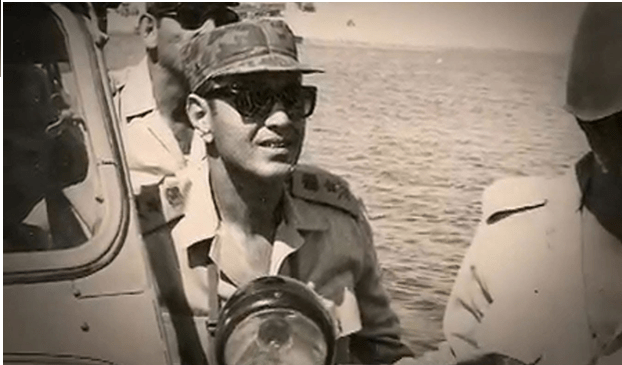
The book of history does not contain all the heroes, and tyrannical rulers do not accept leadership partnerships, and the victories of wars cannot be divided into two.. The October 1973 war has remained an icon of the “political wing of the Egyptian army,” which has been in control of ruling the country since Gamal Abdel Nasser’s coup against President Mohamed Naguib in the early fifties before handing over power to civilians as was planned for the July 1952 revolution. For this reason, the presence of the great Egyptian general, Lieutenant General Saad El-Din, was Al-Shazly, the architect of the October victory, was unwanted by President Sadat, and after him Hosni Mubarak. The propaganda of Sadat and Mubarak was based on establishing their rule among the Egyptian masses as heroes of war and peace, and the exclusive creators of October’s victory. Therefore, obliterating Chadli’s identity represented a victory over the greatest threat, and a theft of the achievement of a military man who loved his homeland and land, understood the nature of the conflict with the Zionist enemy, and knew that the October victory was not the end, but rather was merely the starting whistle. He was the one who said that “the conflict between the Arabs and Israel is an eternal and fateful conflict… and the slogan that It was raised by Sadat and repeated by Arab leaders after him, saying that the October 1973 war was the last war. It is a false, misleading and defeatist slogan.
His birth and upbringing:
Al-Shazly was born in April 1922, in the village of “Shabratna” in the center of Basyoun in Gharbia Governorate. He joined the Military College in February 1939. He was 17 years old at the time. He graduated with the rank of lieutenant in July 1940. He was then assigned to serve in the Royal Guard from 1943 to 1949. He participated in the Palestine War in 1948 as part of a royal company sent by the palace. He joined the Free Officers in 1951, founded the first paratrooper forces in Egypt in 1954, participated in repelling the tripartite aggression against Egypt in 1956, participated in the Yemen war as commander of an infantry brigade between 1965 and 1966, and formed a group of special forces later known as (the Al-Shazly Group) in 1967, whose vital role in the events of the setback became evident.
Turning point
When the 1967 setback occurred, Al-Shazly was in the rank of major general, leading a unit of Egyptian Special Forces with a total of about 1,500 soldiers, known as the “Al-Shazly Group,” on a mission to guard central Sinai… and in the midst of the worst defeat witnessed by the Egyptian army in the modern era and the interruption of communications with the Egyptian leadership, and as a result of the loss of communication between Al-Shazly and the army leadership in Sinai, Al-Shazly made a bold decision, crossing the international border with his forces before sunset. June 5, and stationed his forces about five kilometers inside the occupied Palestinian territories, and remained there for two days until contact was made with the Egyptian General Command, which issued orders to him to withdraw immediately. Al-Shazly responded to the orders and began his withdrawal at night, before sunset on June 8, under extremely difficult circumstances, as he was walking in territory completely controlled by the enemy, without any air support, and with minimal supplies. He was able, with rare craftsmanship, to cross the entire territory of Sinai from the east to the western shore of the Suez Canal (about 200 km). He succeeded in returning his forces and equipment to the Egyptian army safely, avoiding Israeli fire, and sustaining losses of 10% to 20%. He was the last Egyptian commander to withdraw his forces from Sinai.
His rise to leadership:
After this incident, he gained a great reputation in the ranks of the Egyptian army, so he was appointed commander of the Special Forces, the Thunderbolts, and the Parachutes. This was the first and last time in Egyptian history that the paratroopers and the Thunderbolts forces were included in a unified force, the Special Forces. On May 16, 1971, one day after President Sadat overthrew the leaders of the Nasserist regime, in what he called the Correction Revolution, El-Shazly was appointed Chief of Staff of the Egyptian Armed Forces, given that he owed loyalty only to the honor of soldiering, and was not affiliated with any of the combatants on the Egyptian political scene at that time.
His role in the October War
On October 6, 1973, at 14:05 (five minutes past two in the afternoon), the Egyptian and Syrian armies launched a sweeping attack on Israel, along both fronts, and the Egyptian army implemented the “high minarets” plan developed by Lieutenant General Al-Shazly with unexpected success. So much so that Al-Shazly says in His book “October War”: “In the first 24 hours of fighting, the General Command did not issue any order to any sub-unit. Our forces were performing their tasks with the utmost efficiency, ease and ease, as if they were performing a tactical training column.” During that time, an American reconnaissance plane, which the Egyptian air defenses could not shoot down due to its speed, which reached three times the speed of sound and its high altitude, discovered the existence of a gap between the Third Army in Suez and the Second Army in Ismailia. The Americans informed Israel, and Ariel Sharon, commander of one of the Israeli armored divisions, succeeded in crossing to the west of the canal from the gap between the Second and Third Armies, at the Defersoir area near the Bitter Lakes, with a limited force on the night of October 16, amounting to 6 brigades. Armored and 3 infantry brigades. On October 17, Lieutenant General Chadli demanded the withdrawal of 4 armored brigades from east to west. To increase the stranglehold on the Israeli forces in the west, and to eliminate them completely, knowing that the Israeli forces on October 17 were only an armored brigade and a parachute brigade, and Lieutenant General Al-Shazly expected an additional Israeli brigade to cross at night, so he demanded the withdrawal of 4 armored brigades in anticipation of that, and he was content with having the Egyptian forces fight under the umbrella of air defense and with the help of Egyptian aviation, which would guarantee overwhelming Egyptian superiority and the gap would be completely destroyed. From Al-Shazly’s point of view, this plan is considered an implementation of one of the principles of modern warfare, which is “maneuvering with forces,” knowing that the withdrawal of these brigades would not have had any effect on the situation of the five infantry divisions stationed in the east. However, Sadat and Ahmed Ismail strongly rejected this matter, claiming that the Egyptian soldiers had a psychological complex regarding the process of withdrawing to the West since the setback of 1967, and therefore they refused to withdraw any forces from the east to the west, and here matters reached the stage of divorce between them and Al-Shazly.
Discharged from the army:
On December 13, 1973 AD, at the peak of his military work after the October War, Lieutenant General Chadli was discharged from the army by President Anwar Sadat and appointed as Egypt’s ambassador to England and then Portugal. It was as if God had thus protected him from involvement in the Camp David Accords, which he strongly criticized in 1978 and opposed publicly, which made him make the decision to leave his position and go to Algeria as a political refugee.
In exile
Al-Shazli invested his stay in Algeria in writing his memoirs about the war, in which he accused Sadat of making wrong decisions despite all the advice of those around him during the course of operations on the front, which led to causing the breach and misleading the people by concealing the truth of the breach, destroying the missile wall, and besieging the Third Army for a period exceeding three months, as supplies were arriving to them under the supervision of the Israeli army, in exchange for secret concessions. Sadat did not accept Chadli’s rebellion, so he fabricated several political and criminal cases against him, issued a ruling to imprison him, and placed him on waiting lists. This is a case whose ruling was actually implemented by Chadli during the era of Mubarak, who continued his blatant persecution, reaching the point of forging photos of the October War operations room, in which Mubarak put his picture in place of the picture of Chadli himself!
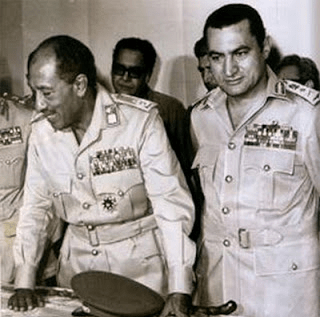
A fabricated photo showing Hosni Mubarak instead of Lieutenant General Chadli
Al-Shazly returned to Egypt in 1992, after 14 years he spent in exile in Algeria, despite receiving repeated guarantees that he would not be harmed. However, he was arrested upon his arrival at Cairo Airport, and all medals and medals were confiscated, and he was forced to serve his prison sentence without trial, even though Egyptian law stipulates that judicial rulings issued in absentia must be subject to another new trial. Al-Shazly was released from prison to return to his hometown in a life resembling a siege, during which he did not appear in the Egyptian media, and no one would have felt his presence had it not been for some episodes recorded with him. International channelsBecause of his testimony to the events and conferences in which he participated, whether present or speaking on the anniversary of the war every year, Mubarak earned the title of war hero, while its hero and most prominent icon lived in house arrest at his home.
His death:
Al-Shazly died on Thursday, February 10, 2011 AD, in the midst of the January Revolution, in his bed at the International Medical Center of the Armed Forces, at the age of 88, which he spent serving his country efficiently and faithfully, after a long illness. Al-Shazly was held in a solemn military and popular funeral after Friday prayers, on the same day in which it was announced that President Hosni Mubarak would step down from his position as President of the Republic.
Honor him
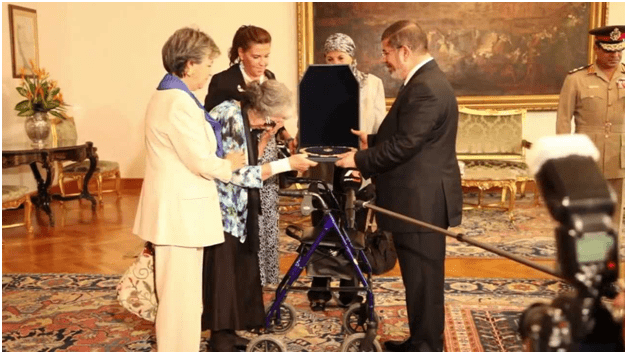
The Supreme Council of the Armed Forces returned the Sinai Star to the family of Lieutenant General El-Shazly, two weeks after the ousted Hosni Mubarak stepped down. On October 3, 2012, President Mohamed Morsi awarded the name Saad El-Din El-Shazly the Great Nile Necklace, and handed it over to his family himself, in honor of his role in the October War. Cameras documented his wife’s crying over the honor he had finally received in the hands of a civilian president, while his military peers deprived him of it.