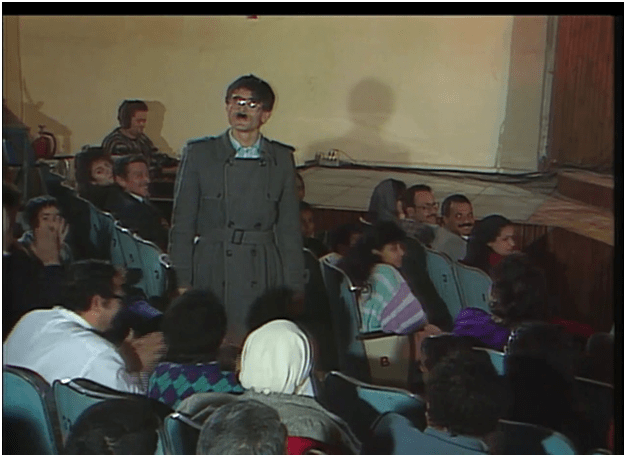
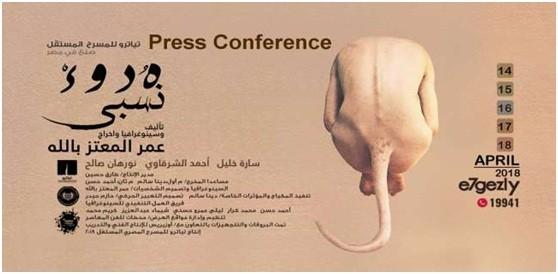
Some creative works achieve immortality, and actors compete to embody them, generation after generation. This is indeed what happened with the masterpiece of the Egyptian playwright and screenwriter. Saad El-Din Wahba“,”Sikkat al-Salama“, which was embodied in three different theatrical works, with the participation of the stars of the generations participating in each of its versions. The beginning was 1964Directed by Egyptian theater giant Saad Ardash, and starring Samiha Ayoub (the author’s wife), Tawfiq Al-Daqen, Shafiq Nour El-Din, Abdel Moneim Ibrahim, Abdel Salam Muhammad, and Rajaa Hussein… and it revolves around Her story It is about a bus with its passengers getting lost in the Egyptian Western Desert. The play presents human models represented by the bus passengers and the mistakes and sins of each passenger. When they are about to die of hunger and thirst, each of them declares his repentance and decides to reform himself. (To watch the play: Here)
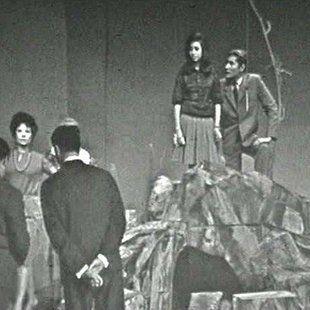
- The first version of the play
The second time, and the most prominent, was in the early 2000s, and was titled “Safety rail 2000“, directed by and starring Egyptian artist Mohamed Sobhi, and it is New formulation The play revolves around a group of travelers on a bus to the Egyptian city of Sharm El-Sheikh. They lose their way and become alone in the vast Sinai desert on the border with the Zionist occupation. They find themselves forced to choose between death or seeking help from the occupation soldiers. The last theatrical presentation of the work was titled “Safety rail 2016“, at the Pioneers Theater in Cairo, starring the artist Badran Badri, and directed by Safa El-Din Shukri… and it revolves around… Her story At Sea, and tells the story of human models represented by the passengers of a ship who nearly died of hunger and thirst after the ship lost its way, so each of them declares his repentance and decides to reform himself.
- No to normalization
“Mohamed Sobhi shouts against normalization on the road to safety”… something like this Exciting titleIn March 2001, the news platforms presented the first scenes of the anticipated theatrical work, in which the starring role is played by the artist Mohamed Sobhi, whose name was at the forefront of the political scene after the announcement of his participation in filming an anti-Zionist series under the name “A Knight Without a Horse,” which began broadcasting the year following the start of the play, in 2002. The play reviews the negatives of each of its heroes, which are revealed by these difficult circumstances, and when they are about to die, each of them begins to… Atonement for his sins, but Muhammad Sobhi flavored it with a political nature about the Arab-Zionist conflict, and clarifies his concept of peace through the dynamics of the characters in the play. In a press conference held in Beirut, which witnessed the first performance of the play at the Palace of Versailles Theater in early March 2001, Sobhi said that in the play he would address the issue of normalization with the occupation, considering that the play’s main message is that “its imperfect characters will appear to have committed all evils and mistakes, but they refused normalization with Israel.”
Our Team
The artist Mohamed Sobhi participated in the second version of the theatrical work that was shown on television, in the role of Qarni Al-Regisir… Sobhi is an Egyptian actor, born on March 3, 1948 in the Egyptian Cairo Governorate. He graduated from the Higher Institute of Dramatic Arts, Department of Acting and Directing in 1971, then he was appointed as a teaching assistant at the institute, and he has many artistic works that included plays, films, and series. Among the most successful plays presented by Muhammad Sahbi are “The Joker,” “You Are Free,” “The Savage,” “The Two Parrots,” “Takreef,” “Hello Shalabi,” “Mama America,” “The Wanis Family,” “The Woman’s Game,” “Romeo and Juliet,” and “Safety Railway 2000,” which are covered in the report. Also participating in the work were actress Simone in the role of Soso the dancer, Shaaban Hussein in the role of Suleiman the bus driver, Khalil Morsi in the role of Fikri Abdel Salam, the journalist who agrees to normalization, Mahmoud Abu Zeid in the role of Othman Abdel Mawjoud, deputy of the People’s Assembly, Ayman Azab in the role of Hussein Abu Al-Saud, the failed chairman of the board of directors, Hamdi Al-Sayed in the role of Abu Al-Majd Al-Shabrawi, the bribed lawyer, Magdy Sobhi in the role of Muhammad Mohieddin, the traitorous husband, and Abeer Farouk in the role The unfaithful wife, Amal Ibrahim in the role of the enslaved woman Madam Julnar, Abdullah Musharraf in the role of the desert dweller, Shawqi Tantawi in the role of Al-Asti Owais, Muhammad Hassan in the role of Fattouh Fathi Fattouh, and Ayoub Ahmed in the role of Ismail Al-Bahrawi, the old businessman.
The message of the play
The play shows the hidden bad aspects of the participating heroes, and their attempts to declare sincere repentance sometimes and artificial repentance at other times, as a begging offering for salvation from the wandering they were subjected to in the desert after they lost their way, but their volatile conscience could not bear the crime of asking for help from the occupation soldiers, in reference to normalization. In professional symbolism for the cultural and political elite calling for normalization with the occupation, came the role of the distinguished journalist with wide influence, who continued throughout the play to sing of principles and morals, but he was soon the first to justify resorting to the occupation soldiers, while the dancer and registrar Qarni (Mohamed Sobhi) refused to be stigmatized with the shame of treason. At the end of the show, the play poses a question: If these fallen figures in society refused to normalize normalization with the occupation, what would be the position of the honorable people? Or as the hero of the play described himself: “About three years ago, several voices came out in the Arab region calling for normalization with the Zionist enemy in the largest attack by groups that say they love peace. Therefore, the play Sikkat al-Salamah came to constitute a cry against normalization.”
Work evaluation
The play was marred by a number of shortcomings that overcoming it would have contributed to its coming out in a more professional manner, such as the long dialogues that continued in some scenes of the play for nearly half a minute of continuous speech by one actor, as well as the essayism that emerged in some of its scenes, especially related to the Palestinian issue at the moment of the discovery of the cemetery of the martyred soldiers. But in general, the work as a whole is distinguished in terms of its material, its idea, the message it conveyed, and the timing of its presentation. It received the approval of the audiences at the time of its presentation, especially since it was a translation of the strong voices rejecting what was known as the “Arab Peace Initiative,” an initiative called for by Saudi King Abdullah bin Abdulaziz in the early 2000s at the Beirut summit, with the aim of settling the Palestinian issue and normalizing relations with the occupation, amid widespread popular protests, of which that play was one of its unique outcomes, and which to this day still represents a sign. Important in the history of Egyptian theatre. In the end, this play reflects the role of purposeful art in expressing the aspirations and demands of peoples. It also reveals the current state of the Arab artistic scene, which ignores the Palestinian issue despite the increasing pace of normalization within what has become known as the deal of the century, with the expansion of the Zionist occupation’s violations against the Palestinian people.