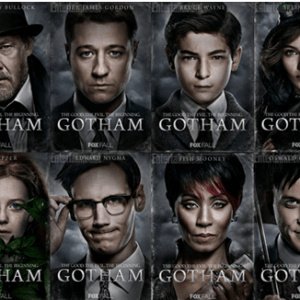
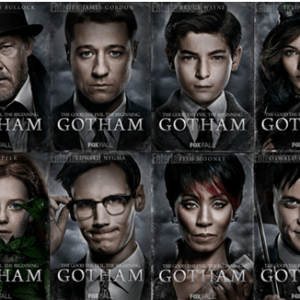
“Mr. Jordan, do I look to you like a man with a plan?!” With this inspiring answer, the greatest villain in the history of world cinema, the Joker, thwarted the attempts of Detective Jordan in the immortal mythology “Batman,” after he tried to discover something about his past or his future plans. The story of Batman has a special character in our memories. Anyone who has not seen it as a child in cartoon episodes will have seen it as a young man in one of its recurring versions. We all know Detective Gordon, the Joker, Harley, Two-Face, the Penguin, the Riddler and the Arkham Maniacs. But where did the Joker come from? How did this unique villain build his puzzling philosophy? How did a brilliant doctor like Harley fall in love with him? How did the penguin create all this hatred inside him? Why was Two-Face left to suffer twice and die in such a tragic way? Are the maniacs of Arkham really evil? What do you think of a work that tries to answer all of this? How did evil arise? Why did it take this violent dimension? Why did no attempt to bring them back to the right path succeed? Is Batman really good? Are his opponents always the bad guys? Exploring the history of Batman’s opponents and attempts to identify their first moments and unique transformations, taking the camera lens away from Batman a little and making room for his opponents to take the stage and gain attention…all of this was not far from the minds of writers and authors. There are works, most notably “The Suicide Squad” that tried to answer a little about all of this, but they never achieved the aspect of comprehensiveness, depth and philosophy. As for “Gotham” – which is a fictional American television series whose characters are inspired by the Batman series and bears the name of the city in which the events took place – it seems to be a unique work that attempts to delve into all of this, with the ample time it has, unlike the limited films, and a brilliant writer who arranges his scenes in complex mathematical equations, so the text never deviates from the mythology of the main story, which makes the viewer feel as if he is watching the rest of the famous film, without separation. The experience this time is different and very exciting, as the writer does not build the heroes of his work in a traditional progressive form, as is usual in metaphysical works of art. Rather, he relies entirely on your knowledge of the end of the story, so he enters directly into the subject, and shows you at length, how these evil heroes reached that final scene, mixing exciting philosophies within the folds of the scenes. There are many philosophical questions in the work, which are difficult for one article to enumerate, but the most prominent of them is that related to the great villain, the Clown: Why does the Joker – as an icon of evil – try to preserve Batman – the icon of goodness – in every possible way? Why is Batman unable every time to eliminate his arch enemy, even though he is completely defeated? And from where The Joker gained this confidence when he bet Batman that he couldn’t kill him, because he needed him? What value does the Joker find in Batman’s survival? Or rather, what value does each find in the other’s survival in the conflict? In Batman’s famous mock trial in Arkham Prison, “Harley”, the Joker’s assistant and one-sided lover, said that she was very grateful to Batman, because if he had not existed, the Joker would not have existed. Harley seemed very understanding of her master’s philosophy. Each of the two opponents complements the other and legitimizes its existence. Perhaps each of them found in the presence of the other a goal for his life, and perhaps each of them also knows that the disappearance of the other puts him in a corner of loss in search of a “battle” and a “goal.” The work – the fourth part of which is currently being presented – continues to convey a clear message, which is that in some battles their owners find warmth and resolution, and they go to great lengths to continue it as it is, perhaps because it gives them the lost heroism, or because they are afraid of the challenges of searching for a new opponent.. It seems difficult to find an opponent who makes you comfortable and you comfort him, you understand each other, and you keep for yourself in each other’s mind a family, a mixture, and a history. Since the first episode, the series has received praise and admiration from critics, with an average viewing of 7 million times per episode. On the website Rotten Tomatoes (the most famous site for evaluating American series), it received a score of 93% based on 68 reviewers, or an average rating of 7.3 out of 10. On the Metacritic website (for evaluating Hollywood works), it received a score of 72 out of 100, based on 33 reviewers. Reread the previous paragraph. Doesn’t it seem strange to find its words – “she” – as if they were describing relationships of love, affection, and passion? Can we say that all humankind’s conflicts are subject to the same considerations, no matter how different the angle of treatment is? Or does the matter not lie in good and evil, but in man’s constant need for a partner, who maintains the experience’s excitement and presence? Or is there some hidden relationship between the villain and the resistor, just as it connects the lover to the lover? Is this what the Joker was really trying to prove? maybe!