“We just want to make the world better. Better does not mean better for everyone, it always means worse for some.” Commander “Waterford” to his maid in the fourth episode of the series “Can We Get Used to Hell?” is a deep philosophical question that the series “The Handmaid’s Tale” or “The Handmaid’s Tale” – which won the Golden Globe and Emmy Awards for Best Drama of 2017, and Best Actress for the heroine “Elisabeth Moss” – is trying to answer, or At least it puts viewers on the road to searching for that answer. That question seemed clear in the work from the first episode. Aunt Lydia, one of the nannies who believe in the new state for maids, asks: “I know this seems strange now, but normal is just what we are accustomed to. What you are living now may not seem normal, but after a while it will seem normal… Can a person get used to hell?” The little maid looks at her stupidly before answering mechanically: “Let’s see that.”
Business story
The events of the series “The Handmaid’s Tale,” based on the novel of the same name by Canadian novelist and poet Margaret Atwood, published in 1985, take place in a not-so-distant future, where a religious dictatorship is established in what used to be the United States of America and is now called “Gilead.” Pollution with chemicals and nuclear radiation has caused high rates of infertility and birth defects, threatening a real disaster. The ruling group – which calls itself “the sons of Jacob” – sees the catastrophe besetting the world as a divine punishment for man’s disobedience and deviation from the teachings of God. And in a new world, he imposes himself with horror and blood. Child-bearing women herald “handmaids” as the mutual property of the leaders of the New World in order to conceive in place of their wives, akin to ritual rape, or as Offred (Elisabeth Moss) says: “We are not mistresses, we are wombs that walk on two legs.” Atwood does not prefer to classify her work as science fiction, but prefers to call it “speculative fiction.” Atwood’s novel belongs to the genre of dystopia, where the fictional imagination imagines a dark future for this world.
Religious connotations
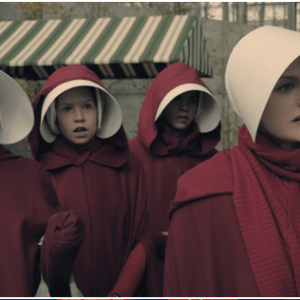
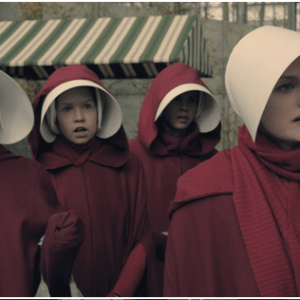
What is striking is that all the names mentioned in the narrative text of the series have their reference in the Bible, as the new world is a literal interpretation of the biblical book of Genesis. Even the colors carried a religious reference. The blue that the leaders’ wives wear refers to the Virgin Mary, who appears in icons and paintings wearing this color, while the red refers to the other Mary, Mary Magdalene, the sinful Mary, but red contains other connotations, the color of the blood of fertility that distinguishes female servants. Red is also the color of life, the color of extinguished desire and the color of embers burning under the ashes of Gilead. The possibility of revolution lies within it from the beginning, or as Offred says, “If they didn’t want us to become an army, then why did they give us uniforms?”
Dystopia through a woman’s eyes
For the first time, Atwood approaches dystopia through the eyes of a woman. The Handmaid’s Tale can be considered the feminist version of Orwell’s novel “1984”. Atwood actually wrote the novel in 1984, and it was published the following year. Where we see through the eyes of the maid, Offred, what the world has become. The script, prepared for television by Bruce Miller, chose to narrate the events most of the time through “Voice Over,” Offred’s inner monologues, as through her voice we experience Gilead’s nightmare. Her voice is the only place where she exercises her freedom, her sarcasm that escapes the eyes of observers and through her passes through her old spirit that has not yet faded. The text also resorts most of the time to “flashback,” achieving several goals through it, including delving into the characters’ past and their inner beings. This juxtaposition between the recent past and the nightmarish present makes you think anxiously that the world in your hands now could turn in the blink of an eye into a horrific nightmare. These memories give the viewer an outlet for some time away from the nightmare of Gilead, and finally these memories represent an act of resistance for Offred, the struggle of memory against the oblivion imposed by authority, like that sentence written in Latin engraved in the heart of the closet of the suicidal maid, which preceded Offred in this place and whose translation is “Do not let fools defeat you,” or as Milan Kundera says in “The Book of Laughter and Forgetting.” “The struggle of man against authority is the struggle of memory against forgetting.”
A nightmare we lived before
The horror does not lie in working through devastation, war, or oppression, nor even the blood spilling in the streets of Gilead (the city of events)… Rather, the essence of horror lies in the fact that this nightmare we have lived before and it is also valid for our coming nights. Director Reed Morano, who directed the first three episodes of “The Handmaid’s Tale,” is credited with establishing the cinematic world of Gilead. It was her stylistic choices that created this nightmarish atmosphere of Gilead’s dystopia along with Atwood’s words. The use of close-up and very close shots succeeded in conveying the suffocating atmosphere and siege that the characters are experiencing. The use of personal point of view shots also makes the viewer identify with the characters and experience the same nightmare. The use of flying shots of the eye of God, which shows the smallness and crushing of the characters at the bottom of the frame, is consistent with the religious fascism that rules as if it were divine destiny, and is also intertextual with the phrases of greeting that the characters exchange, “Under His Eye.”
Female characters
Also, the female characters are always located on the sides of the frame and not in the center, which visually expresses the marginalization and oppression that women suffer in this world, in contrast to the memories that show Offred and Moira in the center of the frame. This comes in addition to the use of special lenses that make the field of vision very small in the frames, and darkening the largest part (i.e. making it outside the field of focal clarity), which is consistent with the atmosphere of confinement, prevention, and strict control that governs Gilead’s dystopia.
The end: revolution
The last episodes of the first season ended a few days ago, in which the maids commit their first act of collective rebellion when they refuse to stone “Janine,” and walk in two rows to the background of Nina Simone’s song “Feeling Good.” “Tidings of a red revolution at the gates of Gilead.” This is how the first season of The Handmaid’s Tale ends, leaving the public and critical success of the first season of the series with hope for a second season at the level of its predecessor, which began airing at the end of last April.