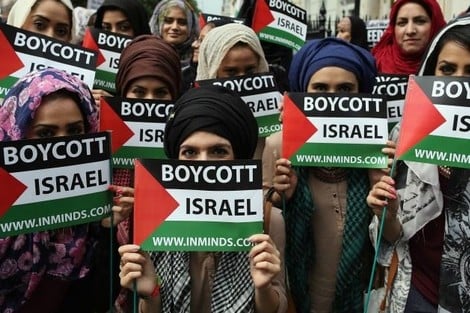

The movement to boycott, divest from, and impose sanctions on Israel is a movement of Palestinian origin and global reach that seeks to resist the Israeli occupation and settler-colonialism, in order to achieve freedom, justice, and equality in Palestine, leading to the right to self-determination for all the Palestinian people in the homeland and the diaspora. The demands of the Boycott Israel Movement (BDS) address the aspirations and rights of all components of the historical Palestinian people, from the Palestinians of the 1948 territories to the Gaza Strip and the West Bank, including Jerusalem, to the camps and diaspora, which was fragmented by Israeli colonial-settlement in stages.
Our historical struggle
The Boycott Israel Movement is a peaceful, inclusive, not exclusionary resistance movement that opposes racism in all its forms, including Zionism and hostility to all religious and ethnic groups. It succeeded in isolating the Israeli regime academically, culturally, politically, and to some degree economically as well, to the point that this regime now considers the movement one of the greatest “strategic dangers” facing it. The founding statement of the movement says that the struggle of the Palestinian people against the Zionist colonial-settler system has continued since the beginning of the last century until today, but Israel continues its oppression of the Palestinians and its colonization of the land without oversight or respite, due to the failure of governments at the international level to hold Israel accountable, and the continuation of international companies and institutions to assist it in its crimes against the Palestinians and its violations of international law. Based on the failure of governments, the “international community” and decision-makers to stop the compounded Israeli oppression against the Palestinian people, Palestinian civil society organizations issued a historic appeal in 2005 addressed to the free people and peoples of the world, calling on them to support the boycott of Israel as a major form of peaceful Palestinian popular resistance, and as the most important form of global solidarity with the struggle of the Palestinian people for their rights.
What do boycott, divestment and sanctions mean?
- Boycott includes stopping dealing with Israel, boycotting Israeli and international companies complicit in their violations of Palestinian rights, and boycotting Israeli sports, cultural, and academic institutions and activities.
- Divestment Divestment campaigns seek to pressure investors and contractors with Israeli and international companies involved in the crimes of the occupying state and apartheid by withdrawing their investments from and/or terminating their contracts with these companies. Investors or contractors may be individuals, institutions, sovereign funds, pension funds, churches, banks, local councils, private entities, charities, or universities.
- Imposing Sanctions: What is meant by sanctions is the punitive measures taken by governments and official and international institutions against a state or entity that violates human rights, with the aim of forcing it to stop these violations. These include military, economic, cultural and other sanctions, for example by stopping military cooperation, stopping free trade agreements, or expelling Israel from international forums such as the United Nations, the Inter-Parliamentary Union, FIFA or others, taking into account that such measures can only be taken by states.
Basic demands
In 2005, more than 170 bodies from popular federations, unions, parties, popular committees, and Palestinian civil society organizations participated in launching the historic call to boycott Israel. He appealed to the free people and peoples of the world to boycott Israel, withdraw investments from it, and impose sanctions on it to achieve the following demands: 1- Ending its occupation and colonization of all Palestinian and Arab lands and dismantling the wall: In 1967, Israel occupied what remained of historic Palestine after The 1948 Nakba: The West Bank, including East Jerusalem, the Gaza Strip, and the Syrian Golan Heights. Since then, the occupying state has adopted a systematic policy aimed at the gradual ethnic cleansing of Palestinians by confiscating land and isolating population centers in ethnic ghettos surrounded by barriers, colonies, watchtowers, and the annexation and apartheid wall. The occupying state also imposed a genocidal siege on the Gaza Strip, turning it into the largest open-air prison in the world, and it almost regularly launches brutal attacks, which have been widely condemned internationally, especially because they included war crimes and crimes against humanity, bordering on genocide. 2- Ending all forms of apartheid against the Palestinians and recognizing the basic right to full equality for the Palestinians of the 1948 territories: The Palestinians who remained steadfast in their homeland despite the ethnic cleansing during the 1948 Nakba constitute 20% of the so-called “citizens of the State of Israel.” They suffer from an institutionalized apartheid system imposed on them by the Israeli regime through more than 50 basic laws that control various aspects of their lives. The Israeli government continues the policy of gradual displacement of Palestinian communities from its lands, as is happening in the Negev and Galilee. The leaders of the occupying state openly incite racist violence against the 1948 Palestinians. 3- Respect, protect and support the rights of Palestinian refugees to return to the homes from which they were displaced and to restore their property, as stipulated in UN General Assembly Resolution 194: Since the establishment of the Israeli settler-colonial state through the brutal ethnic cleansing of more than half of the indigenous Palestinian people in 1948, Israel has acquired the largest possible area of the land of Palestine and displaced many Palestinians whenever it had the opportunity. As a result of this systematic forced displacement, there are more than 7.5 million Palestinian refugees – including internally displaced people – who are deprived of their historical right to return to their homes.
Its global reach
The BDS movement to boycott Israel is supported by federations, unions, parties, international civil society institutions, popular movements and other bodies that represent millions of members across all continents of the world, and is supported by influential figures in public opinion. The UK’s largest union voted democratically to adopt the position that “the Israeli government continues to govern as a racist state and is guilty of the crime of apartheid”, and the union also actively supported the BDS movement.