Mahmoud Mutawa – Lima:
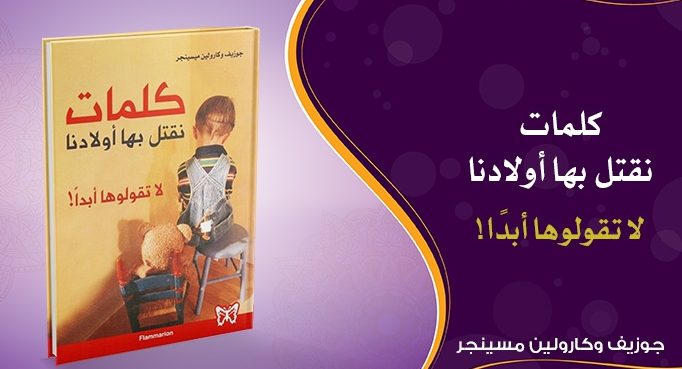
The book “Words With which We Kill Our Children” by Joseph and Caroline Messinger, in 322 pages, published in 2015, talks about many of the phrases and words that parents use daily while talking to their children, which leave a negative impact on them psychologically and emotionally, and may destroy their lives and change the course of their future, as the child is forced to live with the image that his parents create of him..
The two writers say that we have all been exposed one day to such wrong and contradictory words, which they explain and explain the extent of their impact on the child’s psyche. Then they offer us an alternative to these words, which include::
1. You are a failure:
Accusing children of failure is fatal, and parents are ignorant of the long-term impact of these words they use, so they accuse their children of failure when the responsibility for this failure lies with them. Therefore, parents must carefully consider their words before uttering them, because these words that attack the child’s ego affect his behavior when he becomes an adult, change the direction of his future, weaken his personality, and reduce his genetic predispositions..
2. Divorce of children:
When a father divorces his child’s mother, he also divorces his child, and the child feels his father’s absence as a tear, an escape, an abandonment of the home. Therefore, it is necessary for the parents to avoid separation between the child and his father and mother. If you decide to separate from your partner, that is your business, but your child does not have to bear the consequences of the collapse of your marriage.
3. Successful, always successful:
When you impose on your child that he must succeed in everything, you expose him to frustration, deprivation, and the inability to appreciate what he has. Forcing this on your children gives them a bad sign even before they enter the game. They will become unable to satisfy themselves, and will remain unsatisfied with what they achieve.
4. Copy of parents:
The father or mother who dissolves his son’s personality into his own personality causes the formation of a parasitic personality in his child at the age of maturity, so the son’s way of thinking and behaving is the result of the protection his mother surrounds him with and the pride his father feels for his success in school or sports, so he remains attached to his parents’ home and manipulates their feelings. Their guilt becomes his favorite playground.
5. If you don’t, I won’t love you
Refrain from resorting to threatening your children to stop loving them, with the aim of punishing them, even if it is a joke. The feelings that bind you to the piece of your liver are sacred feelings. If you give him love unconditionally, he will live a constructive life and love you back many times over. But if you deprive him of this love or bind him with restrictive conditions, he will live a destroyed life, for which you will pay the price throughout your life..
6. When I was your age:
This classic phrase that compares a child to his father or mother reveals stubborn selfishness. The phrase “I am your age” expresses the situation of a person who plays with other people’s memories and jumps over them and replaces them with his own memories. Comparison weakens the child’s self-confidence, degrades his ability, and creates a feeling of inadequacy in him.
7. I love you more like this:
The use of poisonous words is hereditary. You must have heard this hurtful sentence thousands of times without paying it the slightest attention, so you repeat it without bad intentions. But the harm you inflict on your children is as harmful as a hurtful remark addressed to an overweight girl (Stop eating sweets, I don’t like you when you’re fat like that). There is no significant difference between (I love you more..) and (I don’t love you..) two sentences that express weak, weak love., andPerhaps many will disagree with this proposition.
8. The firstborn, the eldest son:
The sacrifice that is demanded of the firstborn towards his siblings, especially his younger siblings, generates resentment in the firstborn child, as a semi-filial responsibility is imposed on him that he did not ask to bear, so the parents make him a substitute for the father or mother without asking for his opinion. Never ask your firstborn son to be a role model for his siblings, but talk about him, taking him as an example whenever he deserves it. The more you reward him and praise him, the more he will feel his value rises in the eyes of his brothers and sisters.
9. I will hit you:
The word “will” represents the key to indefinitely postponing and postponing what can be done now. Your child has completely understood the difference between what you threaten to do and what you really want to do, so you do not succeed in getting what you want from him. He only understands that his mother does not intend to hit him and therefore there is no immediate danger to him. Therefore, you must break the vicious cycle of threats against the child’s disobedience and violation, by completely eliminating the phrase “I will” and replacing it with a clear and firm sentence, and do not forget to implement your threat if the child continues to be stubborn..