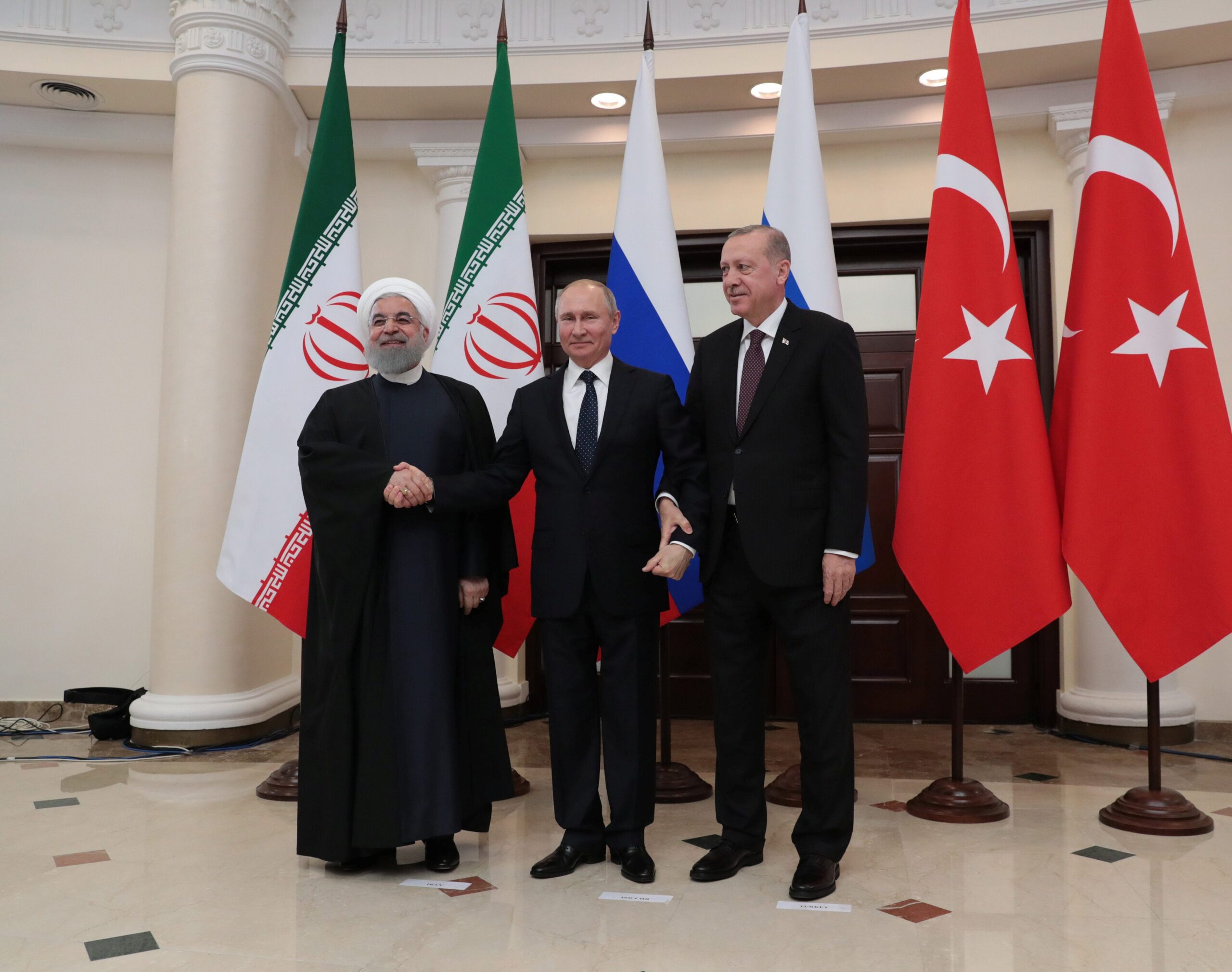

On the evening of Thursday, February 14, 2019, the Russian city of Sochi hosted a summit that brought together the leaders of Turkey, Russia, and Iran to determine the features of the future of the Syrian arena after the United States announced the withdrawal of its forces stationed there. That day witnessed the signing of the Sochi Agreement, which will have a profound impact on the Syrian scene within a year. The final statement of the summit indicated that the leaders agreed to coordinate efforts to bring security and stability to the regions of northeastern Syria, and added that the withdrawal of the United States of America its forces from Syria will enhance security and stability in this country, and stressed the strengthening of tripartite coordination and the emphasis on Syria’s sovereignty, independence, unity and territorial integrity, and the necessity of no one violating these principles.
I hope to find a solution
Turkish President Recep Tayyip Erdogan considered that the hope of reaching a solution to the Syrian crisis had become “more within reach than ever before,” and stressed that his country, which has been fighting terrorism for 34 years and has lost tens of thousands of its citizens as victims of PKK terrorism, feels well the pain of its Iranian brothers. He added: “We do not want to see a new humanitarian tragedy in Syria.” He stressed that Türkiye “made exceptional efforts to maintain calm in Idlib, northern Syria, despite some countries’ attempts to destabilize the situation there,” without further details about the last part. He continued: “We will continue to adhere to what falls upon us within the framework of the Idlib understanding, and we have conveyed to our Russian and Iranian counterparts our expectations for the Syrian regime’s commitment to a ceasefire in the region, and maintaining the status of reducing tension there.”
Did the Syrian regime really commit to it?
The agreement spared the Syrian province of Idlib a bloodbath for an entire year, but it did not prevent the regime forces from escalating their operations, which killed hundreds of civilians at the end of last year. Not a year had passed since the signing of the agreement without Assad’s forces violating it, and Russia failed to fulfill the restrictions of its Syrian ally. Upon its implementation, the agreement established relative calm, but the failure to complete implementation of its main provisions plunged the region once again into a spiral of escalation since the end of April, causing more than 400,000 civilians to flee. The conclusion of this agreement came months after regime forces took control with Russian support following a massive attack on Eastern Ghouta, which formed the most prominent stronghold of the opposition factions near Damascus and was subjected to a stifling siege for years. The United Nations and humanitarian organizations expressed their fear that any attack by regime forces on Idlib, which along with parts of neighboring governorates is home to about three million people, would lead to “the worst humanitarian catastrophe” in the current century.
Terms of agreement
The agreement mainly stipulated the establishment of a demilitarized zone ranging between 15 and 20 kilometers wide separating the areas controlled by the regime forces and the factions, with the jihadi groups withdrawing from it and the opposition factions withdrawing their heavy weapons from it. The agreement also included the opening of two strategic highways that pass through areas under the control of the factions in Idlib before the end of 2018, one of which links the city of Aleppo in the north with Hama all the way to Damascus, while the second connects Aleppo with the coastal province of Latakia. Under this agreement, patrols of Turkish forces and Russian police units will monitor the demilitarized zone.
End of agreement
After both parties to the conflict largely adhered to a ceasefire until February? The regime forces gradually began to intensify their bombing. The escalation reached its peak since the end of April. What is April? With Russian support. Last month, regime forces were able to advance on the ground in southern Idlib and control an enclave that was under the control of jihadist and opposition factions in neighboring northern Hama. The military escalation and Syrian and Russian raids caused the death of nearly 1,000 civilians, according to the Syrian Observatory for Human Rights, in addition to the displacement of more than 400,000 people to areas not covered by bombing near the Turkish border, according to the United Nations.