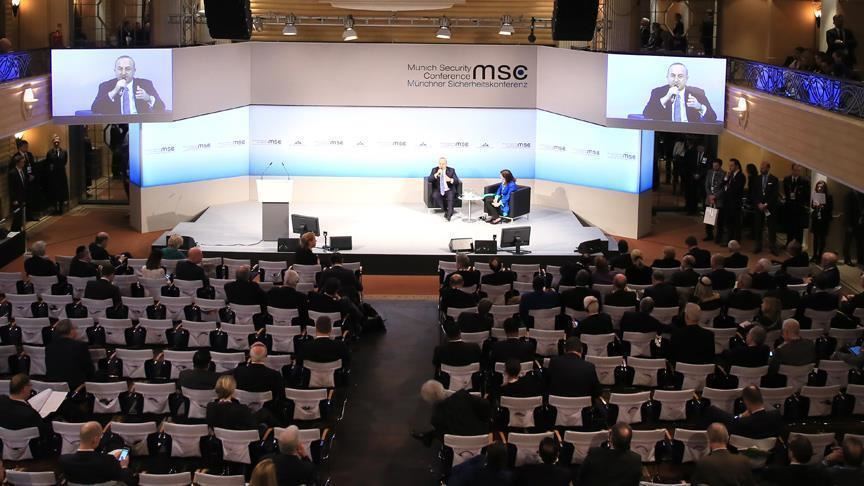

The 56th edition of the Berlin Security Conference began in mid-February and lasted for two days amid a state of ambiguity in a number of international issues, most notably global trade disputes and climate change. The conference, which is held annually, is considered one of the most important international gatherings that issue important messages about the future of life on planet Earth, and it enjoys wide international participation from high-level officials in the fields of politics, economics, defense, and intelligence, led by the presidents and heads of government of 30 countries, and foreign and defense ministers from about 70 countries. The most prominent officials participating in the conference include Azerbaijani President Ilham Aliyev, Afghan Ashraf Ghani, Frenchman Emmanuel Macron, and Canadian Prime Minister Justin Trudeau. A large number of ministers will also participate, such as Turkish Foreign Minister Mevlut Cavusoglu, Foreign Ministers of Russia Sergei Lavrov, Germany Heiko Maas, Iran’s Mohammad Javad Zarif, Defense Minister Annegret Kramp-Karrenbauer of Germany, Canada’s Harjit Sajjan, and Singapore’s Ing Hen. A large number of international officials will also participate, led by NATO Secretary-General Jens Stoltenberg, World Health Organization President Tedros Adhanom Ghebreyesus, and International Police Organization Secretary-General Jürgen Stock. The Executive Director of the World Food Program, David Beasley, and the founder of Facebook, Mark Zuckerberg, will also participate in the conference, as well as about 500 directors of the most important international companies, academics, and representatives of civil society organizations.
Conference agenda:
Among the most prominent topics that topped the conference’s agenda this year were the issues of the international liberal order, the European Union’s self-defense, global trade disputes, climate change, cybersecurity, and economic and technological competition between the great powers and its possible outcomes. The participating officials also discussed a number of topics related to the security policy of the European Union, Africa, Russia, Libya, Iran, and China. The history of the conference dates back to 1963, when its first edition was launched, under the name “International Military Sciences Forum,” and it was described at the time as a “transatlantic family meeting,” due to the fact that its participants were limited to Germany, the United States, and NATO countries only. As of 1994, the name of the conference was changed to the “Munich Security Policy Conference,” and starting in 2008 it became the “Munich Security Conference.” The first edition of the conference witnessed limited participation of no more than 60 officials, while demand for the conference increased as of 1999, with the participation of representatives from Eastern European countries, India, Japan, and China.