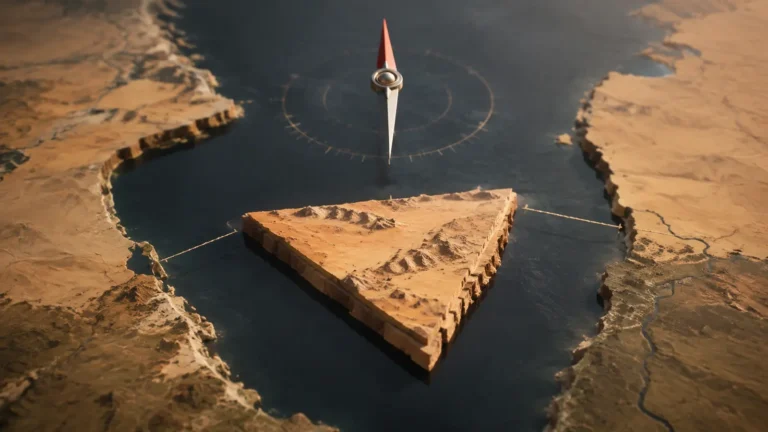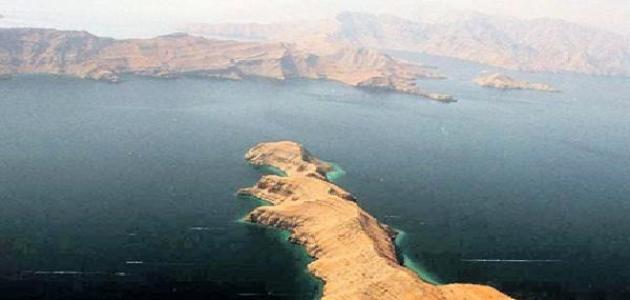

The Strait of Hormuz is a narrow waterway between the Arabian Gulf and the Gulf of Oman. It represents the only seaway from the Arabian Gulf to open seas. It is one of the most important narrow passages in the world from a strategic standpoint, as it is one of the most trafficked by ships, and 20-30 oil tankers pass through it daily, at a rate of one oil tanker every 6 minutes during peak hours. On the northern coast of the corridor is Iran, and on the southern coast are the United Arab Emirates and the Sultanate of Oman. The width of the strait is 65 km, and a third of the world’s production of liquefied natural gas and about 20% of total global oil consumption pass through it, which gives it great strategic importance for international trade.
Origin of name
In the 17th century, the region was ruled by the Kingdom of Hermes, from which the strait appears to have derived its name, as philological historians derived the name “Hermes” from the Persian har-mog, meaning palm tree.
Geographical location
The Strait of Hormuz is located in the Arabian Gulf region and separates the waters of the Arabian Gulf on the one hand from the waters of the Makran Gulf, the Arabian Sea, and the Indian Ocean on the other hand. It is overlooked from the north by Iran and from the south by the Sultanate of Oman, which supervises maritime traffic there, given that the passage for ships falls within its territorial waters.
Its navigation system
To reduce the risk of collision, ship movement through the strait follows a traffic separation system (TSS): incoming ships use a single track, while outgoing ships use a transverse track, with each track two miles wide. The trails are separated by a two-mile-wide “median.” To traverse the strait, ships pass through the territorial waters of Iran and Oman under the transit provisions of UNCLOS. Although not all countries have ratified the Convention, most countries, including the United States, recognize these customary navigation rules as written in the Convention.
Historical differences
In April 1959, by decree, Iran changed the legal status of the strait by expanding its territorial sea by 22 km and declaring that it would only recognize innocent passage through the recently expanded area. In July 1972, by decree, Oman also expanded its territorial sea by 22 km. Thus, by mid-1972, the Strait of Hormuz was completely “closed” by the shared territorial waters of Iran and Oman. During the 1970s, neither Iran nor Oman attempted to obstruct the passage of warships through the strait, but in the 1980s, both countries asserted different claims to (ancient) customary law. Upon ratification of UNCLOS in August 1989, Oman submitted statements confirming its 1981 royal decree that only innocent passage was permitted through the territorial sea. The data also confirmed that prior permission is required before foreign warships can pass through Omani territorial waters. But upon signing the agreement in December 1982, Iran announced a statement stating that “only States Parties to UNCLOS shall be entitled to benefit from the contractual rights arising therefrom,” including “the right of transit passage through the strait used in international navigation.” In May 1993, Iran enacted a comprehensive law on maritime zones, many of whose provisions conflict with provisions of UNCLOS, including the requirement that warships, submarines, and nuclear-powered vessels obtain authorization before exercising innocent passage through Iranian territorial waters.
International position
In the eyes of international law, the Strait is considered part of the high seas, and all ships have the right and freedom to pass through it as long as it does not harm the safety of coastal states or affect their order or security. The Strait of Hormuz gains its importance from the fact that it is considered a bottleneck at the entrance to the Gulf connecting the semi-enclosed waters of the Arabian Gulf and the great seas of the Indian Ocean. It is the only outlet for the Arab countries overlooking the Arabian Gulf other than the Kingdom of Saudi Arabia, the Emirates, and the Sultanate of Oman. Navigation through this strait was never the subject of a regional or international treaty, and navigation in the Strait of Hormuz was subject to the transit system, which does not impose conditions on ships as long as their passage is rapid, without stopping or threatening the countries located on it, provided that ships are subject to the regulations established by the Joint Governmental Maritime Consultative Organization.
Historical events
With the discovery of oil, the strategic importance of the Strait of Hormuz increased due to the large oil reserves in the region. Previous political crises prompted the countries of the region to reduce their dependence on this strait, in previous periods, and to resort to extending oil pipelines. However, these attempts remained limited in their impact, especially with regard to the import of services, technology, and weapons. The Strait has remained the subject of a strategic bet between major powers. The former Soviet Union longed to reach the Strait to achieve its desired superiority and control of the region’s oil, while the United States sought to launch its fleets in the waters of the Indian Ocean and the Arabian Gulf and strengthened political, commercial and military ties with the countries of the region to ensure its access to the sources of oil and to supervise its supply routes.
Tanker war
During the Iran-Iraq War, the Tanker War phase began with Iraq attacking oil tankers and terminals on Iran’s Kharg Island in early 1984. Saddam Hussein’s goal in attacking Iranian oil shipments was to provoke the Iranians to respond with tough measures, such as closing the Strait of Hormuz to all maritime traffic, but Iran limited its retaliatory attacks to Iraqi shipping, leaving the Strait open.
Operation praying mantis
On April 18, 1988, the US Navy launched a day-long battle with Iranian forces in and around the strait. The battle, which the United States codenamed Operation Praying Mantis, was a retaliatory operation in response to the sinking of the warship USS Samuel Roberts by an Iranian-planted mine in the canal on 14 April. American forces sank a frigate, an artillery boat, and six armed speedboats, as well as severely damaging a second frigate.
Iran Air Flight 655 was shot down
On July 3, 1988, 290 people were killed when an Iranian Airbus A300 was shot down over the strait by a guided missile fired by the US Navy from the deck of the cruiser USS Vincennes (CG-49), and the US government refuses to acknowledge its mistake and issue an apology.
Strait Closure Law 2012
After economic sanctions began to be implemented on Iran in 2012, the Iranian Shura Council voted to approve on July 21, 2012 a draft law to close the Strait of Hormuz to oil tankers. Parliament has little authority over defense and foreign policy, as the final say rests with the Supreme Leader Ali Khamenei. However, the law will give political support to any decision to close the strait.
Attack on oil containers 2019
On June 13, 2019, two oil tankers were attacked near the Strait of Hormuz while passing through the Gulf of Oman. The attack occurred on the same day that Japanese Prime Minister Shin-Zo-Abe met with Supreme Leader Khamenei in Iran, and a month after the Gulf of Oman incident. On July 19, 2019, the Iranian Revolutionary Guard announced the seizure of a British oil tanker in the Strait of Hormuz, in retaliation for the Iranian tanker detained in the British colony of Gibraltar. Amid escalating tensions between Iran and the United States, the United States and Saudi Arabia blamed Iran for carrying out the attacks. Iran denied the accusation and blamed the United States for defaming it and spreading misleading information.