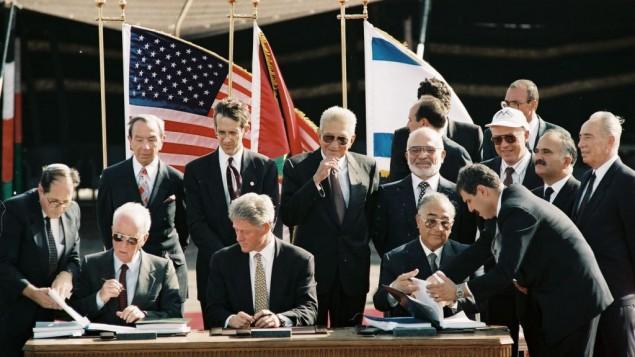
 On October 26, 1994, Jordan and Israel signed the peace treaty known as the “Wadi Araba Agreement”, at the southern border crossing of the Araba, making it the second Arab country after Egypt to sign a peace agreement with Israel.
Agreement details
The content of the treaty stipulates that Jordan regains its occupied territories, which amount to about 380 square kilometers. In addition to its fair share of the water of the Yarmouk and Jordan rivers. Moreover, the treaty clearly and conclusively defined Jordan’s western borders for the first time, putting an end to the dangerous Zionist claim to “Jordan.” The Treaty seeks to lay a solid foundation towards achieving just, comprehensive and lasting peace, and includes a number of areas for ongoing negotiations; to this end. Jordanian and Israeli negotiators signed a series of protocols setting a mutually beneficial framework for relations in areas such as trade, transportation, tourism, communications, energy, culture, science, navigation, environment, health, and agriculture, as well as on cooperation agreements for the Jordan Valley and the Aqaba-Eilat region. Treaty relations between the two countries have stabilized, amending disputes over land and water, and provides for broad cooperation in the field of tourism and trade. It included a pledge by both Jordan and Israel not to allow their lands to be used to become a starting point for directing military strikes through the third country.
Historically
In 1987, Israeli Foreign Minister Shimon Peres and King Hussein attempted to arrange a peace agreement in which Israel would cede the West Bank to Jordan. The two sides signed an agreement setting a framework for holding a peace conference in the Middle East, which was not included in the proposal due to the objection of Israeli Prime Minister Yitzhak Shamir, and the following year Jordan abandoned its claim to the West Bank in favor of reaching a peaceful solution between Israel and the Palestine Liberation Organization. Discussions began in 1994, and Israeli Prime Minister Yitzhak Rabin and Foreign Minister Shimon Peres informed King Hussein of the Oslo Accords with the Palestine Liberation Organization and Jordan. Hussein was consulted with Egyptian President Hosni Mubarak and Syrian President Hafez al-Assad, and thus Mubarak encouraged him, while Assad rejected this talk and asked not to sign any agreement. Rabin, Hussein and Clinton signed in Washington on July 25, 1994.
Signature
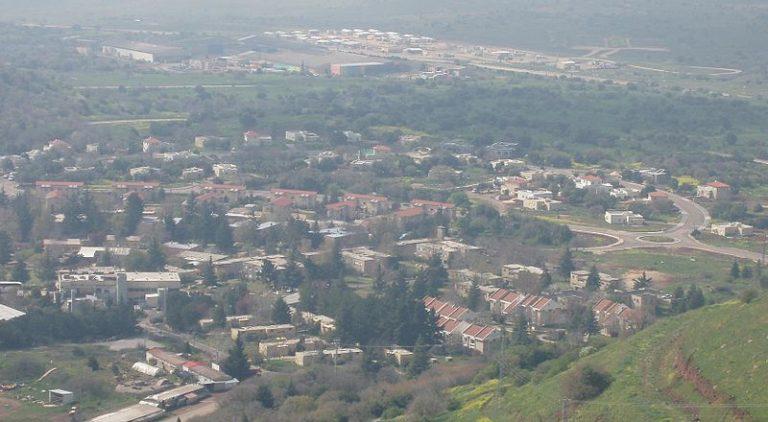
On October 26, 1994, Jordan and Israel signed a peace treaty in a ceremony held in the Arava Valley of Israel, north of Eilat and near the Jordanian border. Israeli Prime Minister Rabin and Jordanian Prime Minister Abdel Salam al-Majali signed the treaty, which shook Head of State Ezer and Eisman in cooperation with King Hussein, and thousands of colorful balloons were then launched into the sky until the event ended.
Main principles
Boundaries: The international border between Israel and Jordan following the Jordan and the Yarmouk River, the Dead Sea, Emek Ha’arava/Wadi Araba, and the Gulf of Aqaba. The two parties agreed to establish full diplomatic and consular relations, exchange resident embassies, grant tourist visas, air and port travel, and establish a free trade zone and an industrial zone in Wadi Araba: diplomatic relations and cooperation. The agreement prohibits hostile propaganda. Security and defense: Each country pledges to respect the sovereignty of each side, not to enter the other party’s territory without permission, and to cooperate against terrorism, including thwarting border attacks and smuggling and preventing any hostile attack against the other, and not to cooperate with any terrorist organization against the other. Israel agreed to give Jordan 5 million cubic meters (1.8 x 10⁹ cubic feet) of water each year with 75% of the Yarmouk River’s water, and both countries could work on developing other water resources and reservoirs. Israel also agreed to help Jordan use desalination technology in order to find additional amounts of water. Palestinian refugees: Israel and Jordan agreed to cooperate in refugee assistance, including the Quartet (Israel, Jordan, Egypt, and the Palestinians) in an attempt to work on solutions.
Results of the agreement
After the agreements, Israel and Jordan opened their borders and installed many border crossings. Allowing tourists, businessmen and workers to travel between the two countries, Israeli tourists began to visit Jordan, and in 1996 the two countries signed a trade treaty. As part of the agreement, Israel helped establish the modern medical center in Amman. In December 2013, Israel and Jordan signed; An agreement to build a desalination plant on the Red Sea, near the Jordanian port of Aqaba.